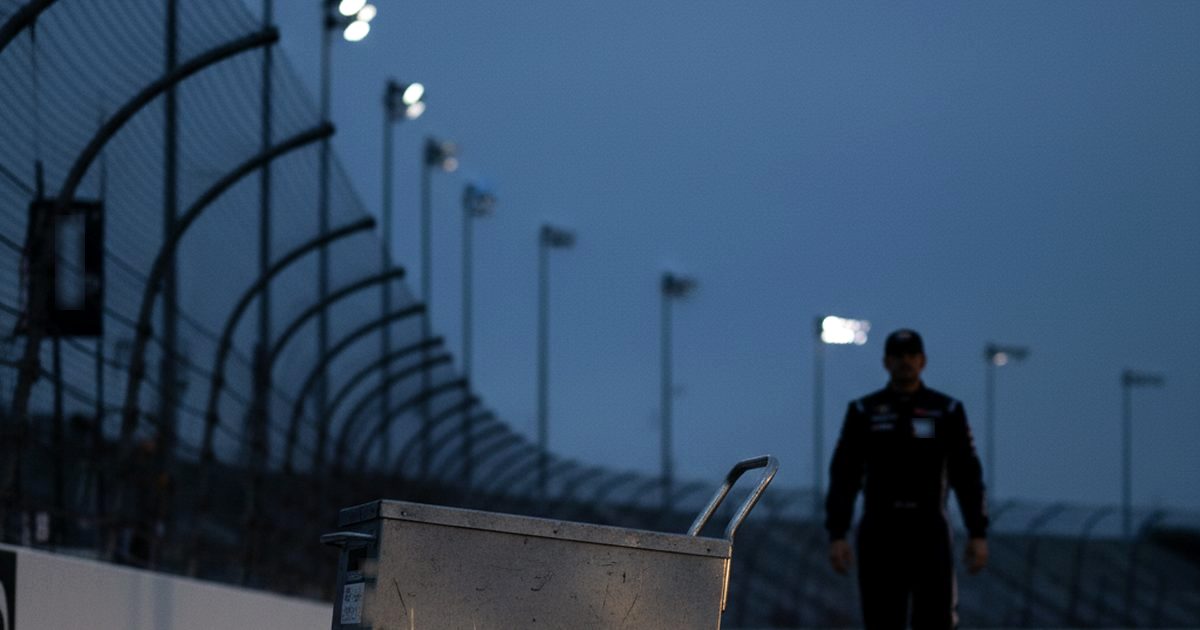
A runaway pit box from Spire Motorsports broke loose on pit lane at Dover Motor Speedway on Saturday and rolled toward FOX Sports pit reporter Amanda Busick, prompting a tire carrier from another team to step into its path and absorb the impact himself.
Donovan Williams, tire carrier for the No. 99 Trackhouse Racing entry of Daniel Suarez, was hospitalized with minor injuries and released the same night, according to FOX Sports. He was ruled out of the All-Star weekend Pit Crew Challenge and the Cup Series All-Star Race itself. Andrew Egnarski was promoted to serve as Suarez’s tire carrier for the event.
The incident occurred as teams were moving pit boxes into position ahead of the NASCAR Craftsman Truck Series ECOSAVE 200. Witnesses said the Spire cart — a wheeled equipment cabinet weighing several hundred pounds when loaded — began rolling on its own and gained speed down the slight grade of pit road. Crew members scrambled clear. Busick, working in front of the wall, was directly in line with the cart’s path.
Williams stepped in front of the cart and attempted to stop it. The collision injured him enough to require evaluation by infield medical staff and transport to a local hospital. Cup Series practice was briefly delayed while the ambulance cleared the area.
A runaway pit box is an equipment failure mode, not a freak event
Runaway pit equipment is not unique to NASCAR. Formula 1 has seen wheel jacks, fueling rigs, and equipment carts roll into traffic during stops at Monaco, Hungary, and Singapore over the past decade. IndyCar penalty grids include specific provisions for pit-equipment containment. The common thread in every series is that the pit lane is an operating surface — closer in failure mode to an airport apron than to the racing surface itself — where a piece of equipment that escapes its assigned position becomes, in the regulatory language used at airfields, a foreign object on an active movement area.
Pit boxes at Cup-level teams are typically secured by wheel chocks, locking casters, or both. NASCAR’s pit-road rules govern how equipment is staged before the green flag and how it must be removed after the final stop, but the period before the race — when teams are still positioning carts and gear — operates under looser working conventions. The Saturday incident occurred during that staging window.
Spire Motorsports had not, as of Sunday, publicly stated whether the cart had been chocked or whether a mechanical failure caused the brakes or casters to release. NASCAR did not announce a penalty against the team.
Pit-lane risk, beyond the obvious
The pit lane is the only place on a race weekend where uniformed crew members, broadcast personnel, officials, and active race cars share the same operating surface for sustained periods. Modern Cup Series pit boxes have grown larger and heavier as teams have added telemetry hardware, refrigeration, tool storage, and supplementary fuel systems. A heavier cart that escapes containment carries more energy and is harder to stop by hand.
The Dover incident lands in the same broader category of pit-lane safety questions raised by recent NASCAR debris policy debates — particularly around what counts as an authorized object on pit road, who is responsible for its containment, and what penalties apply when something escapes.
NASCAR’s post-incident review will likely focus on whether existing chock-and-stage requirements need to extend further into the pre-race staging window, and whether the slope of certain pit lanes — Dover’s is among the more pronounced on the schedule — warrants additional securement standards.
Williams was reported in good spirits Saturday night and was expected to return to crew duties at Charlotte the following weekend.
Stay informed — subscribe to FODNews for daily coverage of FOD incidents and prevention worldwide.