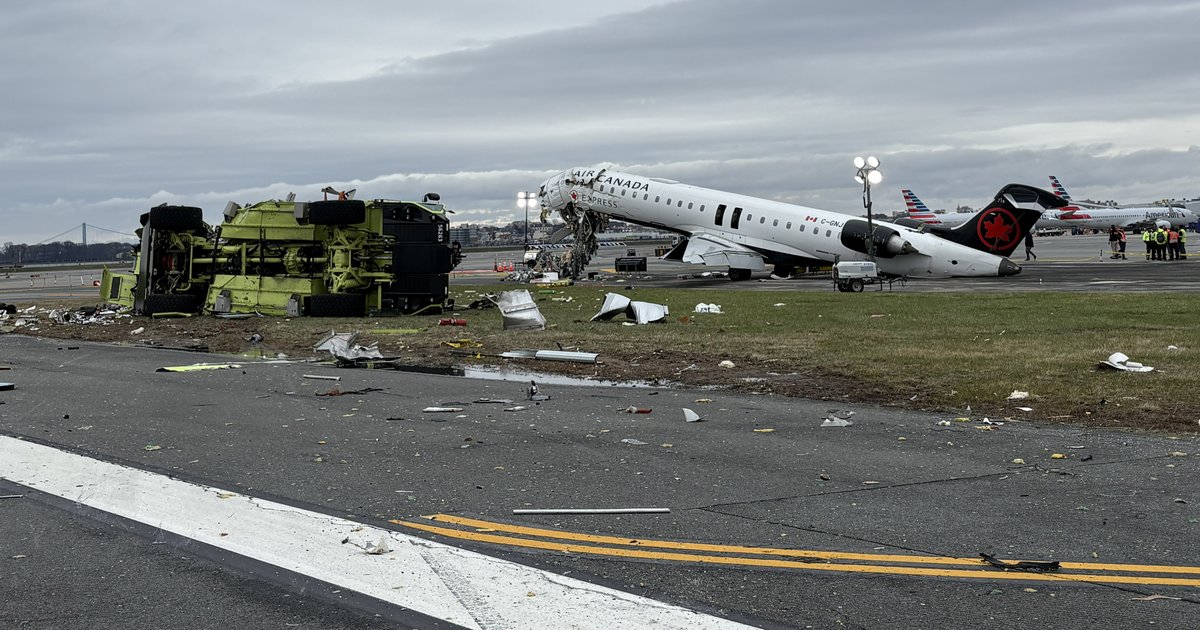
The fire truck that an Air Canada Express regional jet hit during a fatal nighttime landing at LaGuardia Airport last month carried no transponder, leaving the airport’s surface surveillance system unable to reliably track the vehicle or warn controllers of the impending collision, according to a preliminary report the National Transportation Safety Board released last week.
The NTSB’s 15-page preliminary report, dated April 23, lays out a layered chain of failures involving runway-crossing communications, controller workload and a known surveillance gap that federal regulators had flagged a year earlier.
The March 22 collision killed two pilots and injured dozens of passengers and firefighters, ranking among the deadliest U.S. runway incursions in recent years.
What the NTSB Found in the LaGuardia Fire Truck Collision
Jazz Aviation Flight 646, operating as Air Canada Express Flight 8646, was landing on Runway 4 at LaGuardia at 11:37 p.m. Eastern time on March 22 when it struck Rescue 35, an Oshkosh Striker 1500 aircraft rescue and firefighting (ARFF) vehicle. The Bombardier CRJ-900, registered C-GNJZ, had departed Montréal–Trudeau International Airport.
The captain and first officer died at the scene. Of the 72 passengers, two flight attendants and two ARFF crew members, 39 went to local hospitals; six suffered serious injuries. The airplane sustained substantial damage, and the fire truck rolled onto its side after the impact.
The convoy of seven emergency vehicles had been responding to a separate aircraft emergency elsewhere on the airfield.
A Surveillance Gap the FAA Had Already Flagged
LaGuardia uses Airport Surface Detection Equipment, Model X — known as ASDE-X — a system that tracks aircraft and vehicles on runways and taxiways and warns controllers about potential collisions on the surface.
ASDE-X fuses data from surface radar, multilateration sensors, Mode S radar and ADS-B transmissions. None of the seven responding emergency vehicles carried a transponder, the NTSB found. Without one, the system “could not uniquely identify each of the seven responding vehicles or reliably determine their positions, or tracks,” investigators wrote.
“As a result, the system was unable to correlate the track of the airplane with the track of Truck 1” — the lead vehicle in the convoy and the one struck by the jet, the report states.
The FAA had urged airports to close exactly this gap. In May 2025, the agency issued CertAlert 25-01, recommending that airports with ASDE-X voluntarily equip emergency and other movement-area vehicles with ADS-B Out transmitters known as Vehicle Movement Area Transmitters, or VMATs. The recommendation was not a mandate.
Communications and Controller Workload
The preliminary report also points to communication breakdowns and staffing in the LaGuardia tower.
The convoy began trying to contact the tower for permission to cross Runway 4 more than 90 seconds before the collision, according to the NTSB. About 40 seconds after controllers cleared the inbound jet to land, an overlapping radio call obscured a transmission from the lead truck.
Roughly 20 seconds before the collision, the local controller cleared the convoy to cross the runway. At that moment, Flight 8646 was on short final, about 130 feet above the ground, according to the report.
The controller then issued a “stop, stop” instruction, but the firefighters did not initially recognize that the order applied to their convoy, the NTSB said.
Two controllers worked the tower during the overnight shift, which the report describes as standard. One handled the local position; the other simultaneously served as ground controller and controller-in-charge. In the minutes before the collision, the second controller was occupied assisting a United Airlines flight, leaving a single controller responsible for managing both airborne traffic and ground vehicles.
What Comes Next
The NTSB’s report is preliminary and does not assign a probable cause. A final report typically takes about a year to complete. The Federal Aviation Administration, Air Canada, Jazz Aviation, the Port Authority of New York and New Jersey, and Mitsubishi Heavy Industries RJ Aviation are participating parties to the investigation.
Investigators plan to examine controller workload, runway-crossing procedures during off-airport emergencies and the pace of voluntary VMAT adoption at U.S. airports. The case carries docket number DCA26MA161. FODNews tracks continuing coverage on the NTSB tag page and in our aviation section.
Stay With the Story
The NTSB is expected to release additional factual updates as the investigation continues. Subscribe to FODNews for ongoing coverage of runway incursions, surface safety and FOD prevention worldwide.
Sources
- National Transportation Safety Board. Jazz Aviation, Air Canada Express Flight 8646 Collides with Fire Truck on LaGuardia Runway — Investigation DCA26MA161 (updated April 23, 2026).
- National Transportation Safety Board. Preliminary Report (PDF), April 23, 2026.
- Federal Aviation Administration. CertAlert 25-01: Vehicle Movement Area Transmitters, May 2025.
- Federal Aviation Administration. Airport Surface Detection Equipment, Model X (ASDE-X).