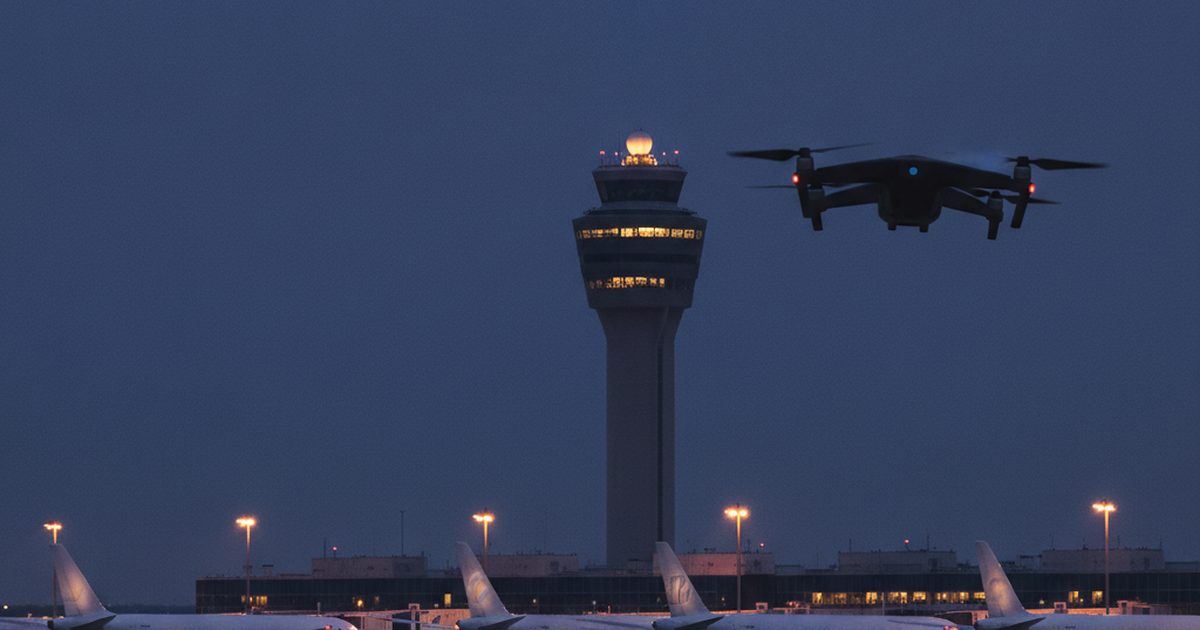
A drone hovering just 20 to 25 feet above San Diego International Airport’s air traffic control tower triggered an FAA ground stop on September 4, 2026. The halt grounded all arrivals and departures for roughly two and a half hours. It also exposed a drone detection gap that leaves U.S. airports investigating incursions with nothing but eyewitness accounts.
The stoppage began around 2 p.m. local time at the start of Labor Day weekend, one of the busiest travel periods of the year. Airport Public Information Officer Nicole Hall confirmed to NBC 7 San Diego that a drone and, separately, a high-altitude weather balloon were both reported near the airfield. The reports prompted the FAA to pause operations.
What Happened Over the Runway
Witnesses described at least one drone hovering an estimated 20 to 25 feet above the airport’s control tower. That position is among the most hazardous an unauthorized aircraft can occupy near an active runway environment. A departing flight crew reportedly spotted a second drone before controllers halted their takeoff. The two sightings point to repeated incursions rather than a single stray aircraft.
San Diego International operates on a single runway, the busiest configuration of its kind in the country. When a ground stop hits, there is no parallel runway to absorb the disruption — every arrival and departure stops at once. The FAA lifted the halt around 4:30 p.m. Flight-tracking data showed more than 400 flights delayed. Average departure holdups ran roughly 122 minutes at the peak of the disruption. Controllers held aircraft already airborne in patterns over the coastline; some diverted. Delays rippled into the following day as airlines worked through the backlog.
The high-altitude balloon reported the same afternoon operated tens of thousands of feet above commercial cruising altitude. It played no role in the ground stop. The balloon posed no operational threat and had already cleared the area before the drone sightings began.
No Sensors, No Suspects: The Drone Detection Gap
Transportation Security Administration investigators arrived to identify who flew the drone. They had no radar track, no flight-path history, and no confirmed operator location. All they had were witness reports. That is not an investigative failure so much as the predictable result of how U.S. drone identification actually works.
The FAA’s Remote ID framework has been in force since September 2023 under 14 CFR Part 89. It requires most registered drones to broadcast an identification number, position, and operator location. That broadcast travels over short-range Bluetooth and Wi-Fi signals. But the broadcast only helps if someone is nearby with a receiver, actively listening. No regulation requires U.S. commercial airports — including San Diego International — to run that monitoring equipment, and none do. Remote ID also exempts drones under 250 grams and home-built aircraft. A separate class of drones navigates entirely by GPS waypoints without transmitting any signal at all. The result: a compliant broadcast can go completely unheard, and a non-compliant flight leaves no trace once it lands.
A Widening Pattern
San Diego is not an isolated case. FAA quarterly data showed reported close encounters between drones and manned aircraft near U.S. airports nearly doubled. Sightings rose from 320 in the first quarter of 2026 to 601 in the second quarter. A drone struck a JetBlue aircraft’s cockpit window approaching JFK in June 2026. A similar shutdown closed Málaga Airport in Spain earlier this year. In August 2026, two consumer drones shut down Tan Son Nhat International Airport in Ho Chi Minh City. The shutdown lasted more than two hours and disrupted dozens of flights. Vietnamese aviation authorities acknowledged their airports rely entirely on pilot eyesight to spot drones. No radar or radio-frequency detection is in place there.
The SAFER SKIES Act was signed into law in December 2025. It gave local law enforcement — including San Diego police — new authority to detect, track, and disable drones. The authority targets aircraft that threaten critical infrastructure. But the law does not mandate detection hardware at commercial airports. Authority to act against a drone is of little use without the sensors to know one is there. Unauthorized flights in controlled airport airspace can draw civil penalties up to $75,000 per violation. But every one of those penalties depends on identifying an operator first.
The TSA investigation into the San Diego incident remains open. The structural gap that left investigators with nothing but witness accounts remains in place. No regulation requires real-time drone detection at any U.S. commercial airport.
Subscribe to FODNews for ongoing coverage of airport security and airfield-hazard incidents worldwide.