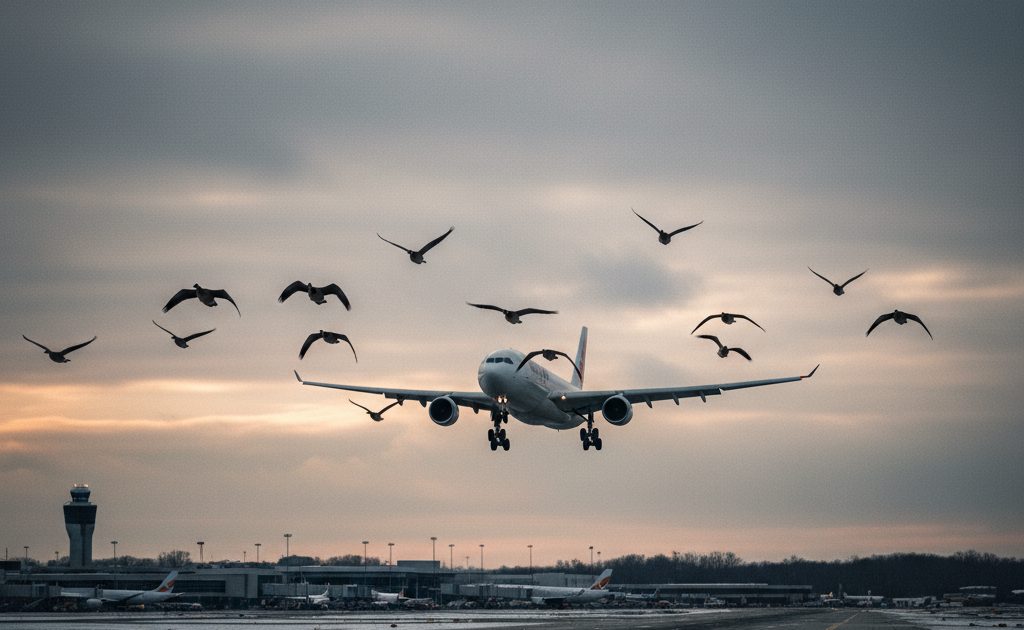
CINCINNATI — Seconds after liftoff from Cincinnati/Northern Kentucky International Airport, the captain of an Alaska Air Cargo Airbus A330 saw them coming. He shouted one word — “Birds” — before eight Canada geese tore through both engines of the wide-body freighter, triggering an engine failure, cockpit smoke, and an emergency landing. The National Transportation Safety Board has confirmed the January 28, 2026 bird strike as the cause of the incident.
No one was injured. But the damage to the aircraft — an Amazon cargo flight operated by Alaska Air Cargo — was substantial, and the sequence of events illustrates how fast a wildlife strike can cascade into a full-blown emergency.
The Strike
Flight 2616, registration N5827K, departed Runway 27 at approximately 3:05 p.m. EST bound for Houston. The aircraft had climbed through 900 to 1,000 feet in clear visual conditions — winds at 15 knots, temperature –9°C — when the captain spotted the flock.
The geese hit both sides of the aircraft simultaneously. The left Rolls-Royce RB211 engine took the worst of it. An “ENG 1 FAULT” alert appeared on the flight deck within seconds, then escalated to “ENG 1 FAIL.” The right engine sustained acoustic liner damage and bird ingestion but remained operational.
Airframe damage extended beyond the engines: the left main landing gear door and strut, left wing inboard flap, right engine pylon, and right wing leading edge slat and track all showed impact damage. Investigators recovered the remains of eight Canada geese from the runway vicinity.
Smoke in the Cockpit
With one engine gone, the situation quickly compounded. A Main Deck Smoke alert activated, and smoke entered the cockpit. Both crew members — the captain and first officer — donned oxygen masks and declared an emergency. Air traffic control vectored the aircraft to Runway 36R.
The smoke cleared before touchdown. The first officer, who was the pilot flying at the time, executed the landing. Airport rescue teams met the aircraft on the runway and applied fire suppression to the left engine as a precaution. No fire had occurred. The aircraft was subsequently towed for inspection.
Two crew members. No injuries.
NTSB Findings
The NTSB released preliminary findings confirming the bird strike as the precipitating cause. The left engine showed fan blade damage, restricted rotation, and misalignment consistent with large-body bird ingestion. The right engine, while less severely damaged, also contained bird remnants.
A final NTSB report is pending. The investigation will examine factors including the flock’s presence in the departure corridor, crew response procedures, and whether wildlife management protocols at CVG contributed to or mitigated the risk.
The FOD Dimension
Bird strikes are among the most common and costly forms of foreign object and wildlife hazard in commercial aviation. The FAA’s Wildlife Strike Database logs thousands of incidents annually; large birds like Canada geese — which can weigh eight pounds or more — present a disproportionate threat to engines at low altitudes during takeoff and initial climb.
At airports across the country, wildlife hazard management programs operate under FAA Advisory Circular 150/5200-33, which mandates risk assessments and mitigation strategies for certificated airports. Whether CVG’s program was current and active will likely be a point of examination in the NTSB’s final report.
As FODNews recently reported, wildlife strikes surged 14% year-over-year in 2024, with general aviation airports bearing the brunt of the increase. Canada geese are a persistent challenge near airports — particularly in the Midwest, where wetlands, retention ponds, and managed grass fields create ideal habitat near active runways. They fly in tight, predictable V-formations that offer little reaction time once sighted.
What Comes Next
The A330 remains out of service pending full inspection and engine assessment. Alaska Air Cargo, which operates flights on behalf of Amazon Air as part of the Amazon cargo network, has not issued a public statement beyond confirming the incident occurred.
The NTSB’s preliminary report is publicly available through the agency’s aviation accident database. A final report, which will include probable cause and any safety recommendations, typically follows within 12 to 24 months of the incident date.
Sources
- WLWT Cincinnati — “Bird strike forces Amazon cargo plane to make emergency landing at CVG”
- New York Post — “Amazon cargo plane hit by flock of geese; pilot shouts ‘Birds!'”
- People — “Amazon cargo plane strikes 8 geese, makes emergency landing”
- Aviation Today — “Alaska Air Cargo A330 suffers dual bird strike at CVG”
- NTSB — Preliminary Report: DCA25FA035 (Alaska Air Cargo A330, CVG)