INDIANAPOLIS — Romain Grosjean had been on the Indianapolis Motor Speedway oval less than a session. Then something hit him at roughly 230 mph.
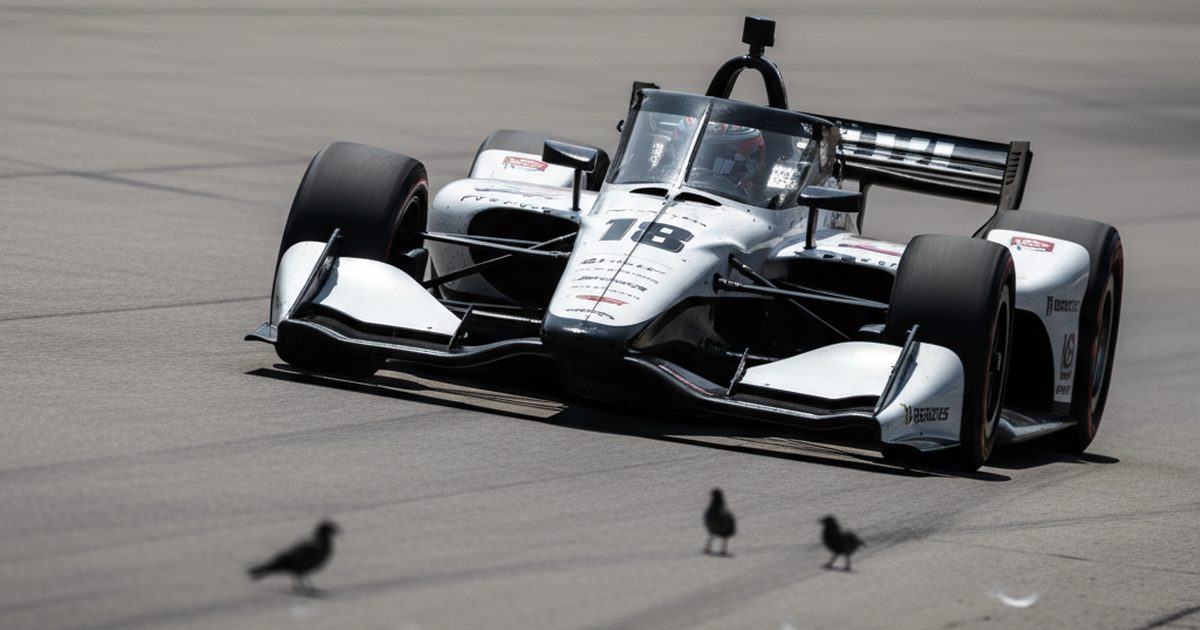
The former Formula 1 driver was back at the Indy 500 for the first time since 2023. He was running Turn 3 on Tuesday when his No. 18 Dale Coyne Racing Honda clipped a bird. The impact splattered blood across his fire suit, painted his roll bar with debris, and coated the aeroscreen.
“I still have blood on my race suit, there were pieces of the bird on my rollbar. The helmet stinks, the seat stinks,” Grosjean told reporters after climbing from the car, according to an Associated Press dispatch carried by ESPN. “I couldn’t see where I was going any more, there’s plenty on the aero screen, so it was far from ideal.”
The collision occurred on day one of IndyCar’s two-day Open Test. It is the only on-track shakedown before official Indy 500 practice opens May 12. Grosjean was uninjured. After cleaning the car, he returned to post the sixth-fastest afternoon lap at 224.307 mph.
The ‘Bad Luck Bird’
Grosjean treated the incident with dark humor. He told reporters he skipped chicken at lunch and dubbed the animal “the bad luck bird.” It is not the first time wildlife has found him at speed. In 2019, a groundhog wandered onto the Circuit Gilles Villeneuve during practice for the Canadian Grand Prix. The animal damaged the nose of his Haas F1 car.
That history points at something the racing world rarely discusses: motorsport has no equivalent of aviation’s wildlife-hazard infrastructure. When a bird hits a Boeing 737, a federally mandated process kicks in. When a bird hits an IndyCar, the driver wipes off the aeroscreen and goes back out.
Aviation Has a Playbook. Motorsport Doesn’t.
Under FAA regulations, certificated airports that experience a triggering wildlife strike must conduct a formal Wildlife Hazard Assessment. A qualified biologist runs it. If warranted, the airport then develops a Wildlife Hazard Management Plan covering habitat modification, dispersal, and reporting to the FAA National Wildlife Strike Database.
Major airports run dedicated wildlife biologists, sweep runways multiple times a day, and treat carcasses as scavenger magnets. The aviation cost runs roughly $900 million a year. Recent incidents range from a Jet2 737 diversion at Leeds Bradford to a JetBlue A320 striking a coyote at Providence.
Motorsport has none of that scaffolding. No IndyCar-equivalent Wildlife Hazard Management Plan. No series-wide strike database. No requirement that tracks survey wildlife or modify habitat. Wildlife on a racetrack is handled ad hoc, by track operations, with whatever resources are on hand.
Why Ovals Make It Worse
The Indianapolis Motor Speedway sits on more than 1,000 acres. The Brickyard Crossing Golf Course wraps the facility, and four of its holes — 7, 8, 9, and 10 — sit inside the infield. Players reach them through a tunnel under the racetrack. Open green space, water hazards, and grass infields are the habitat the FAA tells airports to mitigate. They attract birds.
Ovals compound the risk in three ways:
- Sustained high speed. Indy cars circulate at 220–230 mph for entire stints. Everything is committed.
- Banking and sightlines. Turn entry on a banked oval narrows what the driver can see. A bird crossing the racing line appears late and disappears under the cockpit before the brain can process it.
- Open cockpits. The aeroscreen, introduced in 2020, deflects debris. But at 230 mph, a bird strike still coats the driver’s field of view with biological material no wiper can clear in real time.
The aeroscreen almost certainly prevented a worse outcome. Without it, a bird at this speed would have hit Grosjean directly in the helmet.
A Forgotten Risk Category
Tracks scrub, sweep, and inspect for the FOD they understand — tire rubber, bodywork debris, oil, marbles. Wildlife is harder to plan for, easier to ignore, and almost never logged. No public record exists of how many bird, deer, or rodent strikes IndyCar, NASCAR, or IMSA cars absorb each year. No one is required to report them.
Grosjean’s incident is being treated as an anecdote. Aviation stopped treating bird strikes as anecdotes after a US Airways Airbus put down in the Hudson River in 2009. Motorsport has not had its Hudson moment, and the absence of one is doing the work of a safety policy.
Day 2 of the Open Test continues Wednesday, weather permitting. Grosjean is scheduled to be back in the car.
Sources
- Associated Press / ESPN: Romain Grosjean inadvertently hits bird during Indy 500 run (April 29, 2026)
- FAA Airport Wildlife Hazard Mitigation: faa.gov/airports/airport_safety/wildlife
- FAA National Wildlife Strike Database: wildlife.faa.gov
- Brickyard Crossing Golf Course layout: brickyardcrossing.com
FODNews covers FOD incidents and wildlife strikes across aviation, motorsport, and military operations. Subscribe to FODNews for reports as they happen.