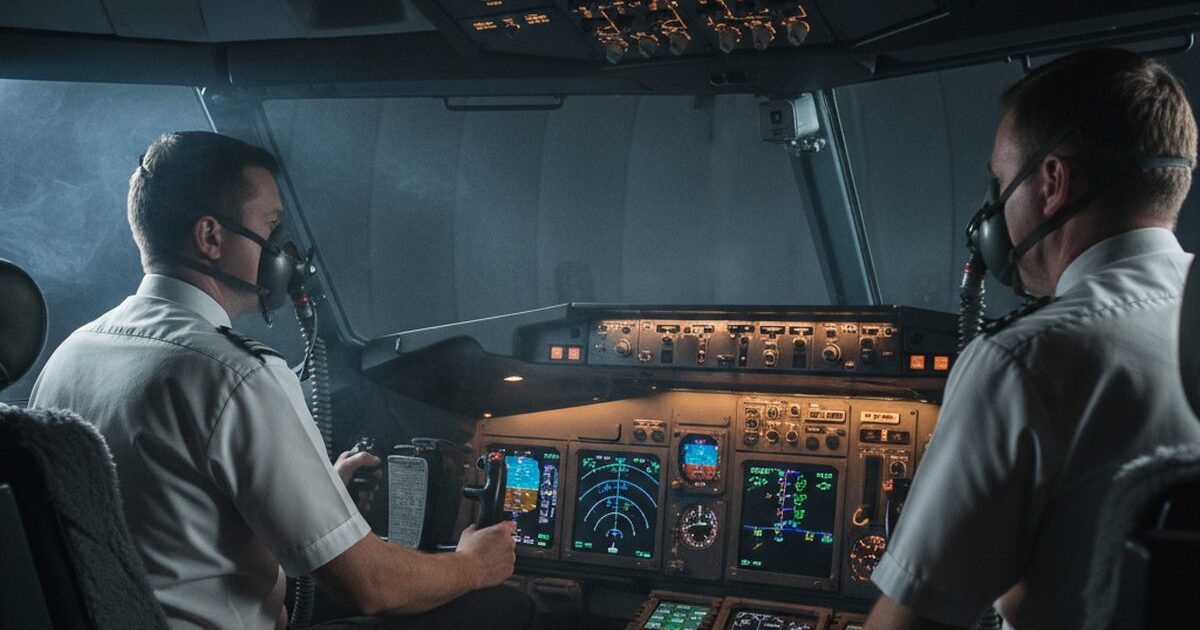
WASHINGTON — The National Transportation Safety Board on May 13, 2026, issued three safety recommendations for realistic smoke-in-cockpit simulator training, targeting a gap in airline preparedness the agency says puts passengers at risk every day.
The recommendations stem from the NTSB’s investigation of a Dec. 20, 2023, bird strike involving Southwest Airlines Flight 554, a Boeing 737-8, departing Louis Armstrong New Orleans International Airport. Shortly after takeoff, a bird was ingested into the left engine, rapidly filling the cockpit with acrid white smoke.
The flight crew donned oxygen masks and declared an emergency. Visibility inside the cockpit deteriorated within seconds, making it nearly impossible to read flight instruments or checklists. All 139 people aboard landed safely — but the crew’s account alarmed investigators.
“The surprise, adrenaline and restricted visibility proved far more challenging than anything they had experienced in training,” the NTSB noted in Aviation Investigation Report AIR-26-03, published this week.
A Daily Problem, Inadequate Response
The FAA receives nearly daily notifications of flights in which crews declare emergencies due to smoke in the cockpit, the NTSB found. Yet airlines are not currently required to conduct realistic smoke-in-cockpit simulation training.
Existing programs typically rely on verbal discussions of procedures rather than immersive simulation. No regulatory requirement exists for exercises that replicate the reduced visibility, elevated workload or time-critical decision-making that actual smoke emergencies impose on flight crews.
The NTSB concluded this training gap “may not adequately prepare crews” and — in severe scenarios — could jeopardize the safe operation of the aircraft. The agency flagged night operations and instrument meteorological conditions as particularly high-risk. “If such an event occurred at night or in instrument meteorological conditions, the consequences could be catastrophic,” the report stated.
Three Safety Recommendations
The NTSB directed its recommendations to three parties.
Recommendation A-26-58 asks the FAA to work with industry to develop standardized, realistic scenario-based simulation of smoke-in-cockpit events for both initial and recurrent pilot training at all passenger-carrying operators. Recommendation A-26-59 asks the FAA to incorporate that training into FAA Order 8900.1A, the governing framework for airline training program oversight.
A third recommendation, A-26-60, urges Airlines for America and the Regional Airline Association to share findings from the Southwest incident with member carriers and encourage adoption of realistic smoke simulation in their existing pilot training programs.
Bird Strikes and Cockpit Risk
The Southwest incident highlights a broader safety challenge. As FODNews has reported, pilots near major airports have documented a worsening bird strike environment, with industry estimates pegging annual costs near $900 million in the United States alone.
Bird ingestion events can produce cockpit smoke through several pathways — thermal damage to engine components, electrical faults, or, as in the Southwest case, engine oil reaching extreme temperatures after a load reduction device activated following the ingestion.
The New Orleans incident is catalogued in the NTSB database under investigation number DCA24LA330. The Boeing 737-8 involved, registered N8830Q, suffered no structural damage, but the crew’s firsthand account of near-total instrument obscuration prompted the NTSB’s broader inquiry into training standards.
What Smoke-in-Cockpit Simulator Training Could Look Like
The NTSB stopped short of mandating specific simulator hardware, but the report’s language points toward full-flight simulators with visual obscuration capabilities — systems capable of filling the virtual cockpit with simulated smoke to replicate the instrument-reading difficulty flight crews face under time pressure.
The agency described the core problem as an absence of any such requirement, noting that even where airlines conduct smoke drills, the exercises tend to be discussion-based rather than procedurally immersive.
Whether the FAA will move quickly to implement standardized training requirements remains to be seen. The agency has 90 days from receipt of the recommendations to submit a formal response.
Subscribe to FODNews for the latest in aviation safety and FOD incident reporting worldwide.