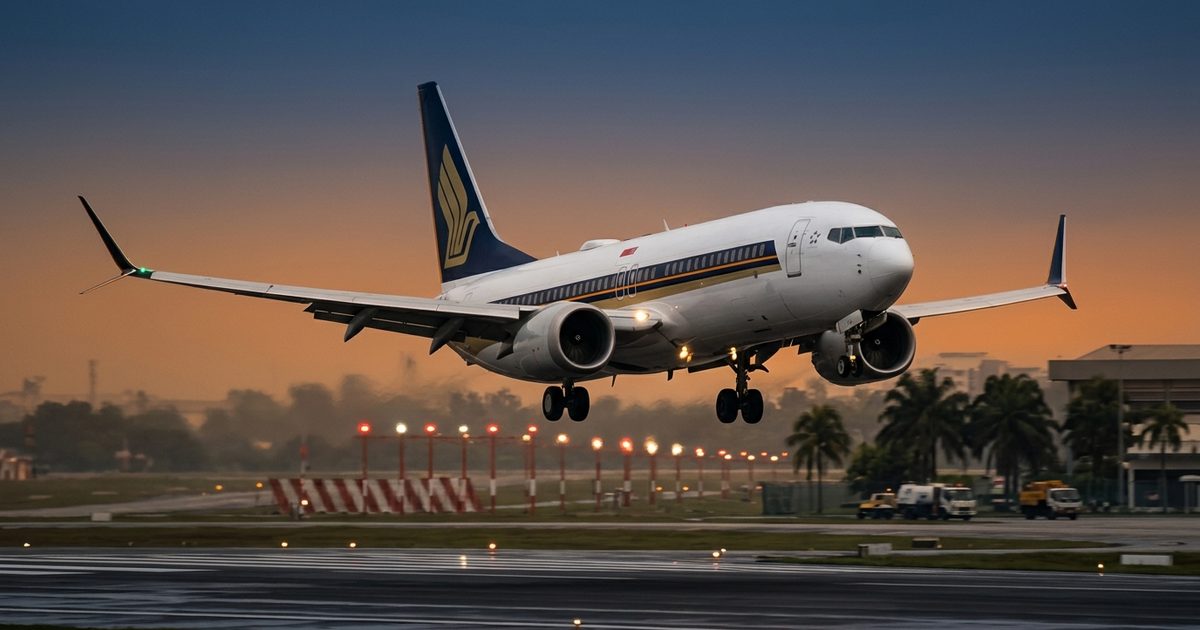
The same flight. The same runway. A different airplane. Eight days after a Singapore Airlines Boeing 737 MAX 8 suffered a double tire burst on landing at Kuala Lumpur International Airport (KLIA), it happened again.
On June 21, 2026, flight SQ114 — operating Singapore Changi Airport to KLIA — suffered a double tire failure on touchdown at Runway 14R/32L. The aircraft, registration 9V-MBA, was towed to a remote parking bay while 152 passengers and eight crew were bused to the terminal. No injuries were reported. The runway closed for approximately six hours.
The event mirrored a June 13 incident in which a different Boeing 737 MAX 8 — registration 9V-MBN — also operating SQ114, also suffered two tire bursts on landing at the same runway. FODNews reported on that earlier failure: Singapore Airlines SQ114 Tire Burst at KLIA (June 13, 2026). That incident also shut Runway 14R/32L for roughly six hours, with the NOTAM showing it unavailable until approximately 7:40 p.m. local time.
Two Aircraft, One Pattern
The detail that most distinguishes this event from a routine tire failure: both incidents involved separate airframes. 9V-MBA and 9V-MBN are different aircraft. Same flight number, same runway, same failure mode — but not the same plane returning to service with a recurring defect.
That distinction reshapes any investigation. When a single aircraft suffers a tire failure, investigators focus on that airframe’s maintenance history, tire condition, and load data. When two different aircraft on the same route suffer the same failure at the same runway within eight days, the scope necessarily broadens.
Simple Flying noted that the involvement of different aircraft “suggests that any investigation will likely focus on a broader range of factors rather than a problem specific to a single aircraft.”
Malaysia Airports’ Statement — and the FOD Angle
Malaysia Airports Holdings Berhad (MAHB) stated publicly after the June 21 event that the tire on 9V-MBA had already burst during departure from Singapore’s Changi Airport — not as a result of conditions at KLIA. Pilots declared a local standby and emergency procedures were activated on approach.
If accurate, that statement shifts the point of failure upstream. But it does not eliminate KLIA’s runway from the operational picture.
A tire that has already burst and is rolling at landing speed sheds rubber, tread fragments, and potentially metal components onto the runway surface. That debris is itself a category of Foreign Object Debris — a direct hazard to any aircraft using the runway afterward. Rubber chunks and shredded tread can puncture subsequent tires, damage landing gear, or enter engine inlets.
A six-hour closure is the operational expression of that hazard: runway crews must locate, catalog, and remove all debris before the surface is cleared for traffic. The same calculus applied on June 13.
Two closures of the same runway, each lasting roughly six hours, each triggered by the same flight on the same route — that is a pattern airports and airlines are obligated to examine, regardless of where the initial failure originated.
Investigation Status
Singapore Airlines confirmed after the June 21 event that two tires deflated after landing and that a replacement aircraft was dispatched to Kuala Lumpur, causing approximately a six-hour delay to the return SQ113 service to Singapore. The carrier said it was coordinating the investigation with Boeing, tire manufacturers, and engineering specialists.
Neither Singapore Airlines nor the Civil Aviation Authority of Singapore (CAAS) had released a formal preliminary finding as of this report.
Taken together, the pattern — two flights, two airframes, one runway, eight days — narrows the field of explanations investigators must work through. Whether the answer lies in a departure-surface condition at Changi, a tire specification or maintenance protocol, or an operational factor common to both flights, the recurrence has elevated this well beyond a single-incident investigation.
FODNews will continue to follow this investigation as findings emerge.
Subscribe to FODNews for continuing coverage of runway safety and FOD incidents worldwide.
Sources
- The Straits Times — “Singapore-bound SIA flight delayed 6 hours in KL due to deflated tyres” (June 2026)
- Simple Flying — “Deja Vu: Singapore Airlines 737 Suffers Identical Double-Tire Blowout On Same Flight, 8 Days Apart” (June 23, 2026)
- AsiaOne — “Singapore Airlines SQ 114 burst tyre KLIA June 21” (June 2026)
- FODNews — “Singapore Airlines SQ114 Tire Burst at KLIA” (June 19, 2026)