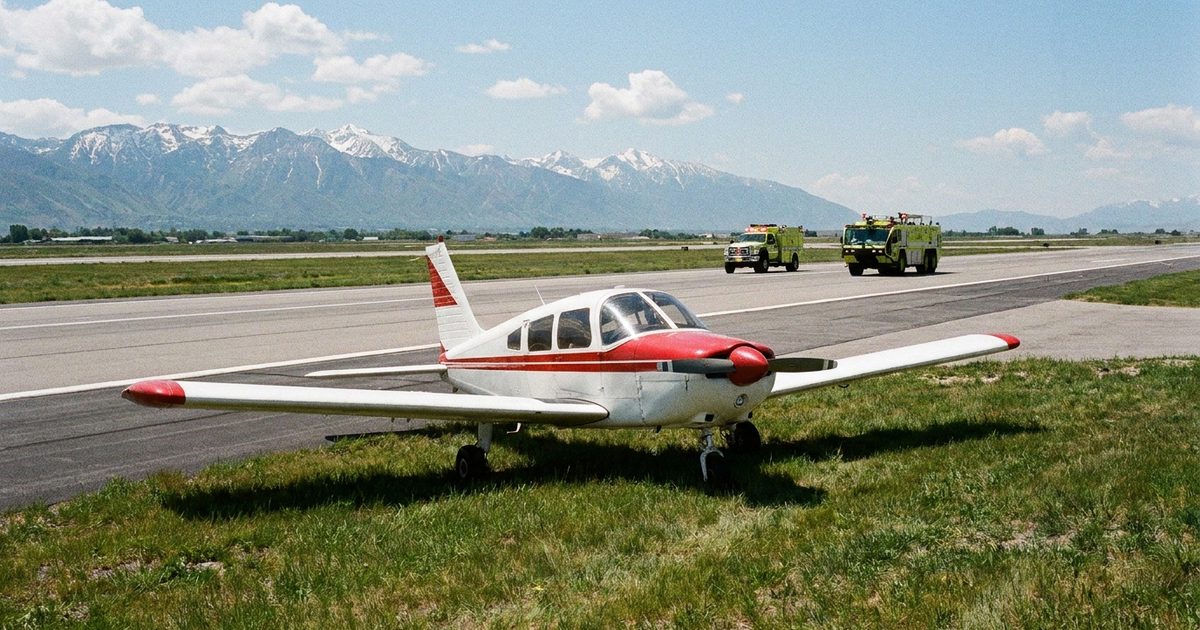
SALT LAKE CITY — A 1963 Piper Cherokee landed on a Salt Lake City runway on the morning of Nov. 2, then slid off the pavement and into the grass at one of the West’s busiest airports. The only person aboard was not hurt, according to the NTSB. The airplane didn’t get off so lightly: the agency lists its damage as substantial.
Gephardt Daily reported that the single-engine plane touched down on runway 35 at Salt Lake City International Airport at 10:25 a.m. and “slipped off a runway upon landing.” An airport spokeswoman told the outlet there were no reported injuries. FOX 13 News gave the time as about 10:30 a.m. and said the Cherokee “immediately went off the west side of the runway after landing.”
A four-seat piston single looks tiny next to the airliners on Salt Lake City’s schedule. A damaged airplane in the grass beside a runway they share is a much bigger problem. FOX 13 said video it received “showed a large airport emergency crew response to the incident.” That’s the usual chain of events: a quick landing goes wrong, and crews have to roll out onto an airfield busy with commercial traffic.
What happened on the Salt Lake City runway
The airplane was a Piper PA-28-235, registration N8620W, flying under Part 91 as a personal flight. The NTSB lists the operator as Purcell Holdings LC. In NTSB case data compiled by OpenAirDocs, the defining event is coded as a runway excursion during the landing roll.
The weather was good for visual flying. At 10:00 a.m., the airport’s weather station reported 10 miles of visibility, a few clouds at 2,500 feet, a broken ceiling at 4,200 feet, and wind from 330 degrees at 11 knots. That wind was within 20 degrees of runway 35’s heading. Investigators have not said what caused the excursion.
The reports disagree on where the flight began. FOX 13, citing FlightRadar24, said the Cherokee was flying in from Brigham City. The NTSB notification lists Salt Lake City as both the departure point and the destination.
How many were aboard, and how the NTSB will handle it
Early accounts were cautious. When FOX 13 posted its story, the number of people aboard had not been released, and the station said there were “reportedly no injuries, although that has yet to be officially confirmed.” The NTSB has since settled it: one occupant, no injuries.
The agency classed the case as a Class 4 investigation. “A preliminary report will not be issued but a final report will be released at the conclusion of the investigation,” the notification states. NTSB staff did not travel to the scene. Investigator Stanley Slinker is leading the case, and the FAA‘s Salt Lake City office is taking part. The NTSB notes that the information “is preliminary and subject to change,” and it has not determined a probable cause.
What an excursion leaves behind
A runway excursion doesn’t end when the airplane stops. Tires dig into soft ground. Rescue vehicles cross the runway edge. Recovery crews eventually drag a damaged airframe back toward the pavement. Each of those steps can leave soil, turf or broken parts close to where much larger airplanes take off and land.
That’s why airfield crews treat the ground around a disabled aircraft as part of the incident scene. FODNews has followed how a single problem at a busy airport can ripple outward, from jet-blast repairs to Midway’s arresting system to the FAA investigation into O’Hare’s fifth tire failure.
Nobody was hurt at Salt Lake City, and a 63-year-old Cherokee came to rest in the grass. The final report will explain why. For now, the episode shows that even a small airplane in the wrong place on a big airfield gets a big response.
Subscribe to FODNews for continuing coverage of FOD incidents and prevention worldwide.
Sources
- NTSB — “Aviation Investigation Notification, WPR27LA030” (Nov. 2, 2026)
- OpenAirDocs — “NTSB WPR27LA030” (compiled from NTSB public data)
- FOX 13 News — “Small plane veers off runway upon landing at Salt Lake City International Airport” (Nov. 2, 2026)
- Gephardt Daily — staff report on Salt Lake City International Airport runway excursion (Nov. 2, 2026)