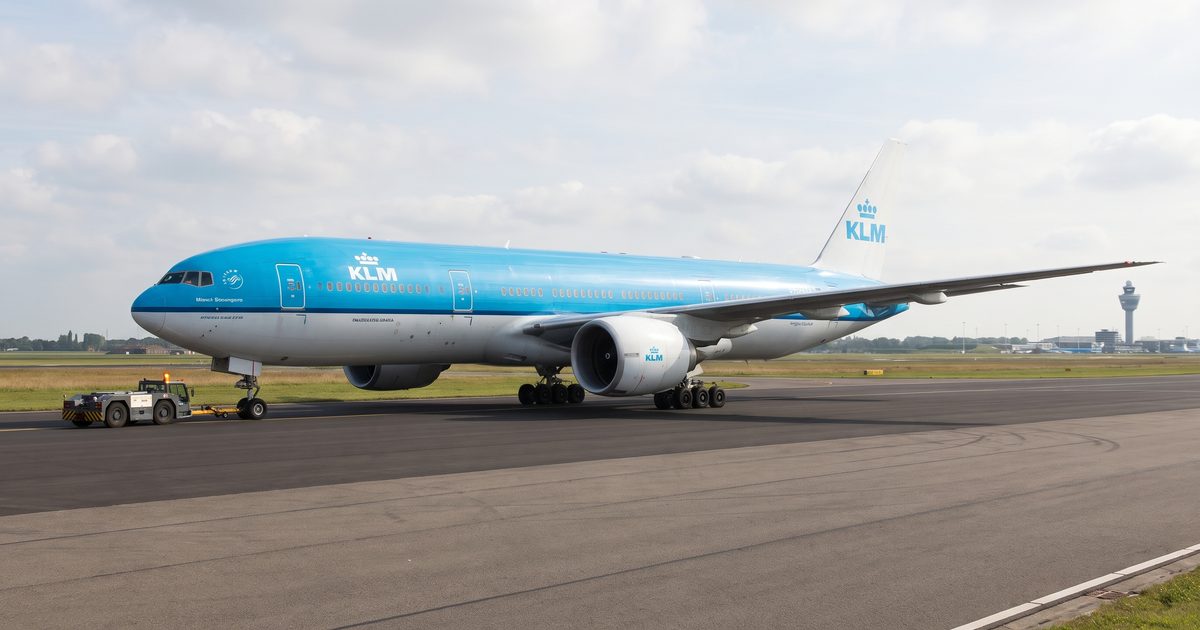
AMSTERDAM — KLM Flight 701 sat lined up on Schiphol’s runway 24 on Friday, Nov. 13, cleared to go and bound for Buenos Aires. The crew pushed the engines up. Then came a loud bang, and the KLM rejected takeoff that followed ended the trip before it began, reported AeroInside.
The Boeing 777-200, registered PH-BQB, never left the ground. It left the runway, and the airport turned to the job that follows any stop like this one. Controllers held the next departure, and a team went out to look for debris.
They found none. Still, the jet stayed in Amsterdam, and the whole rotation was scrubbed.
A bang, then a quick decision
A takeoff roll leaves little room for debate. The crew had clearance, the runway lay open ahead, and the two GE90 engines were accelerating. When the bang came, the pilots stopped.
The crew told air traffic control they had a loud bang from the engines while accelerating, according to AeroInside. The aircraft then left the runway by taxiway B and headed back toward the apron.
In the cabin, passengers soon heard the reason. The crew said they had aborted because they heard “some kind of a loud bang,” AeroInside reported, citing the passenger announcement. The crew added that they would now check what was going on.
What the KLM rejected takeoff set in motion
The stop did not end with one airplane. Another flight was waiting behind Flight 701, already cleared to depart. Once the tower heard about the bang, it cancelled that clearance.
That call matters. A bang from an engine raises a plain question for any airport: is anything lying on the runway? Until someone checks, nobody can say. So the next aircraft waits.
A runway inspection followed. It did not find any debris on the runway, AeroInside reported. Only then could the strip go back to work.
AeroInside’s account, last updated Nov. 14, is the only published report of the incident found so far. It classifies the event as an incident and gives no cause for the bang.
A hot engine and a grounded jet
Emergency services met the aircraft and took a close look. They reported seeing the engine at about 100 degrees Celsius hotter than normal, according to AeroInside. Afterward, the 777 taxied to the apron.
The trip was over. The entire rotation was cancelled, AeroInside reported. That included the onward sector from Buenos Aires to Santiago, Chile.
The disruption therefore reached well beyond one runway in the Netherlands. And the aircraft itself went nowhere. About 19 hours after the rejected takeoff, it was still on the ground in Amsterdam.
What a clean runway tells us
Rejected takeoffs come in many forms. FODNews has reported on a Lufthansa A320 that rejected takeoff at Frankfurt after a nose-tire burst and on pilots who rejected takeoff at Philadelphia after spotting debris. Each event had its own circumstances.
Yet the response follows a familiar pattern, and Schiphol showed it step by step. The crew stops. The aircraft clears the runway. The tower holds the next departure. Then someone drives out and inspects the pavement.
None of those steps depends on knowing what went wrong. In fact, the sequence exists because nobody knows yet. A crew reports a bang, and the runway is treated as suspect until eyes have covered it.
Here, the inspection came back empty. That is a result too. A clean sweep is what lets a runway go back to work.
For anyone who works around runways, that is the lesson of Flight 701. The check is not a formality, even when it finds nothing. It is the difference between assuming a runway is clear and knowing it.
Subscribe to FODNews for continuing coverage of FOD incidents and prevention worldwide.