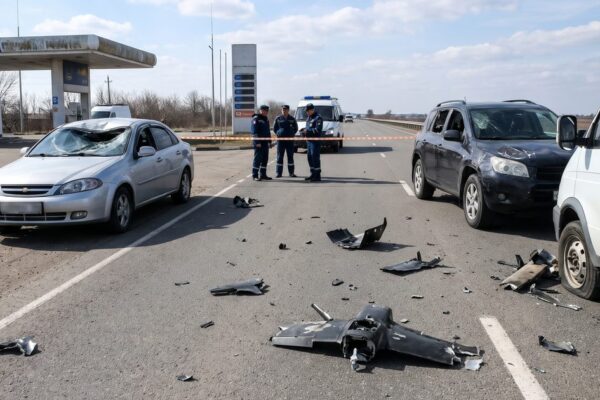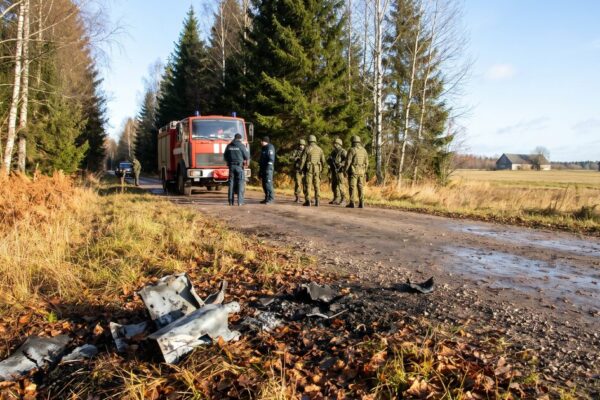

NOWY LIPOWIEC, Poland — Natalie Szponar heard it before anyone could explain it. About 6:30 a.m. on Friday, Nov. 20, the village resident caught a “whistle and a dull impact,” BBC News reported. A Russian Kh-101 cruise missile had come down in a nearby field, the first sign of a Poland missile debris case that now spans two provinces.
The village sits about 50 kilometers from the Ukrainian border. It was not the only place where something fell that morning. Two more objects came down near Rudnik nad Sanem and Mołodycz, also in southeastern Poland.
Nobody was hurt. All three objects landed on undeveloped land and caused no significant property damage, Reuters reported on Nov. 22, citing prosecutors. Open land took the blows. Homes did not.
First reports pointed to two missiles and a drone
The picture on the first day was incomplete. Poland reported three airspace violations, and officials were still sorting out what had crossed the border.
Defense Minister Władysław Kosiniak-Kamysz gave the early count. “There was a Kh-101 missile… In the second case, one can also speak of a missile; in the third, it was most likely a jet-powered drone,” he said, according to Reuters.
So the first tally stood at one confirmed cruise missile, one probable missile and one suspected drone. That would change within two days.
Leaders in Warsaw and at NATO responded the same day
Prime Minister Donald Tusk spoke the same morning. “It seems we are dealing with an intentional provocation,” he said, Reuters reported on Nov. 20.
NATO Secretary General Mark Rutte also spoke out. He called the incident “clearly dangerous.”
Meanwhile, investigators fanned out across the three sites. Their job was simpler to state than to finish: find the wreckage, document it and work out exactly what it was.
What prosecutors found in the Poland missile debris
The answer came on Nov. 22. All three objects were Russian Kh-101 cruise missiles, said the Regional Prosecutor’s Office in Lublin. The suspected drone was a missile too.
Prosecutors also traced where the weapons came from. They said the missiles were manufactured in the fourth quarter of 2026 in Dubna, in the Moscow region. That means they were built no earlier than October.
Meduza also reported the finding. The case covers objects found in both Lublin and Podkarpackie provinces, and prosecutors merged all three cases into one investigation run by their 8th Military Affairs Department.
The fieldwork has moved at a different pace at each site. Work on the ground at Nowy Lipowiec and Rudnik is complete, prosecutors said. At Mołodycz, teams went back to work on Nov. 23.
The recovered material is going to specialist research institutes, prosecutors said. Experts there will try to work out why each missile came down.
Why falling weapons are a ground-safety problem
Debris is usually a runway word. It means the bolt, the tire fragment or the loose panel that a sweep crew hopes to find before an aircraft does. But the same rule holds far from any airfield. Whatever flies can fall, and it lands wherever it happens to be.
On Nov. 20, that meant three patches of open land in southeastern Poland. A cruise missile is large and heavy, and no one on the ground gets a warning. Szponar had only a whistle, then the thud.
Similar cases include missile debris near Biržai, Lithuania, and drone debris in Kyiv’s Holosiivskyi district. Each case carries the same lesson. Wreckage from airborne weapons does not stay inside a conflict zone, and civilians live under the flight paths.
In Poland, the open land did the protecting. Three missiles fell, and empty ground took all three. Now the experts take over, one fragment at a time.
Subscribe to FODNews for continuing coverage of FOD incidents and prevention worldwide.
Sources
- Reuters — “Three Russian missiles flew into Poland Friday, prosecutors say” (Nov. 22, 2026)
- Reuters — “Poland condemns Russian ‘provocation’ after three airspace violations” (Nov. 20, 2026)
- BBC News — report from Nowy Lipowiec (Nov. 20, 2026)
- Prokuratura Okręgowa w Lublinie — “Podsumowanie dotychczasowych czynności oraz zamierzenia śledztwa w sprawie ujawnienia szczątków pocisków manewrujących Ch-101” (Nov. 23, 2026)
- Prokuratura Okręgowa w Lublinie — “Aktualny stan czynności procesowych … (22.11.2026 r.)” (Nov. 22, 2026)
- Meduza — “All three flying objects that fell in Poland turned out to be Russian X-101 cruise missiles” (Nov. 23, 2026)