
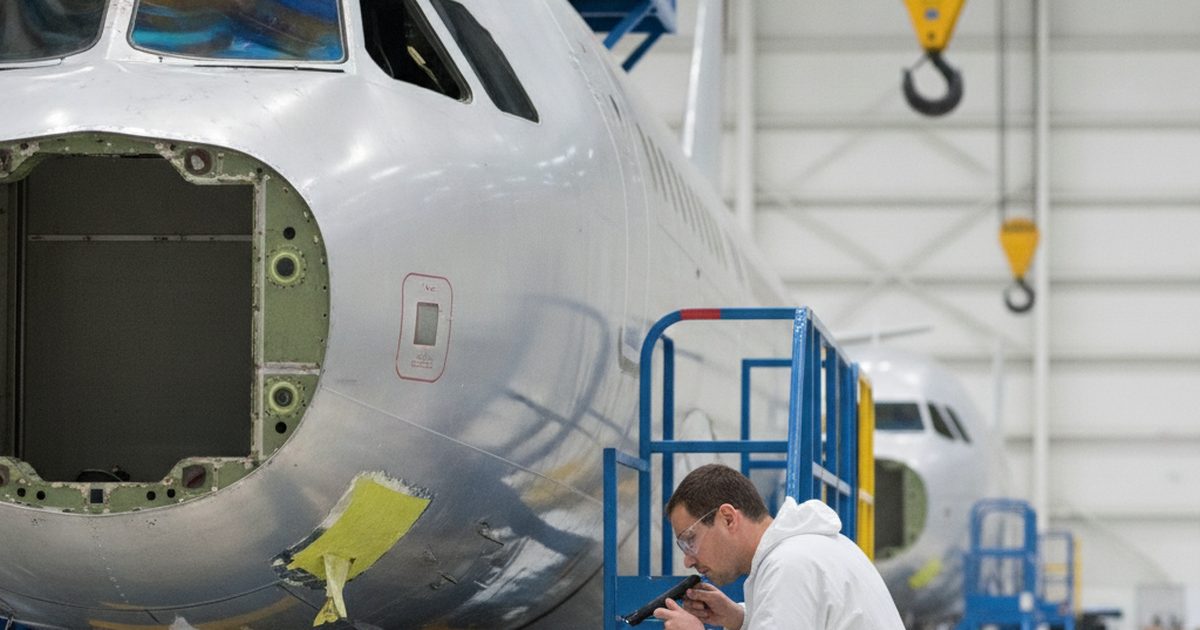
Airbus confirmed on Sept. 26, 2026, that it is investigating an A321neo primer flaw traced to an Italian coatings supplier, after a technician scraping paint from a fuselage panel found gaps in the protective primer underneath. The lapse has triggered an alert affecting roughly 500 aircraft across the global fleet.
The planemaker said the defect traces to TESI, a privately held coatings firm south of Naples that works as a sub-contractor to Leonardo, people familiar with the matter told Reuters. Leonardo has confirmed TESI is a supplier but has not said whether the firm was working on Airbus parts at the time. TESI did not respond to requests for comment, and Airbus declined to name the supplier directly.
The A321neo Primer Flaw: What Was Found, and Where
The gap involves stringers — strengthening rods that run along the forward fuselage section of the A321neo. Airbus sources that section from two suppliers: Leonardo and its own in-house unit, Airbus Atlantic (formerly Stelia). Leonardo, in turn, relies on a single coatings supplier for the work, which is how the flaw traces back to TESI.
The missing primer is designed to prevent corrosion in the aircraft’s “bilge,” the lowest point of the fuselage where moisture tends to collect over time. Engineering teams from both Airbus and Leonardo are now on-site at TESI’s facility working to identify the root cause, which had not been determined as of Reuters’ reporting.
Scale and Airbus’s Safety Position
Airbus has said about 500 aircraft are involved: roughly 250 already delivered to airlines and another 250 at various stages of production. The company has characterized the finding as a quality issue rather than a safety issue. Airbus says the flaw does not require any immediate operational restriction, and airlines can continue flying the affected jets.
Airlines taking new deliveries will be given a shortened, two-year window to complete the repair rather than the usual four-year maintenance cycle. The fix itself is expected to take up to nine days, including two to three days for the core repair work. Notably, the repair will not require removing the affected panel from the fuselage, a detail that has eased some analyst concern about the scope of disruption.
As of this writing, the European Union Aviation Safety Agency (EASA) has not published a public airworthiness directive specific to the coating findings, and Airbus has reaffirmed its 2026 delivery target.
A Second Fuselage Quality Issue in Under a Year
The TESI finding is the second fuselage-related quality lapse Airbus has disclosed in less than a year. Airbus previously disclosed a separate incident in which a mechanic’s tool was found inside an A330neo horizontal tail plane, halting widebody deliveries for two months. Aviation analyst Rob Morris told Reuters the pattern points to persistent weak points deep in the supply chain: “The supply chain is still not under control; we thought it was but it isn’t. It just takes one company and suddenly you have a problem.”
The A321neo is Airbus’s top-selling narrowbody and the backbone of short- and medium-haul fleets worldwide, operated by major carriers including American Airlines, Delta Air Lines, Turkish Airlines, IndiGo and Wizz Air. Airbus has not disclosed which specific airlines are affected or how deliveries will be sequenced for repair.
The Quality-Control Thread
Strictly speaking, a coating gap traced to a sub-tier supplier isn’t foreign object debris — no stray part or tool is lodged in the airframe. But the same disciplines FOD-prevention programs are built on — process control, in-process inspection, and supplier traceability under standards like AS9146 and AS9100 — are exactly what a primer-thickness escape at a coatings vendor exposes when they fail. A gap that isn’t caught until a technician scrapes paint on a finished panel is, in that sense, a quality-system miss of the same species FODNews tracks on the factory floor.
Subscribe to FODNews for continuing coverage of FOD incidents and prevention worldwide.