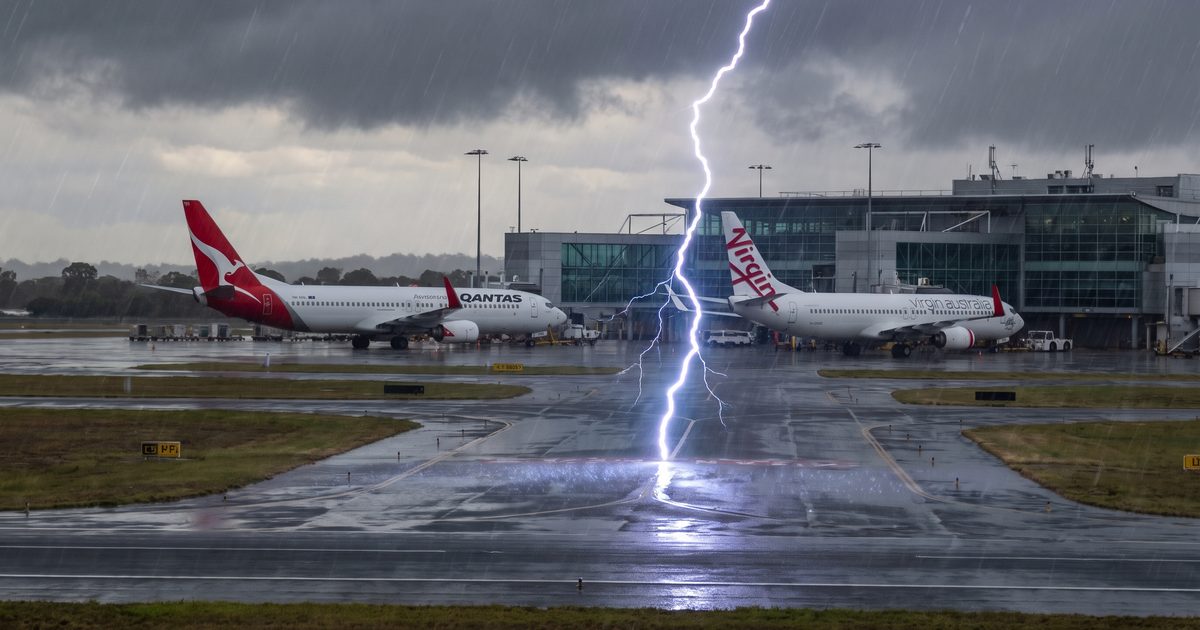
Lightning blasted holes in the western runway at Brisbane Airport on Tuesday afternoon, Oct. 27, forcing emergency repairs that kept the runway closed for more than eight hours.
Footage shared by the airport shows the strike hit the western runway about 3:11 p.m. local time. It left a scattering of holes across a section of bitumen, some of them roughly palm-sized, the Brisbane Times reported.
No flights were canceled Tuesday, and the airport was operating as usual Wednesday, according to the newspaper.
How lightning damaged the Brisbane Airport runway
Brisbane Airport spokesperson Peter Doherty said engineers were immediately deployed to assess the runway, which was closed for emergency repairs. “The lightning hit the centre of the runway, creating damage,” Doherty said.
7NEWS reported that the strike hit the center of the western runway and punched several hand-sized holes. Brisbane Airport senior asset civil engineer Fraser Stevens was photographed surveying the damage.
Doherty said lightning was common around the airport but such damage to a runway was rare. “I spoke to the guy who looks after the runway. He’s been there 27 years and he hadn’t seen something like [what we saw] yesterday.”
Separately, 7NEWS reported that, according to Brisbane Airport, a strike like this on the tarmac is extremely rare and has not happened at the airport in at least the last 30 years.
Some passengers described significant disruption, 7NEWS reported. Meddy Barr, who was in the terminal when the lightning hit, wrote in a social media post: “It sounds like a bomb went off.”
One runway carried the traffic while crews worked
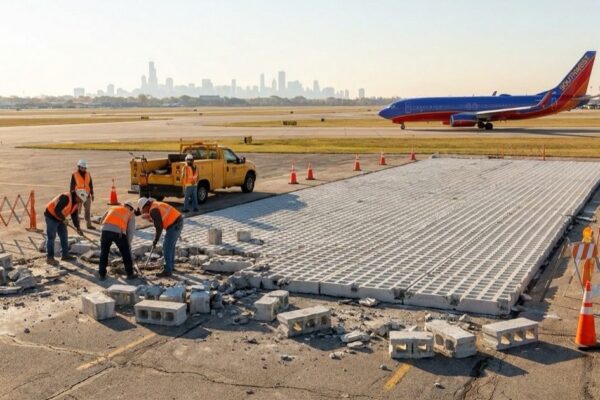
Doherty described the repair: “[Engineers] had to cut out the affected areas and re-asphalt them.” He added: “They spent the evening working on it and had it restored at 11.52pm.”
In a statement reported by InDaily, the airport said engineers put “in significant effort to repair and reopen the runway safely” after the strike. InDaily reported that the runway reopened by 11:52 p.m. with no further impact to flights.
Brisbane Airport Head of Facilities Rod Macbeth praised crews for working through the night, 7NEWS reported.
The airport stayed open throughout the closure. “There are two runways two kilometres apart: one was out of action, the other [eastern runway] kept going through that time,” Doherty told the Brisbane Times. The two runways are about 1.2 miles apart.
“Throughout the repair period, all aircraft were able to use the eastern runway to ensure passengers continued to get to their destinations,” Doherty told InDaily.
Even so, the weather slowed traffic. Doherty said: “We’ve done some numbers and there was an average 48-minute delay through that period in the afternoon, with storm activity around.”
Another traveler, Merita Thorley, said her plane from Townsville was circling above Brisbane as its landing was delayed by 50 minutes, 7NEWS reported.
Severe storms swept south-east Queensland
Severe storms moved through parts of south-east Queensland from about 1 p.m. Tuesday and lasted until about 5 p.m., according to Bureau of Meteorology senior meteorologist David Crock. Large hailstones hit areas of the Gold Coast and Ipswich.
Crock said: “And we had the right conditions for storms to get strong enough for large, or giant hail, which is over five centimetres in diameter.” Five centimeters is about 2 inches.
InDaily reported that the storms brought hail up to 7 centimeters, or about 2.8 inches.
Why broken pavement keeps a runway closed
Damaged runway pavement is a recognized foreign object debris hazard. Loose pieces of asphalt on an active runway can be thrown up by tires or drawn into jet engines.
For that reason, a runway with a broken surface has to stay closed until the damaged areas are cut out and resurfaced. In Brisbane, crews did exactly that, cutting out the affected sections and re-asphalting them before the western runway returned to service.
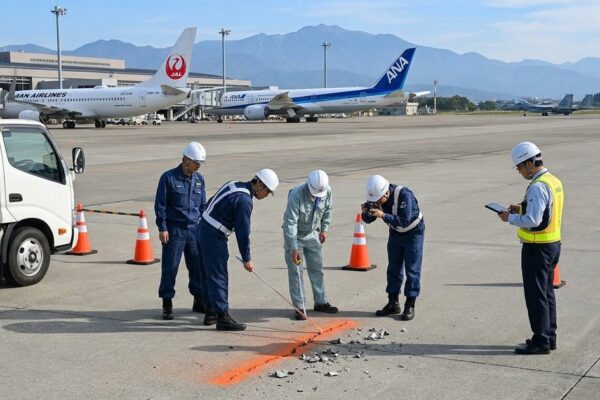
Pavement failures have disrupted other airports in recent months. Recent examples include a hole that opened in a Manchester Airport runway in September and caused hours of delays, and a runway crack that shut Japan’s Komatsu Airport for hours in October.
Subscribe to FODNews for continuing coverage of FOD incidents and prevention worldwide.
Sources
- Brisbane Times — “Lightning blasts holes at Brisbane Airport, runway closed for hours” (Oct. 28, 2026)
- 7NEWS — “Lightning strike punches hand-sized holes in Brisbane Airport runway in rare event not seen in 30 years” (Oct. 28, 2026)
- InDaily — “Planes delayed as lightning blasts holes in airport runway” (Oct. 28, 2026)