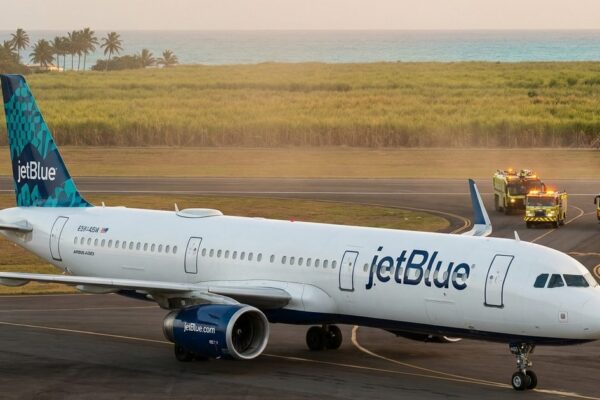

On May 17, a Condor Airbus A320-212 struck birds with both engines on final approach to Berlin Brandenburg Airport. The aircraft was inbound from Frankfurt. The simultaneous dual-engine ingestion is among the most demanding scenarios in commercial aviation — and it exposes the limits of both certification standards and airport wildlife programs.
Condor flight DE4095, registered D-AICI, was descending toward Runway 25L at approximately 11:08 local time. A flock of small birds crossed the approach path. Ground observers captured video showing ingestion into both CFM56-5A3 engines nearly simultaneously.
The crew continued the approach and landed safely. Both engines responded to reverse thrust commands during rollout, and the aircraft taxied normally to the apron. No injuries were reported among passengers or crew. The aircraft remained on the ground at Berlin Brandenburg for inspection in the days that followed.
Why Both Engines Matters
Bird strikes are common in commercial aviation. The FAA database records tens of thousands of reported strikes annually worldwide. Strikes affecting a single engine are serious but manageable. The airframe retains full thrust on the remaining engine, and crews work through well-practiced single-engine procedures.
Dual-engine ingestion on approach is a different problem entirely. Below 3,000 feet on final, an aircraft has limited altitude margin and little time to relight engines or divert. Consequently, the crew of DE4095 faced that geometry directly on May 17.
Engine certification standards require manufacturers to demonstrate tolerance to bird ingestion into a single engine. EASA sets these under CS-33.76; FAA regulations mirror the requirement. There is no certification standard for simultaneous multi-engine ingestion. Instead, regulators rely on fleet-level probabilistic modeling. The goal is to show that a catastrophic dual-engine failure from a bird strike remains within acceptable safety bounds — rare, in other words, but not impossible.
US Airways Flight 1549 established the benchmark in 2009. Canada geese caused near-total thrust loss in both CFM56 engines during initial climb. That A320 ended in a Hudson River ditching. The accident prompted updated FAA bird ingestion rules requiring more rigorous certification standards. The Berlin strike involved smaller birds and both engines continued through touchdown — a far better outcome. Even so, any simultaneous dual-engine wildlife ingestion on approach warrants scrutiny.
BER’s Wildlife Management and Its Limits
Berlin Brandenburg Airport is not operating without wildlife controls. In 2023–2024, BER upgraded to a Robin Radar Systems MAX phased-array bird radar. The 3D system covers roughly 10 kilometers, operates continuously, and feeds flock location data to the airport’s wildlife control team. When the radar flags bird activity in a flight corridor, controllers dispatch falconers, pyrotechnics, or patrol dogs. The goal is to disperse flocks before aircraft arrive.
However, the May 17 encounter demonstrates the inherent gap in that model. Airport-based wildlife programs control the immediate airport environment. Approach corridors extend well beyond the airport boundary. The airspace aircraft descend through passes over land managed by municipalities, farms, and wetland preserves. Bird populations in those areas are largely outside any airport’s direct authority to manage.
That challenge is not unique to BER. Earlier in May, an Air Europa 737 bird strike at Palma de Mallorca ended in a runway excursion. That incident, too, originated beyond the immediate airport perimeter — a pattern regulators are now tracking continent-wide.
Meanwhile, Europe’s spring migration season was in full swing on May 17 and continues into June. Millions of birds are moving northward across the continent during this period. EASA has scheduled a wildlife hazard management session for June 5 as part of its Summer Safety 2026 series. The inclusion also signals that regulators are treating elevated seasonal risk as a current operational concern.
Investigation Status
Germany’s aviation safety authority, the Bundesstelle für Flugunfalluntersuchung (BFU), investigates accidents and serious incidents under ICAO Annex 13 standards. As of late May, no formal BFU investigation report for the D-AICI event had been published. Whether the incident meets the threshold for a serious-incident investigation depends partly on the engine inspection findings. Additionally, BFU’s determination will affect how the event is classified in Germany’s annual aviation safety statistics. Routine reporting would tally it in annual statistics; a formal investigation would produce a public safety analysis.
D-AICI, the affected A320-212, was manufactured in 2000 and has operated with Condor for more than two decades. Its CFM56-5A3 engines will require detailed borescope inspection and potentially teardown assessment before the aircraft returns to service. Furthermore, as of late May 2026, Condor had issued no public statement on the aircraft’s status or return-to-service timeline.
Sources
- The Aviation Herald — Condor A320 at Berlin on May 17th 2026, bird strike into both engines
- Aviation Safety Network — Incident: Airbus A320-212 D-AICI, 17 May 2026
- FAA Federal Register — Airworthiness Standards: Engine Bird Ingestion (2006)
- Robin Radar Systems — Berlin Brandenburg Airport MAX radar upgrade
- EASA — Summer Safety 2026: Wildlife Hazard Management (June 5, 2026)