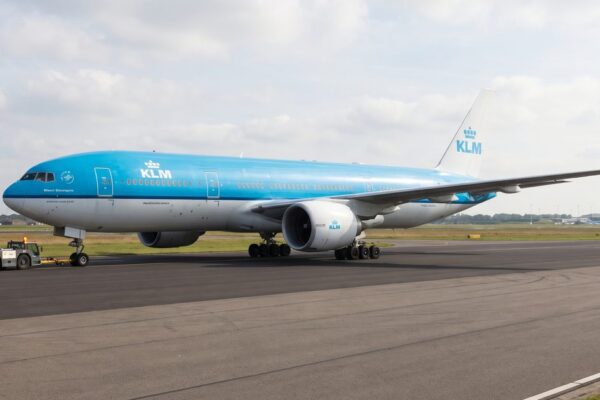

Twelve minutes after a WestJet Encore turboprop lifted off from Kamloops, British Columbia, on March 2, 2023, a cracked compressor blade inside its right engine fractured. The crew heard a loud bang at 25,000 feet as the engine surged and briefly caught fire. They declared an emergency, shut the engine down and diverted to Kelowna, landing safely with 74 passengers and four crew aboard.
That flight is back in the news because Canada’s Transportation Safety Board released its final report on the investigation, A23P0020, on September 22, 2026, more than three years after the incident. The report traces the fire to a compressor blade that fractured from fatigue deep inside the engine. It also finds the problem is far from contained to one aircraft.
What Caused the Cracked Compressor Blade Failure
The flight was operated on a Bombardier DHC-8-402 registered C-GVEN and was bound for Calgary. Its No. 2 engine, a Pratt & Whitney Canada PW150A, lost a blade in its second-stage low-pressure compressor. Investigators traced the crack to an unidentified subsurface flaw, fed by mechanical resonance in a narrow engine-speed band near 26,000 rpm.
The fractured blade did not start the fire directly. The broken blade caused the engine to surge and lose power. In response, the engine’s control system pushed more fuel in to try to recover thrust. That extra fuel built up unburned in the exhaust duct and ignited, sending hot gas briefly back into the nacelle before the crew secured the engine and diverted. The rotor had logged only 909 cycles against a 20,000-cycle life limit — evidence that operating conditions drove the fatigue, not age alone.
The failure is not classic foreign object debris, where an external item like a bird or runway fragment enters an engine. It is closer to domestic object damage: an internal part broke apart on its own, and the fragments then caused damage downstream the same way loose debris would.
A Second Cracked Blade and Two More Damaged Engines
Investigators found a second blade on the same rotor cracked in a matching location, pointing to a shared failure pattern rather than a one-off defect. WestJet Encore ran fleet inspections under instructions from Pratt & Whitney Canada. Those inspections turned up two more engines, serial numbers FA1010 and FA1096, with fractured compressor rotors of the same type.
Across operators flying the Dash 8-400 worldwide, the TSB’s report counts 11 in-flight engine shutdowns tied to this rotor-blade failure since 2012. The list includes Porter Airlines, Flybe, South African Express, Ethiopian Airlines and Norway’s Widerøe, besides WestJet Encore. Add the two fractured rotors WestJet Encore found through its own inspections, and the documented total tied to this shared rotor design reaches 13 — spread across multiple operators and airframes, not confined to a single carrier’s fleet.
CBC News reported on the TSB release, confirming the passenger and crew counts, the Kamloops-to-Calgary routing and the sequence of the engine surge, fire and diversion.
Inspection Protocols Still Rolling Out Fleet-Wide
Pratt & Whitney Canada issued a special instruction in July 2023 requiring an endoscopic inspection of second-stage compressor blades. Any crack found now triggers rotor removal before the next flight. A second instruction followed in January 2024, targeting engines with a higher statistical chance of blade distress, and operators later expanded it to other international fleets.
De Havilland Aircraft of Canada, which builds the Dash 8, issued a service letter in December 2024 recommending operating changes. The manufacturer also worked with Pratt & Whitney on a software fix, which arrived in June 2025. The update changes fuel-flow limits and adds fault detection. Transport Canada made it mandatory through a September 2025 airworthiness directive, with a compliance window of up to 14 months. WestJet Encore separately revised cockpit procedures in May 2024 to limit use of the fuel-saving setting linked to the resonance condition.
Inspection protocols are still being adopted across operators flying the PW150A-powered Dash 8-400, and the worldwide tally of similar rotor failures now stands at 13. The TSB’s findings describe an ongoing safety effort rather than a closed chapter. No injuries were reported in the Kelowna diversion, and the aircraft returned to service after repairs.
A parallel case of a hidden internal flaw distinguished from classic FOD appears in FODNews’ report on the compressor flaw that destroyed a Thunderbirds F-16, which also prompted a new inspection rule.
Subscribe to FODNews for continuing coverage of FOD incidents and prevention worldwide.