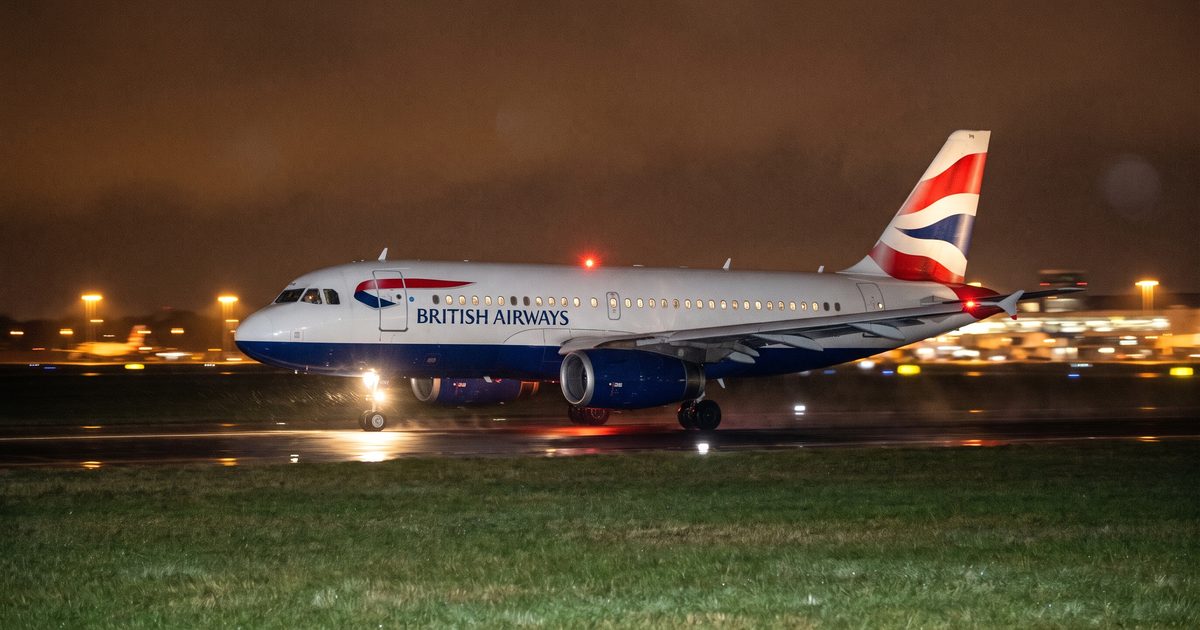
A British Airways Airbus A319’s navigation units began drifting after a jolt on the takeoff roll that investigators linked to its nose gear running over centerline lights and an irregularity in the Edinburgh runway surface, according to a report the Air Accidents Investigation Branch published Oct. 8, 2026. The serious incident happened Oct. 30, 2025, on a British Airways flight from Edinburgh Airport to London Heathrow carrying 132 passengers and six crew. No one was hurt.
“The exact source of the shock loading was not determined but two larger sound impulses from the nose landing gear were captured by the Cockpit Voice Recorder (CVR),” the report said.
A bang on the takeoff roll, then a PAN in the climb
The A319 took off from Runway 06 at 7:18 p.m. local time. Just before rotation speed, the pilots heard a “bang” from the nosewheel.
About nine minutes later, as the jet climbed through about 22,000 feet, a GPS PRIMARY alert appeared and the position error on one inertial reference system reached 28.0 nautical miles. The autopilots and autothrust disengaged, and the crew declared a PAN, an urgency call one step below a mayday.
The flight leveled off at 32,000 feet, and Scottish air traffic control asked the crew to squawk 7700, the emergency code.
On approach, the autopilot and autothrust disconnected again, and a rudder travel limiter fault alert at about 1,500 feet led to a go-around. The aircraft landed safely on its second approach.
What the AAIB found on the Edinburgh runway surface
The AAIB said rhythmic sound pulses picked up by the cockpit voice recorder during the takeoff roll were “consistent with one of the NLG tyres contacting the runway centreline lights.” At about 118 knots groundspeed, one impulse grew louder, and the nose gear squat switch began to flicker between ground and air.
Post-flight inspections found nothing wrong with the nose landing gear, and the navigation units were serviceable.
“The runway surface had multiple repair patches along its length, with several on or near the centreline, in the area just before where the aircraft was calculated to have rotated,” the AAIB said. After inspecting the runway the same day, the airport replaced one patch that had developed an abnormal surface, but it sat to one side of the centerline, and investigators said “it is unlikely the nosewheels travelled over the degraded area.”
The AAIB concluded: “The aircraft’s NLG ran over several runway centreline lights plus another larger irregularity on the runway surface, immediately prior to rotation.” It added that no single irregularity found during the runway inspection appeared capable of causing the shock load.
A known weakness in the navigation units
“Inertial reference drift is a known issue with the model of Air Data Inertial Reference Unit fitted to G-EUPS, when experiencing shock loading outside of its certification requirements,” the AAIB said.
The Northrop Grumman-made units have not been fitted to new aircraft since 2015, and Airbus sent operators a technical notice about them in April 2020. An earlier investigation found five other similar incidents involving them, and Airbus told the AAIB of seven more worldwide since 2021.
That earlier investigation covered a separate event, a similar 2021 occurrence on another British Airways A319 at Edinburgh, in which an uneven runway patch repair “was thought to be causal.” That patch was replaced.
The Scotsman called the 2025 incident “the second such case in four years.” The runway’s full resurfacing, the first in 17 years at Scotland’s busiest airport, began in November 2025, a month after the incident, and was completed in April 2026.
In 2024, the newspaper reported that 16 unplanned closures for emergency repairs had disrupted nearly 100 flights over a year. The airport said at the time: “We always prioritise safety and maintain a regular maintenance regime, and we will continue to complete works where and when required.” Edinburgh Airport declined to comment on the AAIB report.
Why pavement condition is a debris issue
Worn pavement, patch repairs and raised fixtures are closely tied to foreign object debris. Loose patch material can break away as debris, and an uneven surface can send a shock load through landing gear.
Resurfacing and routine runway inspections are the main defenses. Recent examples include lightning that punched holes in Brisbane Airport’s western runway in late October, closing it, and Frankfurt Airport closing its central runway for a 16-day resurfacing project aimed at FOD risk.
Subscribe to FODNews for continuing coverage of FOD incidents and prevention worldwide.