
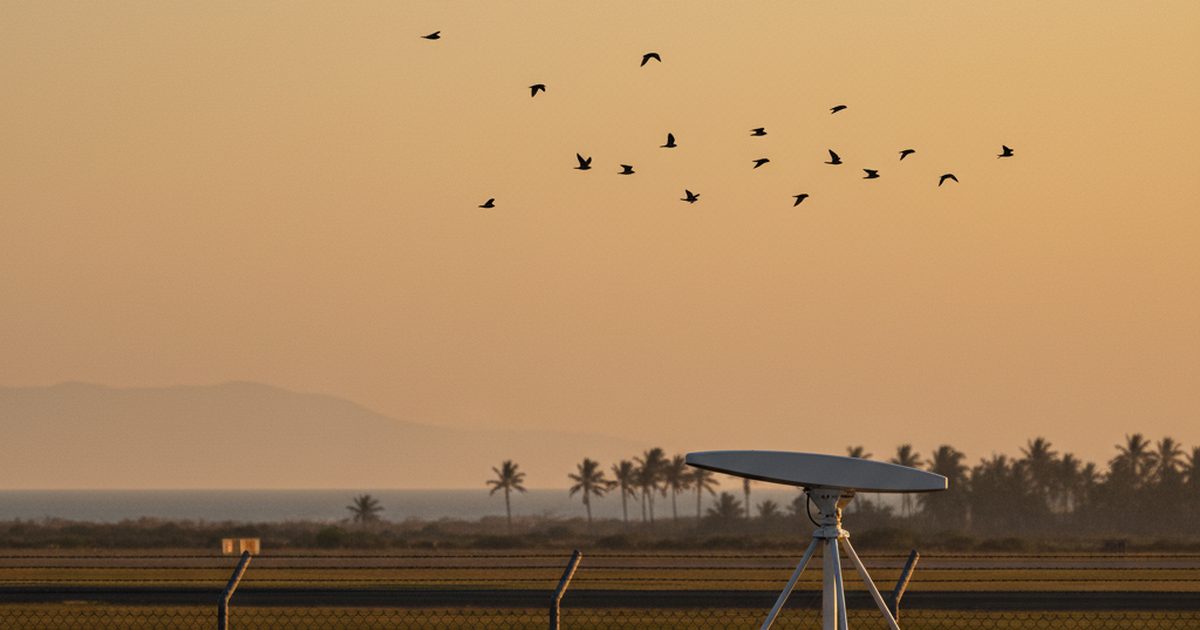
Durban’s King Shaka Airport Joins an Exclusive Group: Africa’s 3D Avian Radar Club
King Shaka International Airport in Durban is now one of only two airports on the African continent operating a purpose-built, three-dimensional bird-strike radar. Safety officials say the deployment marks a fundamental shift in how African airports manage bird-strike risk.
HENSOLDT South Africa and Robin Radar Systems announced earlier this month that the Robin MAX system is now fully operational at King Shaka. The airport serves as KwaZulu-Natal Province’s primary international gateway. The deployment is the first of the Robin MAX radar in South Africa and the system’s sixth continent of operation.
How the Bird-Strike Radar Works
The Robin MAX is a full 3D frequency-modulated continuous-wave phased-array radar with an instrumented range of 15 kilometers and 360-degree horizontal coverage. It rotates at 60 revolutions per minute — the fastest of any avian radar currently on the market — delivering real-time updates every second.
At that speed and range, the system can simultaneously track more than 3,000 individual birds. Each detection is classified by size and flock composition, with position recorded in three dimensions: latitude, longitude, and altitude. A web-based Bird Viewer interface gives wildlife control teams live access to that data. It also enables post-event track replay for incident analysis.
The Barn Swallow Problem
Durban’s bird-strike risk profile is unusually concentrated. The Mount Moreland Barn Swallow roost sits just a few kilometers from the airport in KwaZulu-Natal. Each year between September and early March, it draws flocks of approximately three million birds. The species is an intercontinental migrant. Each evening during peak migration, those numbers create sustained hazard windows for aircraft operations.
Historically, that risk was managed through visual spotters, reactive culling programs, and general hazard awareness. Real-time data on flock movement and altitude was largely unavailable.
The Robin MAX changes that calculus. The system monitors continuously — including at night — and generates population-level track data. Wildlife managers can now build data-driven hazard profiles rather than simply reacting after birds appear on the runway.
A Research Partnership Built In
The deployment at King Shaka is structured as a four-party collaboration. HENSOLDT South Africa served as prime contractor and systems integrator. Robin Radar Systems supplied the hardware and will provide ongoing training and support. Airports Company South Africa (ACSA), which operates South Africa’s nine principal airports, handles operational deployment. The University of KwaZulu-Natal contributes a formal research dimension.
A UKZN team from the Discipline of Biological Sciences is correlating ground-identified birds with radar detections. They are also populating the system’s species database. Long-term movement data will feed into conservation research on the barn swallow population. The partners say that layer should refine the radar’s local-environment performance and inform habitat management policy at the airport.
The dual mandate — reducing bird-strike risk while protecting the swallow population — has drawn attention as a model for biodiversity-sensitive airports.
What Comes Next for African Aviation
Bird strikes remain a recognized and growing safety risk across African aviation. Aircraft movements across the continent are increasing. Airports lacking automated wildlife detection still rely on methods global safety bodies have flagged as insufficient for high-traffic operations.
ACSA operates three international gateways in South Africa: OR Tambo in Johannesburg, Cape Town International, and King Shaka. Whether Durban becomes a template for those airports — or for larger regional hubs like Lagos, Nairobi, or Addis Ababa — has yet to be announced. King Shaka is the first ACSA airport to implement the next-generation web-based platform. The broader network is likely watching.
The announcement follows a string of bird-strike incidents that have underscored the hazard’s operational consequences. A JetBlue flight aborted takeoff at Saint Lucia’s Hewanorra Airport after a bird strike earlier this month. An Air Europa 737 sustained a bird strike at Palma that resulted in a runway excursion. Both incidents illustrate the damage and disruption the hazard produces even at well-resourced airports.
Durban’s deployment doesn’t eliminate that risk. But it gives wildlife managers the data to act before a bird reaches the flight path rather than after one already has.
Stay informed — subscribe to FODNews for daily coverage of FOD incidents and prevention worldwide.
Sources
- DefenceWeb — “HENSOLDT SA and Robin Radar Systems bring bird detection radar to King Shaka International” (May 2026)
- Robin Radar Systems — “HENSOLDT and Robin Partner to Protect Barn Swallows and Enhance Safety at King Shaka International Airport”
- AIN Online — “Bird Strike Prevention Radar Deployed in South Africa” (May 19, 2026)
- Airports Company South Africa (ACSA)