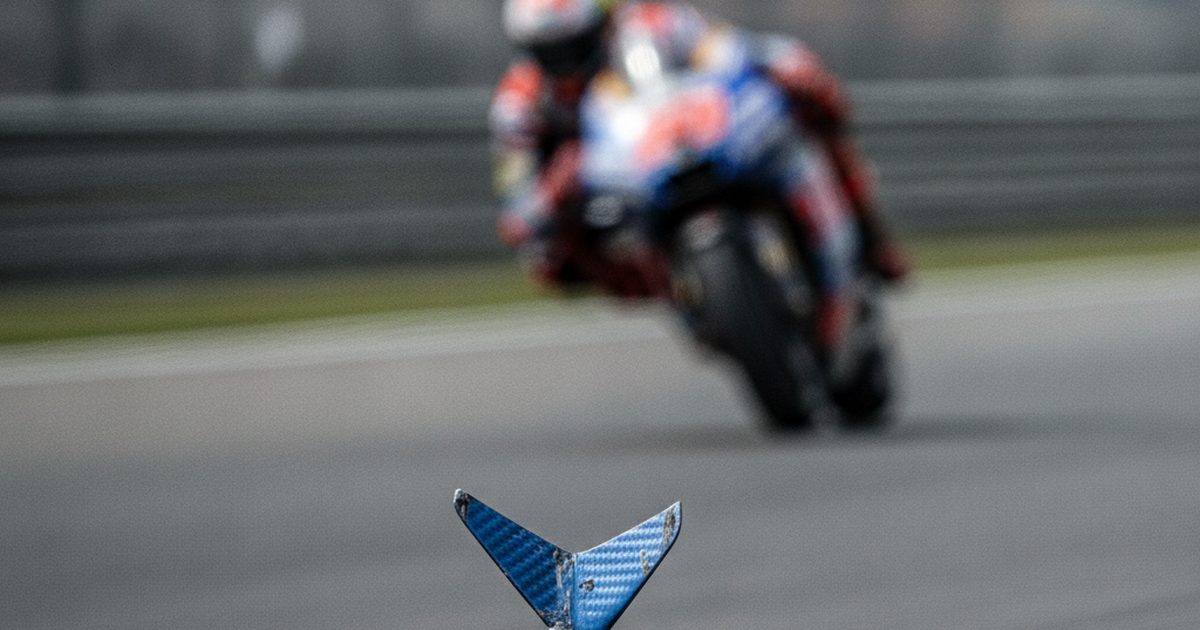
A MotoGP debris rider injury during Sunday’s Austrian Grand Prix has renewed questions about aerodynamic hazards at racing speed. Honda‘s Luca Marini took a direct hit to the chest from a piece of flying carbon-fiber bodywork at the Red Bull Ring. The strike is a reminder that track hazards in motorsport aren’t limited to tire marbles and mechanical parts. Aerodynamic components ride at the same speeds as the machines they’re bolted to, making them a distinct debris risk of their own.
MotoGP Debris Rider Injury Strikes Mid-Race at Turn 4
Marini was battling Fabio Quartararo for position on lap 21 of the Sept. 20-21 race. A blue fragment came off a bike ahead of him on the straight between Turns 3 and 4. Marini believes it was a wing that had detached from Quartararo’s Yamaha M1. “I think it was Quartararo’s wing, because I saw a blue piece that hit me in the braking of Turn 4,” Marini told Motorsport.com afterward. “I saw the wing, I tried to avoid it, but it arrived here [in the chest].”
Marini wasn’t certain how the piece came loose. Still, he said he didn’t know whether Quartararo’s bike had made contact with another rider on the preceding straight. Even so, he rode in pain through the next two corners before refocusing on the race, and he ultimately finished 14th. “I had a lot of pain for those two corners,” he said. “Fortunately everything went well, but it could be much worse.”
A Different Class of MotoGP Debris Risk
Modern MotoGP bodywork is built from lightweight carbon-fiber composites. Riders’ downforce-generating winglets have proliferated across the grid in recent seasons. That aerodynamic push comes with a side effect, though: those same winglets can shed under load. When one separates at racing speed, it becomes a rigid projectile with no engineered trajectory, launching directly into the path of the riders behind it.
By contrast, a tire fragment sheds rubber in a predictable arc and loses energy fast. A detached wing behaves differently — it keeps most of its structural integrity intact. That lets it strike a rider’s body at close to full closing speed, with nothing but leather and armor standing between impact and injury.
FODNews has tracked car-racing debris incidents all season. A detached brake caliper was left sitting on the racing surface at NASCAR’s Gateway race, and barrier debris triggered a triple red flag at Madrid’s F1 debut. Marini’s incident belongs to a related but distinct category, though. Rather than debris scattered across the track for following cars to steer around, a detached winglet becomes an airborne hazard aimed squarely at whoever is drafting closest behind the bike that shed it. Notably, cars racing in that debris field at least have enclosed cockpits and roll structures for partial protection — MotoGP riders have none.
No Formal Response Yet
So far, neither Dorna Sports nor the FIM has issued a statement on the incident. There’s no indication yet of a post-race technical inspection targeting winglet-retention hardware across the grid. Marini was cleared to continue and confirmed afterward that he was fine. Consequently, that likely keeps the incident below the threshold that typically triggers a formal aerodynamics review. Historically, those reviews have followed structural failures at speed, not a component separating without a crash. Whether Sunday’s near-miss changes that calculus for MotoGP’s technical stewards remains to be seen.
Sources: