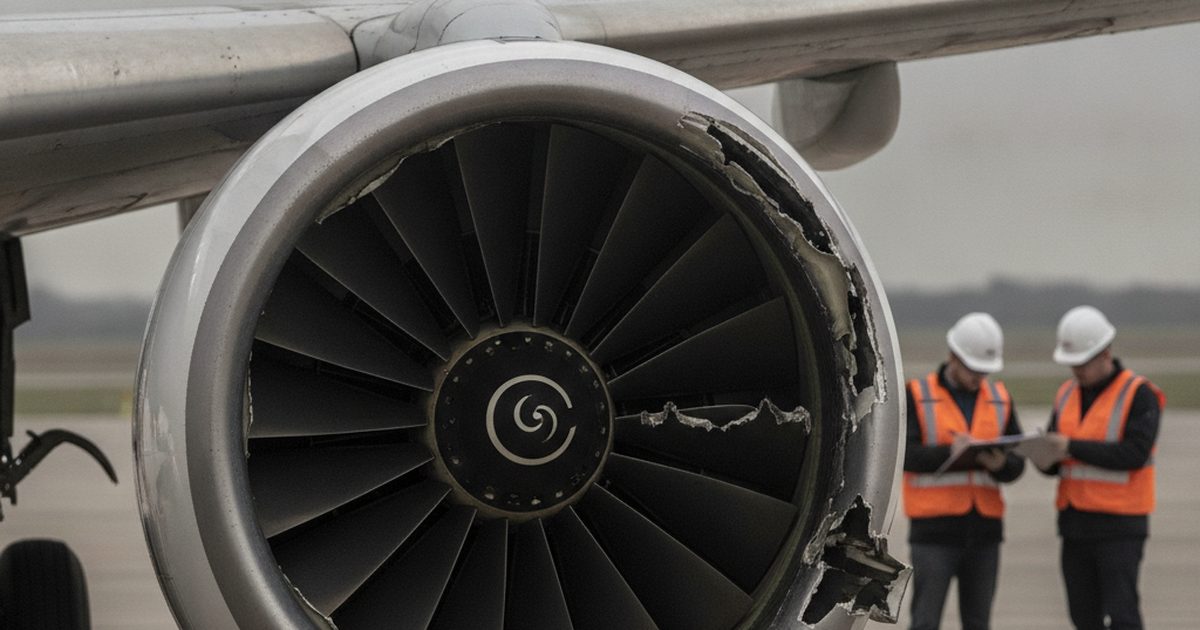
The NTSB-led investigation into last month’s Ryanair engine failure is pointing toward Ryanair engine FOD — foreign object damage — as the likely trigger of the CFM56-7B fan-blade failure. The failure sent engine debris through a cabin window. Ryanair CEO Michael O’Leary disclosed the preliminary finding to analysts on July 20. Investigators believe an external object ingested during the takeoff roll at Thessaloniki initiated the blade separation. O’Leary was careful to caveat the finding: “we can’t say that definitively,” he said. Metallurgical and structural analysis remains pending, expected to conclude in roughly 28 days.
Context: The July 10 Incident
Malta Air Boeing 737-800 registration 9H-QEU departed Thessaloniki on July 10 as Ryanair flight FR1879. Shortly after takeoff, the right-hand CFM56-7B engine suffered an uncontained failure. Fragments pierced the fuselage and shattered a cabin window at row 11. A 61-year-old passenger was partially pulled through the opening before fellow travelers pulled him back. The aircraft returned safely to Thessaloniki. FODNews covered the July 10 incident when it broke; this report covers the new investigative development.
What “FOD as Trigger” Means for Engine Failure
Foreign object damage to a turbofan can initiate a fan-blade failure through a specific chain of events. An ingested object — runway debris, hardware left on the tarmac, or a bird — strikes one or more fan blades at the engine inlet. The impact creates a stress concentration or micro-fracture at the blade root. Under takeoff rotational loads, that fracture can propagate rapidly to full blade separation.
In an uncontained failure, the separated blade exits the engine as a high-velocity projectile. That appears to be what happened over Thessaloniki, with fragments intersecting the fuselage.
The distinction from an internally caused failure matters enormously. Southwest Airlines Flight 1380 in 2018 also involved a CFM56-7B uncontained failure with a shattered cabin window. However, the NTSB traced that event to a low-cycle fatigue crack inside the blade’s dovetail root — not external debris. The resulting safety recommendations targeted blade inspection intervals and non-destructive testing. If FR1879’s investigation confirms FOD, the recommendations will look very different, pointing at runway surface management rather than maintenance protocols.
Liability Follows the Cause
O’Leary’s July 20 framing was deliberate. He noted the engine aboard 9H-QEU had been “fully serviced and overhauled within the last two years.” A verified external-object-damage finding generally limits exposure for the aircraft manufacturer and the engine OEM. Specifically, the failure mechanism would be neither a design defect nor a maintenance oversight.
Consequently, attention shifts to airport operations. Under FAA and ICAO standards, responsibility for keeping departure runway surfaces clear of debris rests with the airport operator. A confirmed FOD origin could significantly narrow Boeing’s and CFM International’s liability exposure. It would also expand scrutiny of FOD prevention practices at Thessaloniki’s Macedonia International Airport. The engine’s clean recent overhaul record reinforces both conclusions.
What Comes Next
O’Leary placed the NTSB draft report approximately 28 days out from his July 20 remarks — mid-to-late August. That document will lay out factual findings. A final report with formal probable cause determination follows months later.
Meanwhile, Greek authorities are running a parallel criminal inquiry with a separate mandate. They are examining potential negligence by the crew, maintenance personnel, or airport operators. The two tracks can reach different conclusions from the same evidence.
If debris analysis confirms the FOD hypothesis, expect scrutiny of three specific questions. First, what object initiated the sequence? Second, what surface conditions existed on the departure runway? Third, did the airport’s FOD inspection program meet ICAO Annex 14 standards?
Subscribe to FODNews for continuing coverage as the NTSB investigation progresses.
Sources
- Reuters — Ryanair CEO says probe suggests foreign object damage in window incident (July 20, 2026)
- Yahoo Finance — Ryanair CEO says probe suggests foreign object damage (July 20, 2026)
- FODNews — Ryanair FR1879: Uncontained CFM56 Failure, Engine Fragment Shatters Window (July 12, 2026)
- NTSB — Southwest Airlines Flight 1380 Final Report (November 2019)
- Aviation Week — O’Leary: Debris May Have Caused Ryanair CFM56 Engine Failure (July 2026)