Starlink-1955 Predicted to Reenter Atmosphere Today as Mega-Constellation Tops 10,000 Satellites
LOS ANGELES — A routine Starlink satellite reentry is expected today as The Aerospace Corporation predicts STARLINK-1955 (NORAD ID 47556) will reenter Earth’s atmosphere at approximately 22:24 UTC on March 21, 2026 — with an uncertainty window of ±10 hours. The Starlink satellite reentry comes as SpaceX’s low Earth orbit constellation crosses a new milestone: 10,000 active satellites.
The satellite launched in February 2021 as part of SpaceX’s 18th dedicated Starlink mission. After roughly five years in service, atmospheric drag steadily lowered its orbit until reentry became inevitable.
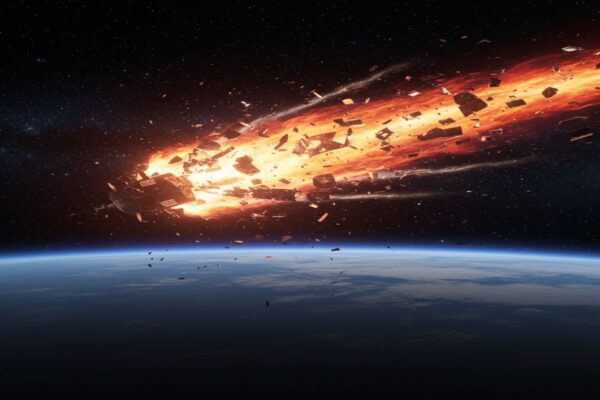
Most of the spacecraft will burn up during descent. However, the sheer scale of annual reentries is prompting growing concern among atmospheric scientists about cumulative effects that may not be visible for years.
A Milestone With a Shadow: The 10,000-Satellite Threshold
SpaceX reached 10,000 active Starlink satellites March 16, 2026, when a Falcon 9 rocket lifted off from California and added 25 more to the constellation. Starlink now accounts for roughly two-thirds of all active satellites in Earth orbit.
That scale requires an enormous operations tempo. Independent estimates put global orbital launches at 259–271 in 2024 and more than 315 in 2025 — driven largely by Starlink and competing broadband constellations. As a result, reentries have accelerated to match: roughly one to two Starlink satellites fall back to Earth every single day.
The ±10-hour uncertainty window around today’s predicted event is typical. Atmospheric density fluctuates with solar activity, making precise reentry timing difficult even for the most sophisticated tracking systems.
Starlink Satellite Reentry at Scale: The Atmospheric Question
Individual Starlink satellites weigh approximately 260 kilograms and vaporize almost completely during reentry — a design SpaceX intended to eliminate ground-level debris risk. Nevertheless, that vaporization process is not without byproduct.
As satellites burn up at high altitude, they release alumina — aluminum oxide particulate — directly into the mesosphere and stratosphere. Researchers estimate that by the 2030s, reentering satellites could inject thousands to tens of thousands of metric tons of alumina and other metals into the middle atmosphere annually.
Alumina is not inert at altitude. Studies indicate it can catalyze the chemical reactions that destroy ozone — the same atmospheric layer protected by the 1987 Montreal Protocol. Modeling published in peer-reviewed journals suggests accumulation of these particles could measurably thin global ozone and delay the recovery the Montreal Protocol set in motion.
The chemical evidence is no longer only theoretical. Research aircraft have sampled exotic metals — aluminum, copper, lithium — embedded in stratospheric aerosol particles at concentrations consistent with satellite reentries. Scientists at the University of Southampton warn that, under high-growth launch scenarios, alumina deposits by 2040 could rival the natural flux of meteoric dust, shifting polar temperatures and stratospheric wind patterns.
In short, what began as a spacecraft disposal solution may be evolving into an unintended atmospheric experiment conducted at planetary scale.
Beyond Ozone: A Widening Set of Concerns
Rocket exhaust compounds the problem. Black carbon soot from hydrocarbon-fueled launch vehicles warms the stratosphere and alters jet stream dynamics. Under high-growth scenarios, independent analyses project stratospheric heating of several degrees Celsius — enough to affect climate and ozone chemistry simultaneously.
Ground-level debris risk from individual Starlink satellites remains low. However, as reentry rates climb, the collective statistical risk rises. Researchers have called for tighter international limits on uncontrolled descents, and the European Space Agency’s ClearSpace-1 mission — planned for 2029 — aims to demonstrate active debris removal for the first time.
Astronomers face a separate but related challenge. Simulations indicate that if Starlink and other mega-constellations reach their projected sizes by decade’s end, a substantial fraction of images from ground-based and space-based observatories will show satellite streaks, complicating scientific data collection. The regulatory backdrop is shifting as well: the FAA recently withdrew a proposed rule that would have required rocket upper stages to deorbit within 25 years, a move critics say undermines long-term debris accountability.
What Comes Next
Researchers and some policymakers are pushing for a circular economy approach to satellite design — extending service lives through refueling, designing hardware for controlled and gentler de-orbits, and selecting materials that minimize atmospheric contamination on reentry. Northrop Grumman’s Mission Extension Vehicles have already demonstrated life-extension docking with aging geostationary satellites, suggesting the technical path exists.
For now, STARLINK-1955 will join the growing daily count of satellites burning up over the Pacific and Atlantic, its passage unremarkable to anyone without a tracking feed. The larger story, however, is accumulating in the stratosphere one satellite at a time.
Subscribe to FODNews for ongoing coverage of space environment and debris issues.
Sources
- The Aerospace Corporation — CORDS Reentry Database: STARLINK-1955 (ID 47556)
- Live Science — Starlink hits 10,000 satellites in orbit (March 17, 2026)
- Modern Sciences — Space launches are changing the chemistry of Earth’s atmosphere (March 2026)
- AGU Publications — Alumina reentry projections through 2040
- Nature — Modelling ozone recovery impacts from satellite reentries (2025)
- EarthSky — 1 to 2 Starlink satellites falling to Earth each day