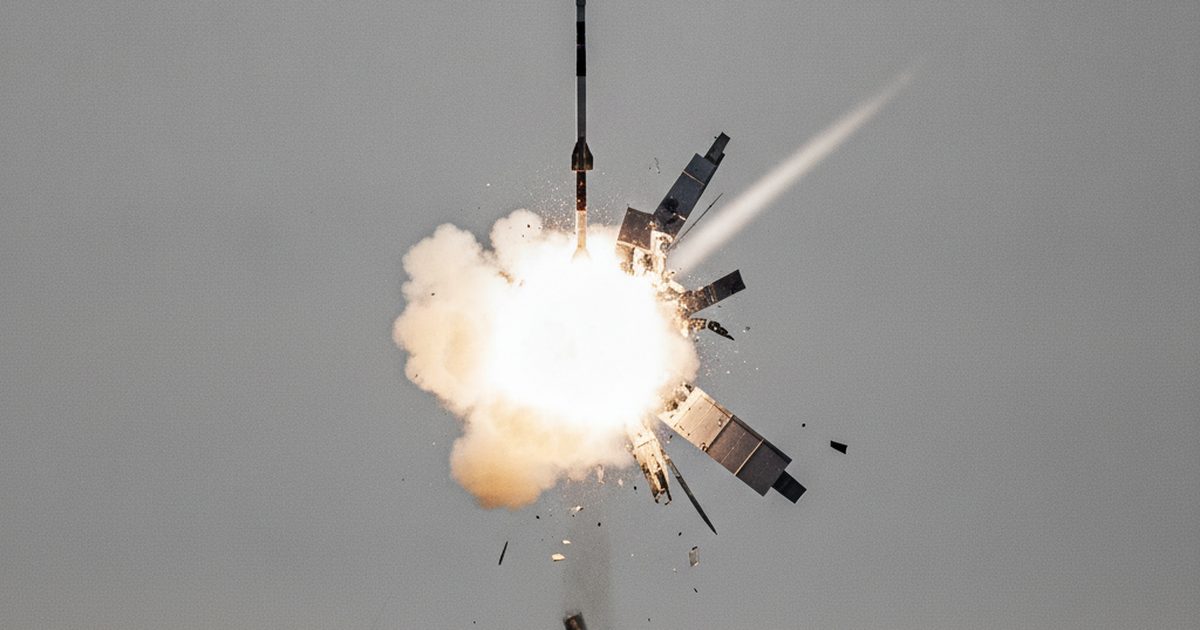
A Taiwan rocket self-destruct ended the country’s first-ever test of a domestically developed satellite launch vehicle on August 19. An early trajectory anomaly triggered the abort moments after liftoff, according to Focus Taiwan. But the debris-containment system worked exactly as designed, keeping all wreckage inside a pre-planned safety zone.
The National Chung-Shan Institute of Science and Technology (NCSIST) launched the uncrewed vehicle. NCSIST is Taiwan’s top state defense and aerospace research body. It flew from the Jiupeng Base, in a sparsely populated part of Pingtung County on Taiwan’s southern coast. Shortly after liftoff, the rocket deviated from its intended flight path, and ground controllers executed a pre-planned abort sequence.
Self-Destruct as Designed, Not as Failure
“Following launch, an early orbital anomaly occurred during flight, so we activated the self-destruct mechanism according to the pre-planned contingency plan,” NCSIST said in a statement. The goal, the institute said, was to control the impact point within the planned safety zone — “with no personnel or property damage.”
The exclusion zone carried a minimum radius of 20 nautical miles (37 kilometers), per the institute’s pre-launch firing notice. Its trajectory ceiling topped out at 100,000 feet (about 30,480 meters). All debris, including engine parts and structural fragments, fell within those boundaries. Local media reported that nearby residents saw the rocket spiral out of control before crashing into a mountainous area. Some were alarmed until NCSIST clarified the vehicle was not a missile.
A Debris-Containment Case Study
Range safety planning — abort sequences, pre-designated debris zones, flight termination systems — exists to convert an uncontrolled failure into a contained one. This test is a clean illustration of that system working. Instead of an unguided rocket falling wherever its trajectory took it, the self-destruct command brought the vehicle down inside boundaries set before the flight ever began.
NCSIST will analyze flight telemetry to determine the root cause and revise the vehicle’s design before the next test. The Pingtung County government has separately called on the institute to suspend further launches. It wants a procedures review and flight-path changes that avoid nearby indigenous and residential areas.
A Separate Program From Taiwan’s Civilian Space Agency
The rocket was a sub-scale prototype for a planned solid-fueled launch vehicle meant to place small payloads into low Earth orbit. It’s a military-run program, distinct from the liquid-fueled orbital launcher under development by the civilian Taiwan Space Agency. That program isn’t expected to fly before the early 2030s. Wednesday’s flight carried no satellite payload. That’s standard practice for a maiden test focused on vehicle performance, not delivering a working spacecraft.
Subscribe to FODNews for daily coverage of FOD incidents and prevention worldwide.