Three months after the LaGuardia runway collision that killed two pilots and injured 41 other people, the key question is no longer simple. Investigators are not looking at one bad call or one missing device. They are looking at a chain. On March 22, 2026, Jazz Aviation Flight 8646 hit an Oshkosh Striker airport fire truck on Runway 4. The NTSB has not issued a probable cause. Still, the crash already shows how five safety layers can fail at once. One fix is now moving: make every airfield vehicle visible to the systems that watch the runway.
The Port Authority of New York and New Jersey says it will add transponders to airfield vehicles at LaGuardia, John F. Kennedy International Airport and Newark Liberty International Airport. Meanwhile, the FAA is using artificial intelligence to look for the same gap at other airports. That is the systems lesson three months later. The runway is not just pavement. It is a data network, and that network failed.
LaGuardia Runway Collision Exposed Five Safety Gaps
Safety teams often use the “Swiss cheese model” to explain crashes. Each layer of defense has holes. A bad outcome happens when the holes line up. At LaGuardia, the early record points to five holes in one short window.
Our earlier coverage of the NTSB preliminary report on the LaGuardia fire truck and ASDE-X failure traced the event. An airport rescue and firefighting convoy went to help a United Airlines Boeing 737 MAX 8. The crew had reported a cabin odor after two aborted takeoffs. At about 11:37 p.m., a controller cleared the fire truck to cross Runway 4. At the same time, the controller cleared the CRJ-900 to land. The clearances went out on separate radio channels. Therefore, neither crew heard the other one.
The controller saw the conflict and sent an urgent stop command. However, the truck’s turret operator did not first know the call was meant for his vehicle. By the time the warning made sense, the jet was already in the flare.
The Truck the System Could Not See
The simplest gap was also the most serious. The Oshkosh Striker had no transponder. The FAA says Airport Surface Detection Equipment, Model X, or ASDE-X, combines several data sources to track aircraft and vehicles on the movement area. Without a transponder, the truck did not appear as it should have. It was on the runway, but it was not in the full digital picture.
As a result, ASDE-X gave no alert before impact. The warning tool built for this kind of conflict lacked the data it needed.
The Lights Left Almost No Margin
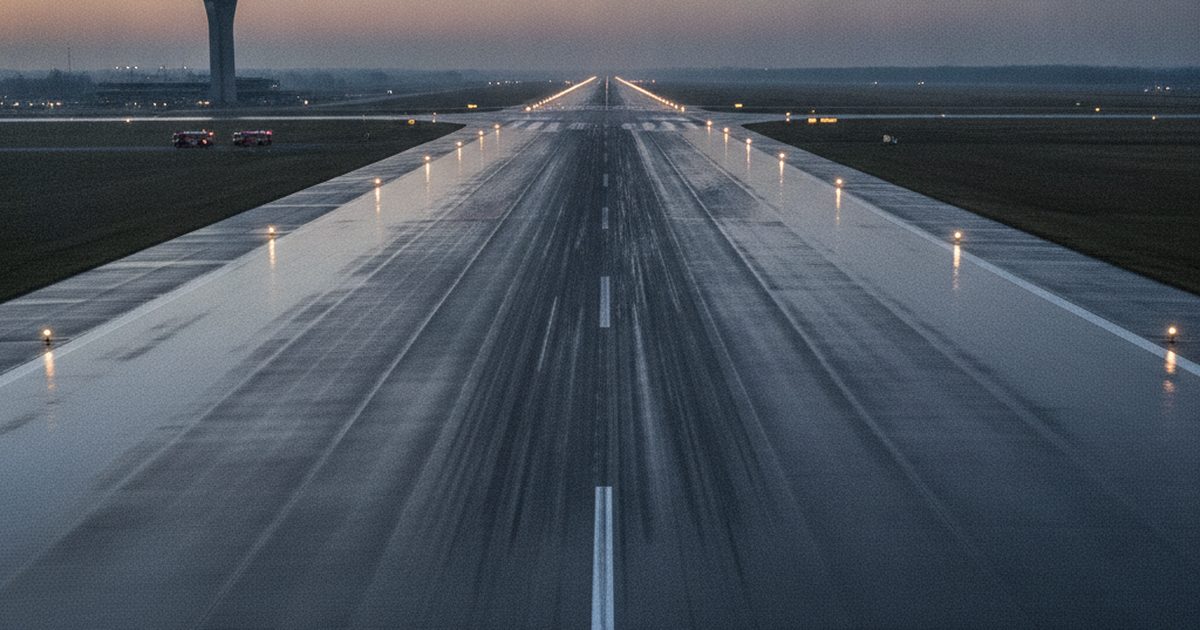
Runway entrance lights formed another layer. These red in-pavement lights warn drivers when a runway is unsafe to enter. Reports say the lights changed only about three seconds before impact. That timing may fit normal traffic flow. In this case, it left almost no room after radio contact had failed.
The Tower Was Below Its Target
LaGuardia’s tower had 33 controllers on duty that night. Its target was 37. The NTSB has not said staffing caused the crash. Still, the shortfall matters. Controllers were handling a night emergency convoy, an arriving regional jet and at least one separate event.
Weather also cut the margin. Visibility was about four miles, with mist and light rain. A dark fire truck on a wet runway would have been hard to see from the cockpit.
The Backup Layers Failed in Sequence
Each safety layer existed to catch a miss by another layer. ASDE-X should help flag a runway conflict. Runway entrance lights should warn a vehicle crew. A radio stop call should halt a crossing. Finally, the flight crew’s visual scan is the last line of defense.
Any one of those layers could have broken the chain. None did.
Port Authority Chief Communications Officer James Allen said after the crash that the ARFF vehicle “was operating in direct communication with, and under the direction of, air traffic control.” He also said the FAA reported ASDE-X “did not alert the tower in this case.” Those two points matter together. The truck had human clearance. Yet the machine layer did not warn the tower.
The NTSB has stressed a key limit. Its preliminary report lists facts. It does not assign blame or probable cause. The active case, NTSB investigation DCA26MA161, will take more time. Major crash reports often take 12 to 24 months.
The First Fix: Transponders on Airfield Vehicles
The first clear response came from the Port Authority. After the April 2026 preliminary report, the agency said it would add transponders to ARFF vehicles and other airfield gear at its three major airports.
The logic is direct. ASDE-X can warn controllers only about targets it can see. If a truck is not visible to the system, the system cannot warn the tower. Therefore, vehicle transponders restore a key automated layer.
This change will not solve every risk. It will not stop a controller from issuing two conflicting clearances. It will not fix a missed radio call. However, it does close the blind spot that made the LaGuardia fire truck hard for ASDE-X to track.
The FAA has urged other airports to review the same issue. It has also said federal grants can help pay for vehicle transponders. For now, that is guidance, not a nationwide rule. The final NTSB report could change that debate.
The agency is also funding wider runway-safety work. Reported plans include nearly $4 million in fiscal 2027 funds and equipment upgrades at 74 airports by the end of 2026.
AI Is Looking for the Same Blind Spot
The FAA is also using data to find risk before it appears in another crash report.
The agency is deploying Palantir’s Foundry platform across airport operations. Foundry can pull together incident reports, surface surveillance feeds, NTSB files, vehicle-tracking records and equipment lists. Then it can flag airports with similar risk patterns. One pattern is simple: ground vehicles that may not carry transponders.
The platform is not a live collision-avoidance tool. FAA officials have said it would not have stopped the March 22 crash. That event depended on fast, simultaneous failures. Instead, Foundry looks for patterns that build over time. Those patterns can include runway incursions, near misses and weak vehicle tracking.
After LaGuardia, the FAA used Foundry to find other airports where airfield vehicles lack transponders. The goal is prevention by inventory. Find the same blind spot before another aircraft reaches it. Reports say the agency has put high-traffic airports, including Chicago O’Hare and Reagan National, higher on the upgrade list based partly on AI risk reviews.
Foundry has already shaped a separate safety move. In April 2026, the FAA banned parallel landings at San Francisco International Airport after the platform flagged a cluster of TCAS alerts tied to parallel approaches. That choice reduced capacity to lower collision risk. It also shows how data can push action before a crash.
Drones Are Part of the Debate, Not the Main Fix
LaGuardia has also pushed a wider debate about drones in airport surface safety. The debate began before March 22. Since then, it has gained force.
Metro Airport News reported in May 2026 that the FAA is studying controlled drone use for several jobs. Those jobs include ARFF scene awareness, crash-scene records, perimeter checks and pavement inspections. FAA airport technology teams have tested drones at several airports. They tested pavement inspection work at five sites from 2020 to 2022.
The agency’s view has stayed steady. Drones can support airport safety. They cannot replace normal inspections or core operating controls. A drone over an active runway at night could add risk. So any approved drone work needs tight control, clear approval and a strong safety case.
For FOD detection and runway checks, fixed sensors may move faster. These include AI cameras on light poles, thermal imaging for poor weather and vehicle-tracking systems that stay on the ground. They are less dramatic than drones. However, they fit more easily into current airport systems.
The larger lesson is still the same. Runway safety is a systems problem. The question is not which single tool would have stopped the crash. Instead, the question is how better data can give controllers, crews and drivers more time when something starts to go wrong.
What Comes Next
The NTSB’s final report on Flight 8646 will likely focus on the missing transponder, the conflicting clearances and the radio breakdown. Possible responses could include mandatory transponders on ARFF vehicles. They could also include stronger rules for split radio channels or staffing guidance for airports with ASDE-X. Any rule will depend on the final findings and the FAA’s response.
Three months later, one point is clear. A gap that should not exist at a major airport did exist. LaGuardia had ASDE-X to help prevent runway conflicts. Yet one truck did not provide the data the system needed.
That is the core failure in this analysis. It was not a broken machine. It was an assumption. Everyone assumed that each vehicle on an active movement area would be visible to the tools built to see it.
One major airport authority has stopped making that assumption. Whether the rest of the industry follows before the final NTSB report, or after it, will show how aviation learns from its worst nights.
Stay informed — subscribe to FODNews for daily coverage of FOD incidents and prevention worldwide.
Sources
- National Transportation Safety Board — Investigation DCA26MA161 (LaGuardia, March 22, 2026)
- JOIFF — NTSB Issues Preliminary Report on Deadly LaGuardia Runway Collision
- Metro Airport News — Runway Safety in the Drone Age
- InjuryReportUSA — Air Canada Flight 8646 LaGuardia Crash: Injuries, Lawsuits, and Liability Analysis
- Federal Aviation Administration — Airport Surface Detection Equipment, Model X (ASDE-X)
- Federal Aviation Administration — Runway Status Lights
- Politico — FAA Uses AI to Identify Aviation Close Calls (June 2026)
- Syracuse.com — Transponders to Be Installed on NY Airport Ground Vehicles After Deadly Collision
- FODNews — NTSB: LaGuardia Fire Truck Had No Transponder; ASDE-X Failed to Alert (Prior Coverage)