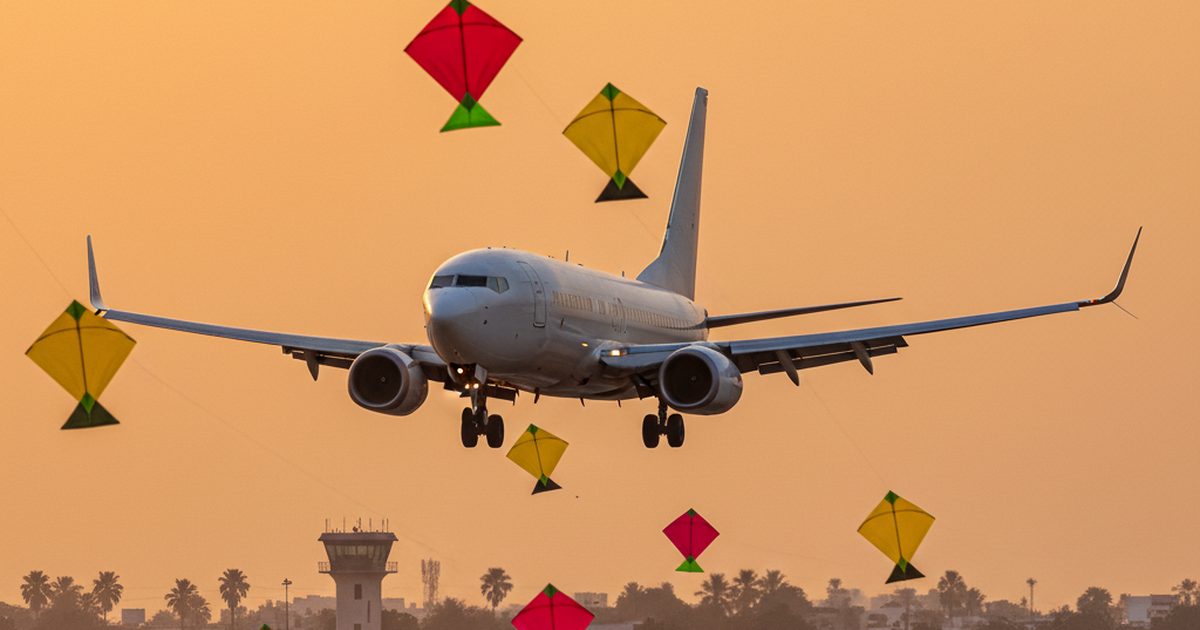
A Boeing 737-800 was about 150ft above the ground on approach to runway 05 at Ahmedabad. The crew spotted three kites off the left side of the aircraft. One sat 10 to 20m away — closer than the wing is long. Maintenance later peeled a length of kite line off the leading edge. It is one of two Ahmedabad kite incidents disclosed in early May by Czech investigators.
Both events happened at Sardar Vallabhbhai Patel International Airport (VAAH/AMD) in the first quarter, almost certainly during Gujarat’s Uttarayan kite festival on 14–15 January. The Czech Air Accident Investigation Institute (UZPLN) posted the reports in early May, first covered by FlightGlobal on 6 May. UZPLN did not name the airframes, but 737-800 operator Smartwings has a long-standing wet-lease partnership with India’s SpiceJet.
What the Czech investigators reported
Both occurrences share the same shape: a 737-800 on visual approach to runway 05, kites and lines reaching the aircraft during the most vulnerable phase of flight — low altitude, low energy, gear and flaps extended. In the first event, a kite sat as close as 10–20m at 150ft AGL, and maintenance found line wrapped around the leading edge of the left wing. In the second, the crew saw “a large number” of kites near the runway, then stopped repeatedly during taxi to report kites and strings on the taxiway. On arrival, maintenance unwound a kite from the wing and recovered line remnants from the leading edge.
Neither event caused injuries or hull damage. Both required maintenance attention before further flight. Both put physical objects in direct contact with a 737’s leading-edge devices, slats, pitot probes, and angle-of-attack vanes.
This isn’t ordinary kite string
The headline is the kite. The hazard is the line.
The traditional Indian kite-fighting string at Uttarayan is manja — cotton or synthetic thread coated with a paste of powdered glass, aluminum oxide, or zirconia alumina. It is engineered to cut. Kite fliers use it to sever rivals’ lines mid-air. It also routinely cuts motorcyclists, pedestrians, and birds. India’s National Green Tribunal banned the synthetic “China manja” version in 2017; enforcement is patchy. Manja dominates Gujarat skies during Uttarayan.
UZPLN does not specify whether the recovered guidelines were manja, but any line strong enough to wrap a 737 leading edge can also abrade composite, paint, sensor housings, and probe heads. The maintenance question shifts from “remove debris” to “inspect for wear” — a category most airline ops manuals don’t have a checklist for.
A FOD category the playbook doesn’t cover
Airport FOD programs handle two threat classes well: wildlife under ICAO Annex 14, and pavement debris through FOD walks, sweeps, and detection systems. FAA AC 150/5210-24 defines FOD broadly enough to include kites in principle. In practice, the architecture for human-launched aerial objects looks nothing like the architecture for birds.
- Outside the fence is outside the program. Kite fliers operate on rooftops beyond airport property. Wildlife teams don’t patrol there.
- No detection layer. Nothing in the standard airfield kit catches an airborne kite at 150ft beyond visual reports from ATC and crews.
- Birds don’t have a calendar. Kites do. Uttarayan falls on the same two days every January. The risk was known, issued as a NOTAM, and the hazard arrived anyway.
What comes next
UZPLN’s disclosure pushes kite incursions into the same investigative grammar as a runway incursion or wildlife strike — the kind regulators and operators actually act on. The substantive levers sit with India’s DGCA and Gujarat state authorities. Operators flying into Ahmedabad during the festival window have practical options that don’t require regulatory reform: heightened crew briefings, post-flight leading-edge and probe inspections targeting string entanglement, and schedule adjustments around 14–15 January where commercially viable.
The broader lesson is categorical. A fire truck with its transponder off. A tire fragment spotted by a passenger. A glass-coated kite string at 150ft, arriving two weeks after the NOTAM that predicted it. The common thread: an object in a category nobody’s program was built to catch.
Sources
- FlightGlobal: Kites interfered with arriving 737s at Ahmedabad: investigators (David Kaminski-Morrow, 6 May 2026)
- UZPLN — Air Accidents Investigation Institute, Czech Republic
- FAA — Advisory Circular 150/5210-24, Airport Foreign Object Debris (FOD) Management
- Wikipedia — International Kite Festival in Gujarat – Uttarayan
- Wikipedia — Manja (string)
Stay on top of FOD safety news. Subscribe to FODNews for original incident reporting and analysis on aviation, military, and motorsport FOD.