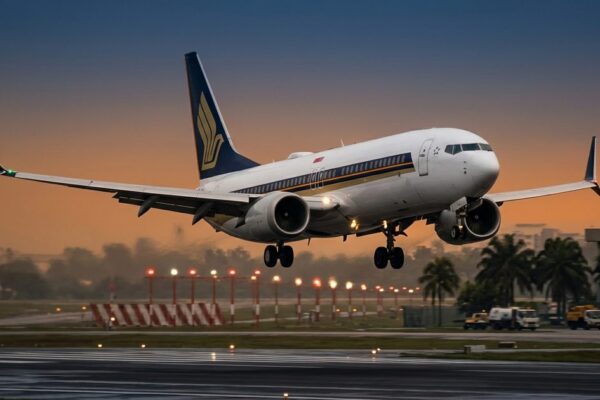
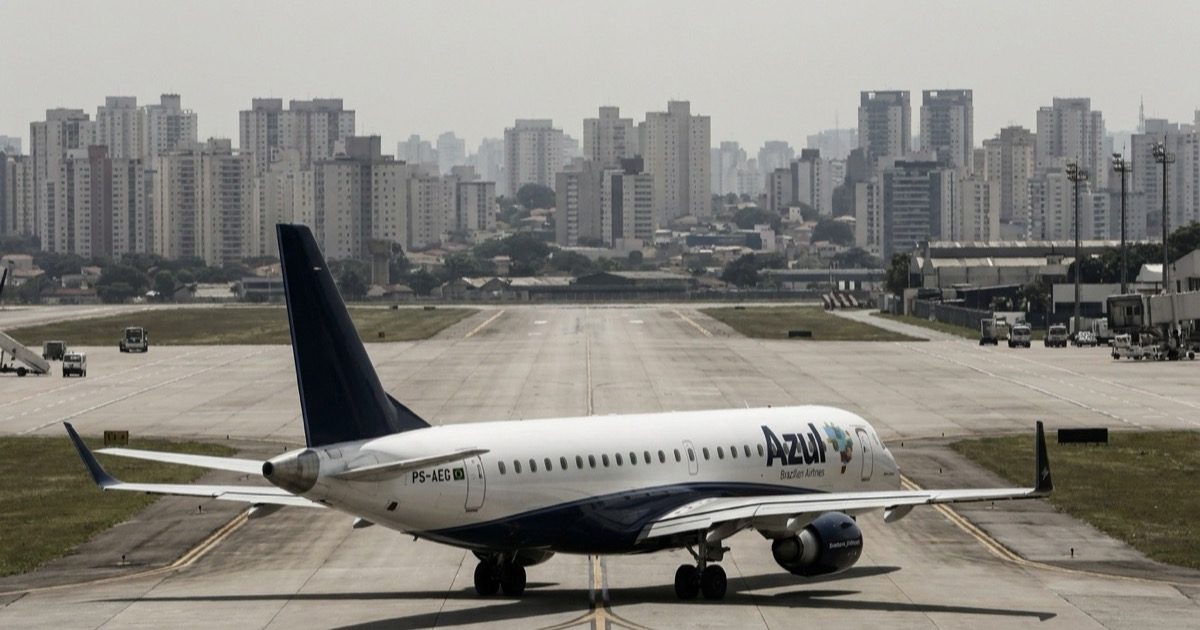
SÃO PAULO — Brazilian air-accident investigators are examining a Congonhas near-collision involving an Azul Linhas Aéreas Embraer E195-E2 and a Gol Boeing 737-800. The two jets came within 400 feet of each other over downtown São Paulo last week. The encounter has reignited debate over congestion at the country’s most constrained major airport.
The Centro de Investigação e Prevenção de Acidentes Aeronáuticos, known as CENIPA, has opened an inquiry into the April 30 incident at Congonhas Airport (SBSP). Brazil’s air-accident agency confirmed the probe.
According to a detailed account published by The Aviation Herald, Azul flight AD-6408 was cleared for takeoff from runway 17R but waited roughly 50 seconds before beginning its takeoff roll. The Embraer E195-E2, registered PS-ADE, was bound for Belo Horizonte. By the time the regional jet started moving, Gol flight G3-1629 was already on short final to the same runway. The 737-800, registered PR-GXN, was inbound from Salvador.
The control tower instructed the Embraer to abort and ordered the Boeing to go around. The 737 crew began the missed approach. The E195-E2 continued its takeoff roll. A second stop instruction from the tower drew no response — the Embraer had already left the tower frequency.
The controller then directed the Gol crew to turn right to break the conflict. The 737-800 reported a Traffic Collision Avoidance System resolution advisory as the two aircraft converged.
Inside the Congonhas near-collision: how close they came
Automatic Dependent Surveillance–Broadcast data transmitted by both jets show how tight the gap became.
At 14:33:57 UTC, vertical separation had collapsed to 400 feet with 0.27 nautical miles between the aircraft. Nine seconds later, separation was 200 feet vertical and 0.18 nautical miles, with the trajectories already diverging. By 14:34:12 UTC, the jets were 200 feet apart vertically and 0.14 nautical miles laterally, but pulling away from each other.
Standard separation minima for departing and arriving traffic on the same runway are measured in thousands of feet, not hundreds. The figures place the encounter well inside any safe margin.
The Gol 737-800 repositioned for another approach and landed safely about 15 minutes later. The Azul Embraer continued to Belo Horizonte without further incident.
A single-runway pressure cooker
Congonhas, wedged into a residential district six miles south of central São Paulo, operates a single 6,365-foot runway, 17R/35L. It handles more than 22 million passengers a year and is the busiest domestic airport in Brazil. The airport carries a long memory of risk. In July 2007, a TAM Airbus A320 overran the same runway in heavy rain, killing 199 people in what remains Latin America’s deadliest aviation accident.
Capacity at Congonhas has been a chronic concern for regulators and operators alike. Brazil’s civil aviation authority, ANAC, sets slot allocations. Air traffic services come from the air force–run Departamento de Controle do Espaço Aéreo, or DECEA, with mixed military and civilian controllers.
The April 30 sequence is likely to draw scrutiny on three fronts. Why did the Embraer wait nearly a minute after a takeoff clearance before rolling? Why did it not respond to two stop instructions? And how did a frequency change occur during the takeoff sequence? CENIPA investigators will also examine whether tower spacing of the arriving 737-800 left an adequate buffer if the departing flight was slow off the mark.
Pattern of close calls
The incident lands amid a string of unrelated but high-profile aviation safety events that have kept regulators and the public attentive to runway and approach risk. On May 3, a United Airlines Boeing 767-400ER struck a New Jersey Turnpike light pole and a bakery delivery truck while on a low circling approach to Newark Liberty’s runway 29, crossing Interstate 95 roughly 720 feet before the threshold. Earlier this year, a 737 MAX suffered a bird strike at Laredo that filled its cabin with smoke and prompted a delayed FAA mitigation timeline. The Congonhas event differs in kind — a runway incursion between two airliners under positive ATC control — but it lands in the same news cycle.
The Embraer E195-E2 is the second-generation E-Jet, powered by Pratt & Whitney PW1900G geared turbofans. It entered Azul’s fleet to replace older E195s. The Boeing 737-800 is the workhorse of Gol’s domestic network.
Neither airline had issued a public statement on the investigation as of Monday. CENIPA inquiries in Brazil typically produce a preliminary report within 30 days and a final report that can take a year or more.
Subscribe to FODNews for ongoing coverage of this investigation and other airport-safety incidents.
Sources
- The Aviation Herald — “Incident: Azul E295 and Gol B738 at Sao Paulo on Apr 30th 2026, near collision between takeoff and go around”
- Ground observer footage with ATC audio (Golf Romeo Oscar, via YouTube)
- Departamento de Controle do Espaço Aéreo (DECEA)
- Congonhas Airport — operational and historical background