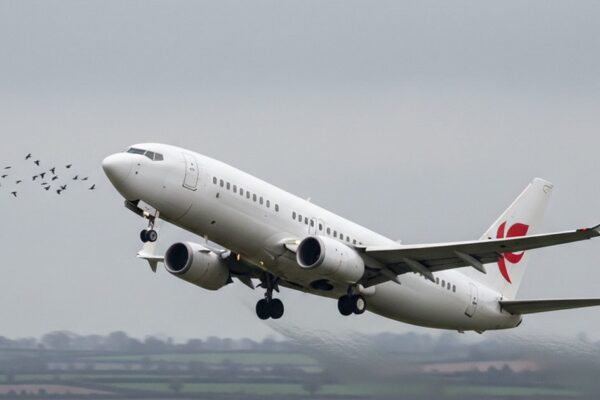

A bird strike is supposed to be an engine problem. In at least two documented cases aboard Southwest Airlines Boeing 737 MAX 8 jets, it became something else: an oil-filled cloud pushed directly into the passenger cabin.
On April 21, 2026, the U.S. Department of Transportation’s Office of Inspector General released audit AV2026026, examining how the Federal Aviation Administration responded to those incidents. Its conclusion: the FAA followed its own rules. But those rules left dangerous gaps — and full corrective action won’t reach the entire affected fleet until mid-2028.
The Chain Reaction Nobody Planned For
The LEAP-1B engine powering the 737 MAX 8 includes a Load Reduction Device, or LRD. The safety mechanism activates when the engine sustains severe damage — such as a bird strike.
When the LRD trips, it can inject more than a quart of engine oil into the aircraft’s environmental control system. That system feeds air to the cockpit and cabin. The result: oil mist, smoke, and irritating fumes spreading through the aircraft at the worst possible moment — typically just after takeoff.
Two flights in 2023 traced exactly that sequence:
- Southwest Flight WN3923, March 5, 2023 — Departed Havana bound for Fort Lauderdale. A bird strike on takeoff damaged the engine, triggered LRD activation, and forced the crew to return. There were 147 passengers and six crew aboard.
- Southwest Flight WN554, December 20, 2023 — Departed New Orleans for Tampa. A bird strike into the left engine triggered the same sequence. The aircraft returned to New Orleans with 133 passengers and six crew aboard.
Both flights landed safely. No serious injuries were reported. But the OIG’s auditors found the incident chain exposed structural weaknesses in how the FAA monitors, trains for, and simulates this specific failure mode.
What the Audit Found
The OIG’s review centered on the FAA’s Corrective Action Review Board (CARB), which convened on November 26, 2024. The board reached consensus on a path forward: direct Boeing to develop a software update for the LEAP-1B’s LRD. Once certified, the FAA would issue an Airworthiness Directive requiring its installation fleet-wide.
That process is underway. It is also slow.
The software fix won’t reach the estimated 612 U.S.-registered Boeing 737 MAX 8 and MAX 9 aircraft until mid-2028. That timeline also covers roughly 197 Airbus A320neo and A321neo jets powered by LEAP-1B variants. Together, that’s nearly five years after the first incident.
The audit also flagged three additional concerns the CARB did not fully resolve:
- Fleet monitoring gaps. The FAA lacks a formal mechanism to track whether the software update rolls out on schedule. If Boeing or the FAA slip the timeline, affected operators may not be notified proactively.
- Uneven pilot awareness. Newly hired flight crews are not consistently being informed of the risks associated with LRD activation. The OIG found training programs vary across carriers.
- Simulator limitations. Current 737 MAX full flight simulators can simulate engine vibration but cannot replicate LRD activation directly, and do not model smoke or fumes in the flight deck. Crews training on these simulators have no realistic exposure to the scenario.
Four Recommendations, All Accepted
The OIG issued four recommendations — all accepted by the FAA: proactively notify operators if the software timeline slips; extend outreach to LEAP-1B operators not already covered by NTSB recommendations (AIR-25-03); verify that air carrier training programs inform newly hired crews of LRD risks; and issue guidance on simulating limited cockpit visibility in crew training scenarios.
Acceptance, however, isn’t implementation. The OIG’s authority ends at the recommendation stage; follow-through is the FAA’s responsibility.
Secondary FOD, Primary Consequences
Bird strikes are one of the most common forms of foreign object debris in aviation. They are rarely thought of as cabin emergencies. This audit makes the case that they can be — specifically when engine architecture channels the aftermath of a strike into the aircraft’s air supply.
The incidents reviewed here didn’t produce a crash. But they produced a scenario in which crews managed reduced visibility, increased workload, and potential crew and passenger exposure during a critical flight phase. All of it downstream of a bird hitting a fan blade.
As pilots have noted in their own surveys of bird strike frequency near major airports, these events are not edge cases. The audit raises a question: are the downstream systems — in this instance, an LRD pushing oil into an ECS — fully accounted for in training, oversight, and fleet-wide readiness?
For the roughly 800 LEAP-1B-equipped aircraft currently flying in the U.S., the answer, for now, is: not yet.
Subscribe to FODNews for continuing coverage of FOD incidents, safety audits, and prevention standards worldwide.
Sources
- DOT OIG Audit AV2026026 — FAA Followed Its Policy When Responding to Fume Events in Boeing 737 MAX 8 Aircraft, But Further Assessment Is Warranted (April 21, 2026)
- Simple Flying — US Watchdog Slams FAA Inaction On Boeing 737 MAX Cabin Smoke Risk (April 25, 2026)
- FlightGlobal — DOT Inspector Raises Concern About FAA’s Response to LEAP Engine Smoke Incidents