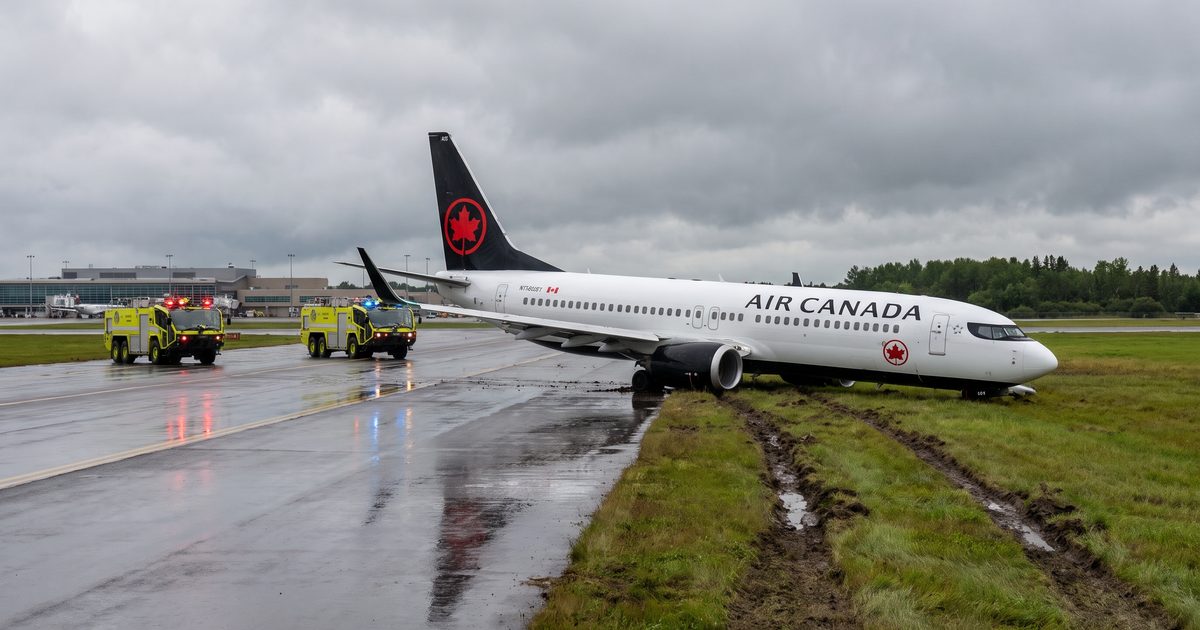
MONTREAL — The Transportation Safety Board of Canada is still investigating a July 9 runway excursion in Montreal, in which an Air Canada jet ended up in the grass and its left engine ingested objects.
As of late October, the agency had not released a report. Its investigation page was last updated July 30, and the TSB has not said what caused the excursion.
No injuries were reported among the 155 passengers and six crew members the TSB says were aboard. Air Canada put the count at 156 passengers and six crew, according to CBC News and the Montreal Gazette.
What the TSB says happened in the Air Canada Montreal excursion
The aircraft was a Boeing 737 MAX, registration C-GEOJ. The TSB said it was on an instrument flight rules flight from Los Angeles International Airport to Montréal-Trudeau International Airport.
According to the TSB, the jet landed on Runway 06L, which was wet. It was still slowing down when the pilot turned right onto high-speed exit taxiway B3. The aircraft ended up in the grass and came to rest about 100 feet south of taxiway B, about 800 feet from the edge of the runway.
“Damage to the aircraft was limited to the left engine, which had ingested objects,” the TSB said. The agency has not identified the objects.
In an email statement to CBC News, Air Canada said Flight AC774 arrived from Los Angeles around 4 p.m. local time. The airline said the plane landed normally but “sustained a runway excursion and travelled through the grass when exiting the main runway.” Air Canada told the Gazette that the flight had a “taxiway excursion” after it exited the runway.
Three hours on board as the runway stayed closed
Passenger Barbara Edelston Peterson told CBC News it was pouring rain. “We were going very fast and suddenly there was a big smoke smell and the next thing I knew, we were tumbling on the grass,” she said.
“There was smoke, dirt and grass right at my window so I couldn’t see outside,” she added. In a video she posted on Facebook, she said she was amazed the plane didn’t strike a red and white checkered box on the grass nearby, the Gazette reported.
Passengers spent about three hours on the plane. They then left by staircase and were bused to the terminal, and Air Canada confirmed by 7:45 p.m. that everyone had disembarked. Edelston Peterson called the crew a “class act.”
The runway, one of the airport’s two, was closed for almost six hours and reopened around 9:45 p.m., the Gazette reported. An airport spokesperson said delays ran about 30 minutes for domestic and international flights and 45 minutes to an hour for U.S. flights.
NAV CANADA told CBC News it put in place a temporary ground stop and then flow restrictions “to safely manage arrivals and departures.” It said the weather was “also contributing to operational complexity and delays.”
What investigators have done since
The TSB sent a team of investigators on July 9. “We are deploying investigators to the scene to gather information and assess the accident,” a TSB spokesperson told CBC News.
The TSB laboratory has since pulled data from the flight data recorder and cockpit voice recorders. In the days after the excursion, investigators went back to the site to measure the aircraft’s path precisely, look at marks left on the runway and measure the runway surface texture for wheel grip calculations.
The TSB has classified the case as a class 3 investigation. That type of investigation examines a small number of safety issues and may lead to recommendations, and it is generally completed within 450 days.
“Air Canada is undertaking a detailed investigation into this incident, and will work with relevant authorities to determine the cause,” the airline told the Gazette. Air Canada said it would tow the plane to a hangar for a “full inspection.”
Why an excursion onto grass is a foreign object debris event
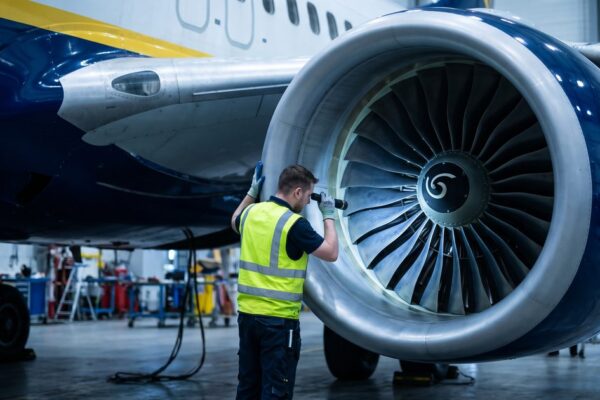
An aircraft that leaves the pavement puts its low-slung engines close to soil, turf, stones and airfield fixtures. That makes an excursion onto grass a foreign object debris event as well as a runway safety event.
In this case, the TSB has said only that the left engine “had ingested objects.” It has not said what those objects were or how much damage they caused beyond that statement.
Earlier incidents include an air ambulance jet whose tire burst at 130 knots in Las Vegas, sending it off the runway and scattering debris. Engine ingestion has also driven new inspection requirements, such as the Air Force’s new post-FOD engine inspection rule after a Thunderbirds F-16 loss.
Subscribe to FODNews for continuing coverage of FOD incidents and prevention worldwide.
Sources
- Transportation Safety Board of Canada — “Air transportation safety investigation A26Q0096” (July 9, 2026)
- CBC News — “Air Canada plane veers off runway at Montreal airport after landing, no injuries” (July 9, 2026)
- Montreal Gazette — “Update: TSB to investigate why Air Canada 737 veered off taxiway at Trudeau airport” (July 9, 2026)