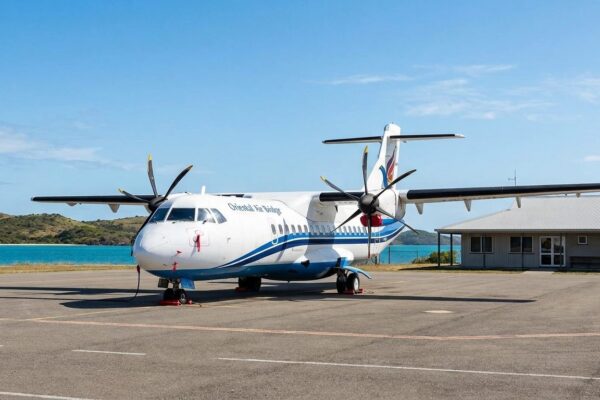

CHENNAI, India — A bird strike during final approach to Chennai International Airport ripped roughly 18 inches from the nose radome of a British Airways Boeing 787-8 Dreamliner in the early hours of July 13, 2026, exposing the aircraft’s weather radar antenna and forcing cancellation of the scheduled return flight to London.
All 226 inbound passengers disembarked safely, but 226 outbound travelers were stranded after engineers determined the required radome spare part was not available on site.
What the British Airways Bird Strike Tore Away
The impact occurred at approximately 3:30 a.m. local time as flight BA35 — British Airways’ daily London Heathrow–Chennai service — was on final approach, according to officials from the Airports Authority of India (AAI).
The strike tore away roughly 18 inches of the radome — the composite nose cone beneath the cockpit that shields both navigation instruments and the aircraft’s weather radar from the elements. The structural breach left the radar antenna exposed.
Despite the damage, the Boeing 787-8 landed safely. Passengers disembarked without incident, and the aircraft was towed to a remote apron for a detailed damage assessment.
Spare Part Shortage Grounds Jet, Cancels Return Flight
Engineers examined whether temporary repairs could return the aircraft to service for its 5:30 a.m. departure back to London. That option was ruled out when the airline confirmed the required radome replacement part was not immediately available at Chennai.
“One of the spares had to be changed but it wasn’t immediately available,” an AAI official told The Hindu. “Hence the flight from Chennai to London, which had to depart at 5:30 a.m. was cancelled.”
British Airways confirmed both the incident and the cancellation, adding that it had notified the Director General of Civil Aviation (DGCA) as required under Indian aviation regulations. The airline said affected passengers were accommodated at hotels, rebooked on subsequent services, or rerouted via other cities.
The 787-8 remained grounded at Chennai pending the arrival of replacement parts and completion of a full airworthiness inspection.
Chennai Airport’s Escalating Bird Hazard Problem
The incident is the latest in a string of serious bird-strike events at Chennai, an airport that aviation safety watchers have flagged for persistent wildlife hazard concerns. Earlier this year, an AirAsia aircraft sustained engine damage in a bird strike at the same airport, raising questions about how effectively the airfield is managing its wildlife risk.
In the BA35 case, airport officials pointed to elevated bird activity near the Guindy area — particularly around the Race Course, where excavation work for a proposed Eco Park is suspected of disturbing local bird populations and drawing them toward the airport’s approach corridors. The precise cause of the July 13 strike has not been officially confirmed by wildlife management authorities.
Chennai already deploys acoustic deterrents including “thunder booms” on the airfield to disperse birds from runways, but strikes on approach — outside the airport perimeter — are significantly harder to manage with ground-based methods.
Radome Damage: A Recognizable FOD Pattern
Radome strikes are among the more structurally dramatic outcomes of a bird-as-FOD event. The radome is a lightweight composite cone that shields the weather radar while minimizing electromagnetic interference — making it effective but comparatively fragile under high-energy impacts.
A near-identical damage pattern was documented in a separate incident in which a China Southern Airbus A330 suffered a major radome tear after a bird strike, illustrating that this failure mode is not unique to any single aircraft type or region.
In both cases, the aircraft landed safely, but the post-strike grounding, parts shortage, and cascading schedule disruption followed the same operational playbook.
India’s Broader Bird Strike Crisis
India logged 1,782 bird strike incidents in 2025, according to DGCA data — a figure advocates say understates the true hazard due to inconsistent reporting. The British Airways incident adds urgency to calls for AAI to conduct a comprehensive wildlife hazard assessment around Chennai’s approach paths, particularly given ongoing construction in adjacent corridors.
The DGCA investigation into the July 13 strike remains open. British Airways has not issued a statement beyond confirming the incident and passenger arrangements.
FODNews will continue monitoring for DGCA findings and any airline safety actions at Chennai. Subscribe to the FODNews briefing for incident updates.
Sources
- New Indian Express — Bird strike before landing at Chennai damages British Airways flight’s nose cone; return service cancelled (July 13, 2026)
- The Hindu — British Airways flight suffers bird hit just before landing in Chennai (July 14, 2026)
- Times of India — Bird strike grounds British Airways flight to London from Chennai (July 2026)
- UNI India — British Airways flight grounded following bird hit while landing at Chennai airport (July 2026)
- Airports Authority of India (AAI)
- Directorate General of Civil Aviation (DGCA), India