
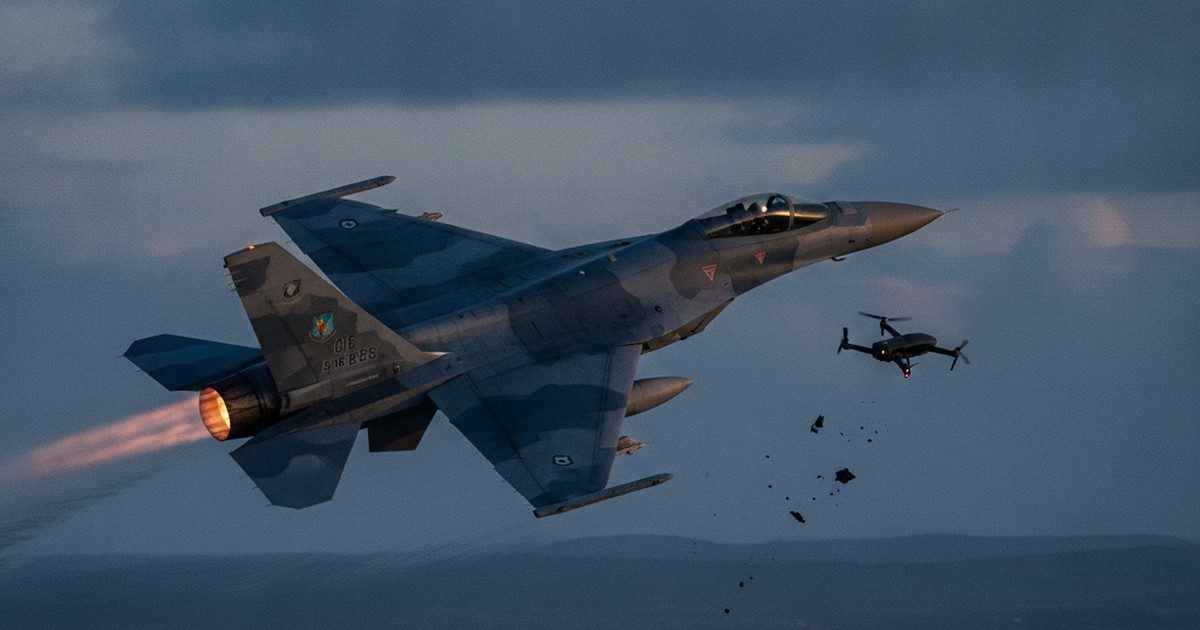
Twice in five days this August, European air forces scrambled fighter jets to shoot down unidentified drones. One incident unfolded over Romanian farmland near the Moldovan border. The other happened over a Black Sea gas platform. A Spanish Air Force F-18 handled the first intercept, and a pair of Romanian F-16s handled the second. Together, the incidents show how routine armed intercepts of unknown drones have become along NATO’s eastern flank — and how often they leave debris behind on the ground, at sea, or drifting toward critical infrastructure.
Spanish F-18 downs drone near Moldovan border
At 4:44 a.m. local time on Aug. 16, Romania’s Ministry of National Defense detected an aerial object entering national airspace from the direction of Moldova, about 24 kilometers north of the city of Galati.
In response, a Spanish Air Force F-18, flying a NATO air-policing mission out of the Mihail Kogalniceanu 57th Air Base, tracked the object by radar and received authorization to engage. The jet shot the drone down at 5:01 a.m., according to the ministry, as first reported by Caliber.Az.
In the end, debris fell in an uninhabited stretch of farmland between the villages of Baleni and Cudalbi, in Galati County. Officials reported no injuries or property damage.
The intercept was one of several drone incursions reported along NATO’s eastern and northern borders that same week. On Aug. 14, an Italian Eurofighter shot down a drone of unknown origin over Latvia, with support from Turkish F-16s scrambled from Estonia. Finland briefly restricted airspace and maritime traffic over the eastern Gulf of Finland as a precaution, Reuters reported. Lithuania and Estonia have logged similar violations through the spring and summer. Officials attribute the pattern to spillover from Ukrainian long-range strikes on Russian Baltic Sea ports, plus Russian electronic-warfare activity that can pull stray drones off course.
Romanian F-16s engage explosive-laden sea drone
Four days later, on Aug. 20, a Romanian-flagged commercial vessel reported a maritime drone drifting near the Neptun Alpha gas platform, roughly 80 nautical miles east of Constanta in Romania’s Black Sea exclusive economic zone. The report came in at 6:28 a.m. local time.
Romania’s Ministry of National Defence scrambled two F-16 fighter jets of the Romanian Air Force to the location. One aircraft engaged the drone with its onboard cannon and struck the target, according to an open-source alert published by Clearwater Dynamics and corroborated by regional outlet UA.News. The drone was reported to be carrying an explosive charge, so a Romanian Coast Guard vessel carrying a Navy explosive ordnance disposal team went to the site to inspect and secure the remnants.
Notably, Romanian officials said the platform engagement followed the destruction of two other drones in the same area on Aug. 11. It marked the fourth confirmed drone destroyed by Romanian forces in 2026. European Commission President Ursula von der Leyen described the incident as part of “a hybrid war” against the European Union in a statement posted to X. She pointed to the bloc’s Eastern Flank Watch and European Drone Defense Initiative as responses to the rising tempo of incursions.
A recurring debris problem
Overall, both engagements reflect a hazard that gets less attention than the intercepts themselves: what happens to the drone afterward. A drone destroyed in flight or at sea does not simply vanish. Instead, it becomes debris that falls onto farmland, drifts near a gas platform, or, in the case of an explosive-carrying unit, triggers a dedicated ordnance disposal response before crews consider the area safe.
For instance, in the Romanian border case, officials confirmed the debris field was uninhabited only after the fact. By contrast, in the Black Sea case, the drone’s explosive payload meant the engagement itself did not end the risk: Navy EOD specialists still had to locate, inspect, and neutralize the remains near active energy infrastructure. Likewise, a similar debris-recovery operation followed the Latvian intercept, where soldiers searched a wooded area near the village of Rugaji for wreckage.
Armed intercepts of unidentified drones are now a near-weekly occurrence along NATO’s eastern and northern borders. As a result, the falling debris they generate — over farmland, near offshore platforms, or in residential areas — has become a parallel hazard. Authorities in Romania, Latvia, Finland, and neighboring states now manage that hazard routinely, right alongside the intercepts themselves.
Subscribe to FODNews for continuing coverage of drone-related incidents and airspace security worldwide.
Sources
- Caliber.Az — “Romanian airspace sees another drone shot down by Spanish F-18”
- Reuters — “Drone incursions sow fear, chaos along NATO’s Baltic and Finnish borders”
- Clearwater Dynamics — “F-16 Engagement of Maritime Drone, Neptun Deep Gas Field, Romania”
- UA.News — “Romanian F-16s shot down a maritime drone in the Black Sea”