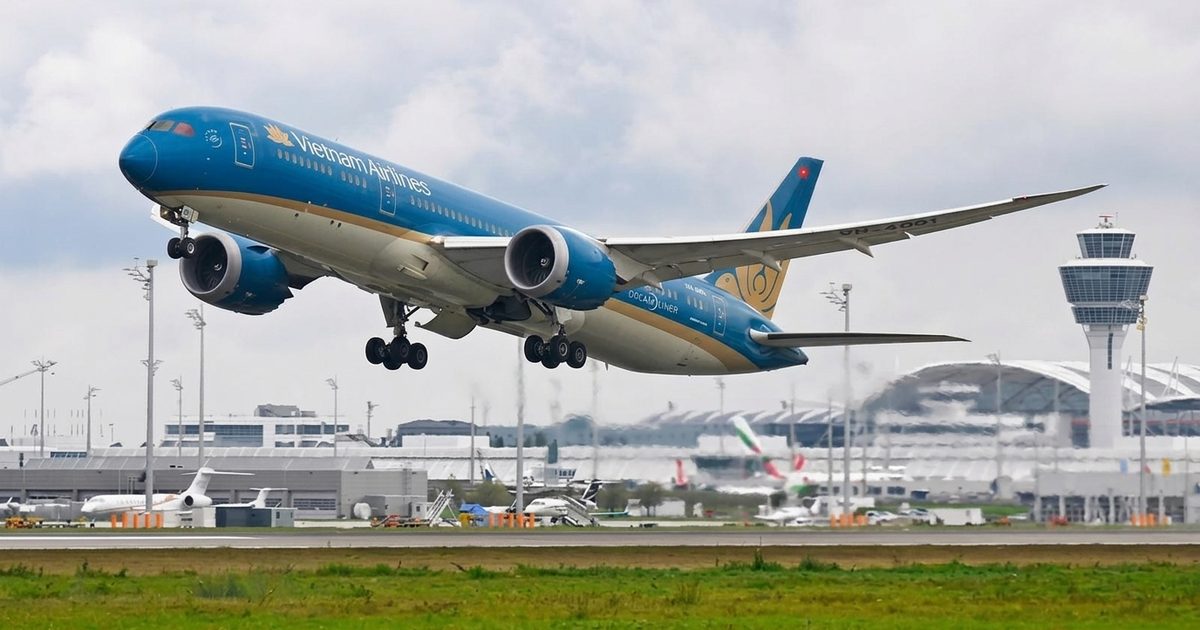
MUNICH — A Vietnam Airlines Boeing 787-9 Dreamliner overran the runway during takeoff at Munich Airport on August 15. The jet struck its tail on the pavement and burst four main-gear tires. It barely became airborne with roughly 91 meters of runway remaining. The aircraft dumped fuel and circled for nearly two hours before landing safely. But the Vietnam Airlines runway overrun scattered tire debris across a second runway and shut down half of one of Europe’s busiest airports for hours.
All 271 passengers and 16 crew aboard flight VN34, bound for Hanoi, were uninjured. Investigators still don’t know why a widebody jet failed to accelerate normally. The aircraft was well under maximum takeoff weight, on one of Europe’s longest runways, in clear weather.
A Takeoff Roll That Didn’t Go as Planned
According to a preliminary report from Vietnam’s Civil Aviation Authority (CAAV), the 787-9 — registration VN-A867 — was cleared for departure on runway 26L shortly after 1:45 p.m. local time. The jet weighed about 240 metric tons, under its 247.2-ton maximum takeoff weight. Weather was good.
The CAAV’s findings, detailed in reporting on the preliminary report, describe an unusual sequence. Partway down the runway, the aircraft’s speed stopped increasing for about two seconds. It then resumed accelerating and reached V1 — the speed beyond which a takeoff can no longer be safely rejected. Shortly after, the speed dropped again.
With V1 already passed, the crew judged there was no longer enough runway to abort. They pushed the engines to maximum thrust. The jet rotated with only about 91 meters (299 feet) of the 4,000-meter runway left. Video reviewed by aviation-safety outlet AeroInside shows the aircraft became airborne roughly 120 meters past the runway end. It was already over grass near the approach lighting.
Tail Strike and a Runway-Debris Event
As the 787 rotated, its tail contacted the pavement, kicking up a large dust cloud. It left scrape marks and torn skin on the underside of the rear fuselage. The overrun also damaged runway edge lights and equipment beyond the paved surface.
Four of the aircraft’s eight main landing-gear tires burst — three on the left, one on the right. That’s the core FOD angle: burst-tire debris was left scattered across the airport surface. The aircraft itself became a runway obstruction after landing, forcing a shutdown and debris inspection before operations could resume.
Moments after becoming airborne, the crew received warnings of a possible tail strike and low tire pressure. They climbed to roughly 9,000-10,000 feet, declared an emergency, and dumped fuel to reduce landing weight.
Two Hours Aloft, Then a Landing on the Second Runway
The aircraft circled Munich for nearly two hours, making two low passes so controllers could visually inspect the landing gear. It then committed to landing. It touched down on runway 26R at about 3:57 p.m. local time, trailing smoke from its damaged left main gear.
The 787 could not taxi clear under its own power, leaving it disabled on 26R. That forced a temporary closure of that runway too. Munich rerouted traffic through its remaining runway while crews cleared the jet and swept for debris. No injuries were reported, and there was no fire.
Investigation Still Open — Cause Undetermined
Germany’s Federal Bureau of Aircraft Accident Investigation (BFU) is leading the probe, as required for an occurrence on German soil. CAAV and Vietnam’s own investigation body are assisting. The flight data and cockpit voice recorders have been recovered for analysis.
The open question is why the 787’s speed stalled and then dropped again during a routine takeoff roll. CAAV has stressed its findings remain preliminary, and neither CAAV nor the BFU has identified a confirmed cause. Theories have circulated on social media, but none are substantiated by either authority. The cause remains officially undetermined and the investigation continues.
The aircraft remains grounded at Munich for structural inspection. Vietnam Airlines has arranged alternative flights and accommodation for affected passengers.
It’s the latest in a string of tire-burst incidents that have closed runways and forced FOD sweeps at major airports this year. Earlier this month, a Kenya Airways 737 tire burst shut down Cape Town’s only runway — a reminder that tire failures routinely become runway-contamination events in their own right.
Stay informed — subscribe to FODNews for daily coverage of FOD incidents and prevention worldwide.
Sources
- Reuters — “Vietnam aviation body says passenger plane returned to Munich after tail strike” (Aug 17, 2026)
- India Today — “Speed drops twice, near-runway disaster: Vietnam flight’s 2-hour horror in Munich” (Aug 19, 2026)
- AeroInside — “Vietnam B789 at Munich on Aug 15th 2026, late rotation, tailstrike, runway overrun, tyre damage”
- aviationa2z — “Vietnam Airlines Boeing 787 Suffers Runway Overrun and Tail Strike” (Aug 16, 2026)