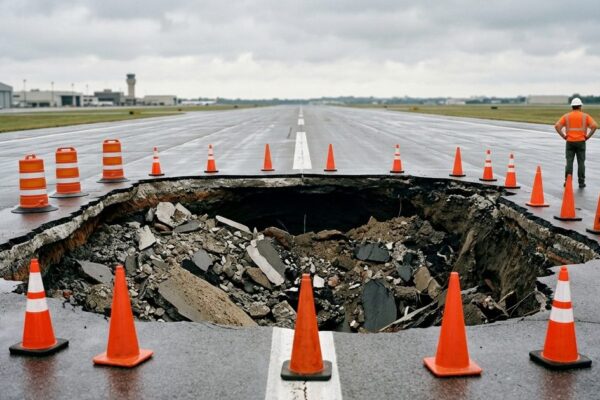

TOKYO — Tokyo Haneda Airport‘s Runway C was shut down twice within a 48-hour window in mid-July after extreme summer heat triggered pavement failures that created a Haneda Runway C FOD hazard on one of Japan’s busiest runways. The back-to-back closures forced waves of delays, diversions and schedule disruptions across domestic and international networks.
Pavement Hole Discovered During Peak Afternoon Operations
Inspections on July 13 found a hole in Runway C’s surface measuring roughly 20 centimeters across and several centimeters deep near the runway’s central section, according to reporting by The Traveler. The defect was consistent with heat-induced pavement fatigue; record summer temperatures were identified as a contributing factor in the asphalt’s failure.
Operations managers ordered an immediate suspension of Runway C during the afternoon — a peak period for domestic departures and arriving international flights — and rerouted traffic onto Haneda’s remaining runways.
Emergency repair crews completed patching work through the evening, and the runway returned to service after inspections confirmed the repaired section met safety standards. Within 48 hours, authorities identified an additional surface concern and ordered a second closure, prolonging disruption into the summer travel peak.
Flights Delayed, Diverted, Passengers Stranded
With Runway C out of service, reduced capacity created a cascade of problems during one of Haneda’s busiest periods of the year. Domestic routes saw the most immediate impact as carriers struggled to maintain short-haul rotation schedules.
Some arriving international flights were held in airborne holding stacks or diverted to alternate airports. Residual delays stretched into overnight and early-morning banks, affecting passengers well beyond the initial closure windows.
Travelers reported long lines at rebooking counters, packed terminals and missed connections. Some were rerouted through alternative Japanese hubs; others received next-day rebookings.
Haneda Runway C FOD: A Repeating Pattern of Surface Failures
The back-to-back closures arrive as Haneda is already under scrutiny for runway surface integrity. In June, an exposed metal plate on Runway 05 caused tire blowouts on two successive aircraft — a Skymark 737 and a Japan Airlines 767 — within hours of each other, prompting emergency inspections and a separate wave of delays.
Together, the incidents point to a pattern of runway-surface FOD events at one of Asia’s busiest airports. The two episodes are unrelated in direct cause — an embedded metal plate versus heat-degraded asphalt — but both expose the same vulnerability: surface damage can emerge with little warning and produce rapid, far-reaching disruption.
Aviation safety specialists note that prolonged high temperatures accelerate wear on asphalt pavements, particularly at high-traffic airports where heavy aircraft repeatedly stress the same surface. Japan’s Meteorological Agency has recorded above-normal temperatures across the Tokyo region in July 2026 — conditions that can push aged pavement beyond its design tolerances.
Climate Pressure on Airport Infrastructure
The Runway C incident is drawing fresh attention to the intersection of climate trends and airport infrastructure management. Haneda serves tens of millions of passengers annually and has little tolerance for runway outages during the summer peak, when school holidays, domestic tourism and recovering international demand all converge.
Industry discussions have increasingly emphasized predictive maintenance — sensor networks and advanced pavement modeling — as tools for identifying at-risk sections before they fail. Events like the Runway C closure reinforce the case for more proactive inspection regimes during the hottest months.
What Comes Next
As of this report, Runway C had returned to service following the second set of repairs. Haneda’s advisories continue to urge travelers to allow extra connection time and monitor flight status closely through the summer season.
For passengers with Haneda itineraries in the coming weeks, the twin closures are a reminder that tight connections and slot-constrained schedules leave little buffer when a runway goes offline unexpectedly.
Subscribe to FODNews for ongoing coverage of FOD incidents and runway safety worldwide.