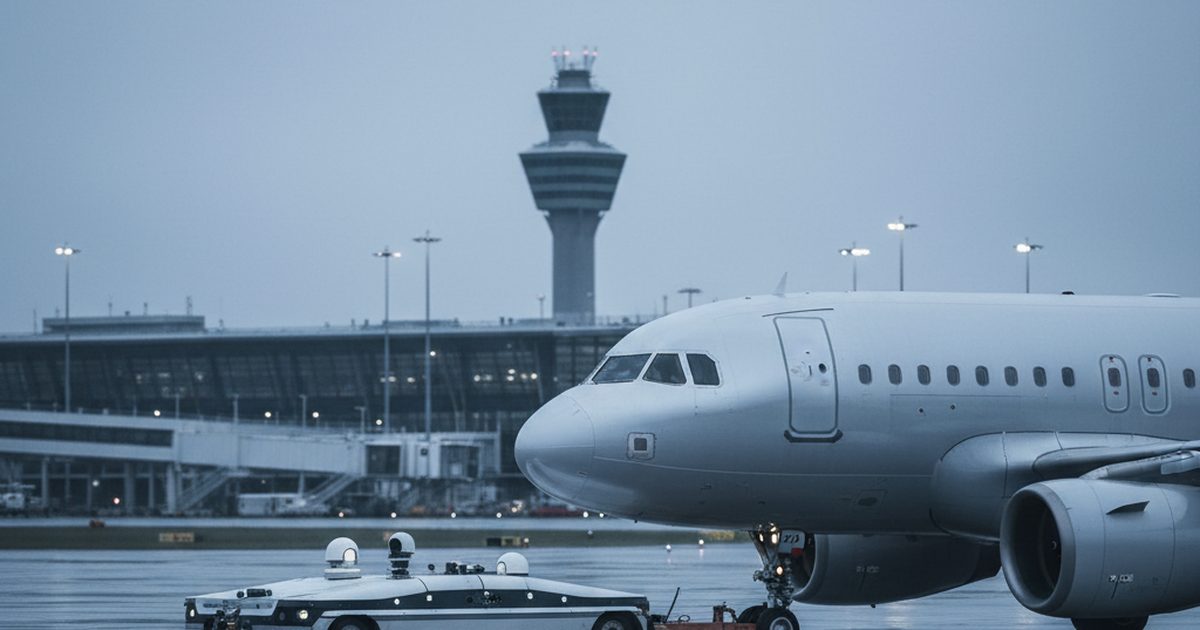
Amsterdam Airport Schiphol began regular operations with the world’s first fully electric TaxiBot in June 2026, towing Airbus A320-family aircraft to and from the distant Polderbaan runway with main engines off — and the project partners are already eyeing autonomous foreign object debris detection as the next frontier.
The rollout is a joint effort between Schiphol, easyJet, Airbus, Menzies Aviation, and TaxiBot manufacturer Smart Airport Systems. Four easyJet A320neo aircraft have been equipped to use the vehicle, which the pilot controls directly from the cockpit. Engines remain cold throughout the taxi; crews start them only at the runway threshold before departure.
How It Works — and Why Polderbaan
Polderbaan is Schiphol’s most remote runway, located roughly six kilometers from the terminal complex. That long ground roll makes it ideal for showcasing the electric TaxiBot’s potential. Schiphol estimates taxi fuel consumption can be cut by up to 65 percent on those routes compared with conventional engine-on taxiing.
easyJet puts the per-flight savings at approximately 95 kilograms of fuel and 299 kilograms of CO₂ on an average A320neo cycle at Schiphol. Beyond fuel, reduced main-engine operation lowers NOx emissions and ultrafine particulate output — both significant contributors to air quality issues around busy European hubs.
The electric TaxiBot can travel at up to 23 knots (42 km/h). Schiphol has operated two hybrid TaxiBots towing KLM Boeing 737s to Polderbaan since 2022. The new fully electric system is the first of its kind in scheduled Airbus operations anywhere in the world. Three additional electric TaxiBots are expected to enter service at Schiphol before the end of 2026.
Smart Ramp — and the FOD Milestone Ahead
The TaxiBot deployment sits inside a broader ground-operations overhaul called the Smart Ramp programme, a multi-airport initiative reported by Future Travel Experience that includes Schiphol, KLM, and a coalition of international carriers and airport operators.
The programme’s published roadmap explicitly lists autonomous FOD detection and removal as a key next milestone. The broader vision calls for autonomous systems to manage an inbound aircraft’s entire ground flow — from final approach to stand — without human intervention at every step.
Schiphol and KLM have already run a first trial with one autonomous FOD detection vendor. That trial found the robots could behave in “unpredictable ways” on a live apron, according to programme documentation, which prompted plans for a second trial with a different vendor. The follow-on test will evaluate both detection and removal capabilities, first in a controlled environment and then on the live ramp at Schiphol.
Data cited within the Smart Ramp consortium suggests autonomous FOD systems can detect up to 10 times more debris than traditional human inspection teams. That benchmark has also emerged in Munich Airport’s parallel autonomous FOD detection programme, which targets operational deployment by 2027.
Context: A Pattern Across Major Hubs
Schiphol joins a growing list of airports investing in autonomous ramp safety technology. Dallas-Fort Worth launched a $2 million pilot for autonomous FOD detection and removal earlier in 2026, while Munich has been among the most vocal advocates for the technology after its Smart Ramp trials. The common thread: labor cost pressures, safety liability, and sustainability mandates are converging to accelerate the business case for robotic ramp operations.
At Schiphol, the electric TaxiBot is the visible proof point that ground automation is moving from pilot to program. The FOD detection milestone is next on the list.
Subscribe to FODNews for continuing coverage of autonomous FOD detection developments across global aviation.
Sources
- Future Travel Experience — Schiphol launches world’s first electric TaxiBot (June 2026)
- Future Travel Experience — How Schiphol is driving autonomous Smart Ramp innovation (September 2025)
- FODNews — Munich Airport Plans Autonomous FOD Detection Robots by 2027
- FODNews — Dallas-Fort Worth Launches $2M Pilot for Fully Autonomous FOD Detection and Removal Robot