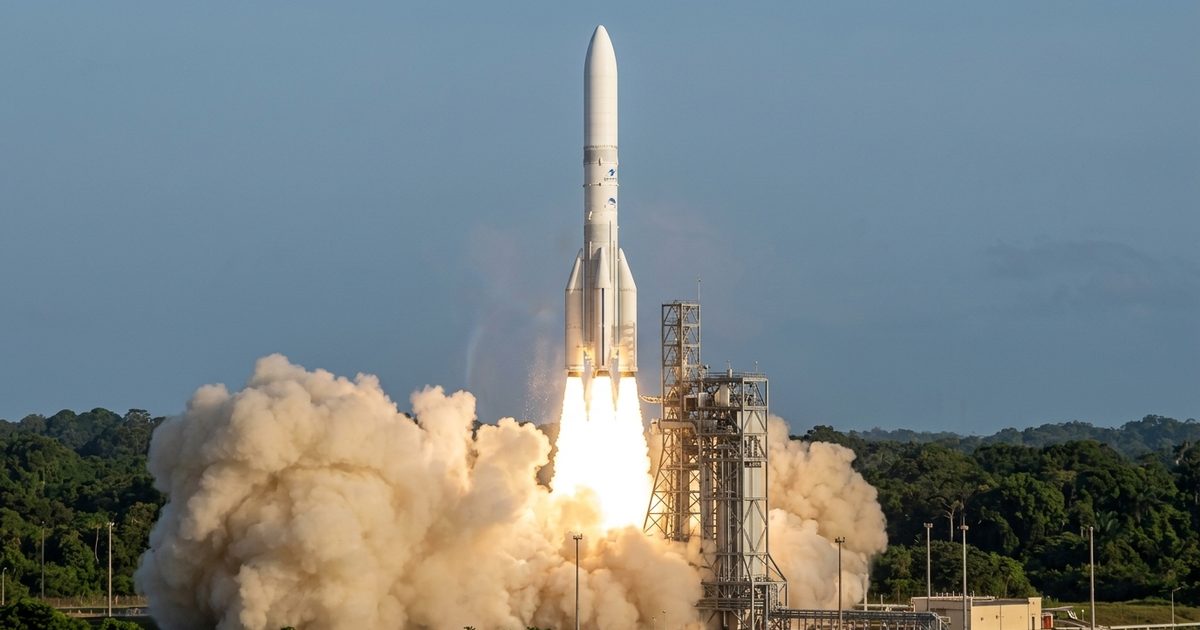
Europe’s Ariane 6 rocket deployed 36 Amazon Leo broadband satellites to low Earth orbit last week in a record-breaking mission that highlighted both the ambitions of European spaceflight and growing LEO congestion in an already strained orbital environment. The June 17 launch — designated VA269 by Arianespace — marked the debut of upgraded P160C solid rocket boosters and set a new benchmark for the heaviest single payload ever lifted by a European launch vehicle.
A New European Benchmark
Flight VA269 lifted off from Europe’s Spaceport in Kourou, French Guiana, at 09:21 local time on June 17. The Ariane 64 configuration — equipped with four P160C-based boosters — placed all 36 satellites into orbit just over an hour after liftoff, completing the eighth consecutive successful orbital insertion for Ariane 6.
The P160C is a larger, more capable evolution of the P120C motor used on earlier Ariane 6 missions. Each booster holds 156 tonnes of propellant — 14 tonnes more than its predecessor — and stands 14.5 meters tall. That upgrade delivers a 10 to 15 percent performance improvement depending on the target orbit. On VA269, the gain translated directly into four additional satellites compared with the previous two Amazon Leo missions, which each carried 32.
The new configuration surpassed the payload record previously held by Ariane 5, set in 2013 during ESA’s ATV Albert Einstein resupply mission to the International Space Station. ESA confirmed the record in a launch-day release, calling VA269 “the most powerful version of Ariane 6 to launch so far.”
“Ariane 6 has proven itself yet again, cementing its versatility as a launcher that can deliver all types of missions to all orbits,” said ESA Director General Josef Aschbacher. He highlighted the rocket’s modular design, noting that three distinct versions had flown within two years — with further upgrades still planned.
ESA Director of Space Transportation Géraldine Naja called it “a remarkable demonstration of European engineering excellence.” The P160C boosters were developed by Europropulsion under contract from ArianeGroup and Avio, with structural components manufactured across Italy, France, and Norway.
Amazon’s Kuiper Contract and the European Launch Pipeline
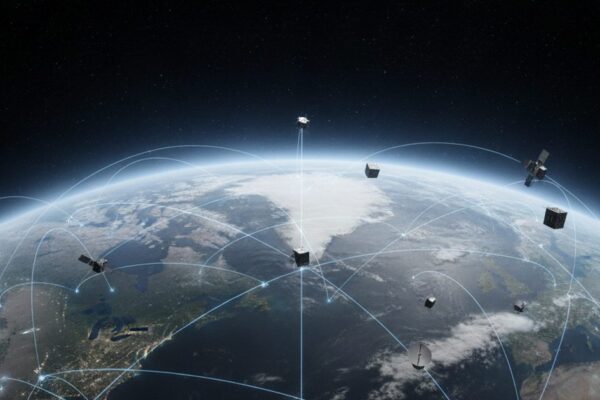
The 36 satellites are part of Amazon’s Project Kuiper broadband constellation, a competitor to SpaceX’s Starlink network. VA269 was the third Ariane 6 mission under an 18-flight contract Arianespace signed with Amazon in 2022, with 15 launches still remaining. The full contract, if completed, would place roughly 600 Kuiper satellites in orbit aboard Ariane vehicles.
Arianespace currently operates at a cadence of roughly six to eight launches per year. ESA Director General Aschbacher has outlined aspirations to increase that substantially — to 12, 15, or 20 launches annually by 2030 — contingent on firm orders from European governmental and commercial customers and continued investment in production capacity.
The Vinci upper stage performed a controlled de-orbit burn approximately two hours and 40 minutes after liftoff, a maneuver intended to limit the mission’s long-term footprint in the orbital environment — and a procedural acknowledgment of the debris-mitigation requirements now embedded in commercial launch operations.
Growing LEO Congestion
VA269’s 36 additions arrive into an orbital environment already under strain. Just weeks before the launch, the Zhuque-2E upper stage broke apart in orbit, generating an estimated 100 to 150 trackable debris fragments in bands that overlap with ISS operations and active Starlink traffic. The event intensified calls for stronger enforcement of post-mission disposal requirements across all operators.
ESA’s Space Environment Office estimates more than 54,000 objects larger than 10 centimeters are currently in orbit, alongside roughly 1.2 million debris pieces between 1 and 10 centimeters — totals that grow with each new constellation deployment. The agency has described current LEO traffic density as approaching unsustainable levels without more aggressive mitigation.
Efforts to raise the baseline are underway at the policy level. Earlier this month, a coalition of space agencies and national authorities signed the International Space Operations Standards orbital debris removal declaration at the Berlin Airshow, committing signatories to active debris removal timelines and end-of-life disposal standards. Whether commercial launch contracts will eventually be conditioned on such commitments remains an open question.
The Tension That Won’t Go Away
VA269 illustrates a tension regulators, operators, and researchers cannot easily resolve: the same launch capabilities that make LEO broadband commercially viable also accelerate the rate at which orbital slots are occupied and residual hardware accumulates.
Ariane 6 performed a disposal burn after satellite deployment — in line with current best practices. But with ESA targeting a potential tripling of annual launch cadence by the end of the decade, and with Amazon, SpaceX, and other operators each pursuing multi-hundred-satellite constellations, the cumulative pressure on orbital density is compounding year over year.
For now, VA269 stands as an engineering milestone — clear evidence that Europe’s upgraded heavy-lift capability can compete for large commercial constellation contracts. The debris question it amplifies is one the entire industry is still working out how to answer.
Stay current on orbital debris events and LEO congestion news. Subscribe to FODNews for weekly updates.
Sources
- ESA — Ariane 6 launches with more powerful boosters: a new record for Europe (June 17, 2026)
- Orbital Today — ESA Launches New Ariane 6 Configuration With Record Upmass (June 18, 2026)
- SatNews — Arianespace Fights Back – Possibly! (June 19, 2026)
- Spaceflight Now — Live coverage: Arianespace to launch its heaviest payload to date with Amazon Leo flight (June 17, 2026)
- Avio — The new Ariane 6 with 4 P160-C boosters successfully launches Amazon Leo satellites
- ESA Space Debris Office — Space Environment Statistics