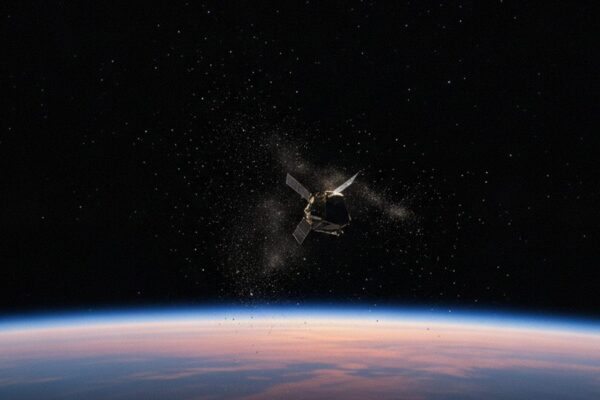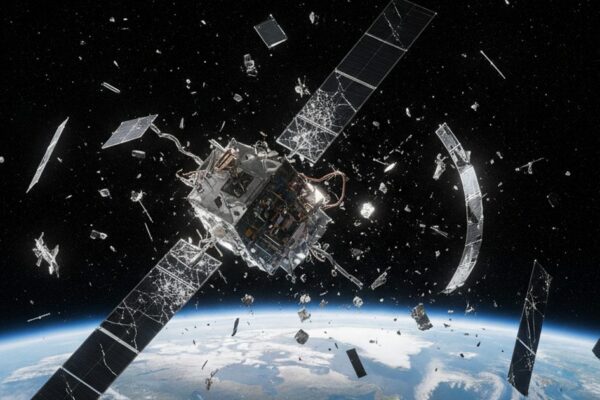

Astronomers have discovered a previously undetected geostationary orbit debris cloud — 25 newly identified tracks of objects circling the critical 35,786-kilometer ring where the world’s most valuable communications and weather satellites operate. The find raises urgent questions about collision risk to assets that cannot be easily replaced, repaired, or relocated.
Researchers at the University of Warwick in the United Kingdom identified those tracks in geostationary orbit, according to a study highlighted by EurekAlert. Approximately 80 percent of the tracks could not be matched to any known catalogued satellite or debris fragment — meaning the objects are effectively invisible to standard space surveillance networks.
A Belt of Unknown Objects in Geostationary Orbit
The fragments are estimated to be roughly five centimeters (about two inches) in diameter — far too small to be consistently tracked by current ground-based radar systems, yet large enough to cause catastrophic damage on impact.
At geostationary altitudes, objects travel at approximately three kilometers per second relative to Earth. Relative velocities between objects in slightly different orbital slots can still reach several kilometers per second. A five-centimeter fragment striking a satellite at even a fraction of that speed carries the kinetic energy of a small explosive charge. That is more than enough to puncture a fuel tank, shatter solar panels, or destroy an attitude control system.
That is the same physics that governs foreign object debris on airport runways: size doesn’t determine danger. Energy per unit mass does. In orbital mechanics, as on a flight line, the smallest objects are often the most treacherous precisely because they are the hardest to see.
Why GEO Is Different — and Why That Matters
Geostationary orbit is fundamentally different from low Earth orbit. In LEO, atmospheric drag gradually pulls debris back into the atmosphere, where it burns up. That process takes years to decades for objects in the 400–1,200 km range, but it eventually clears them.
At 35,786 kilometers, however, there is no atmosphere. Objects created in GEO by a collision or fragmentation event remain indefinitely. A debris cloud discovered today in geostationary orbit is, for all practical purposes, a permanent feature of that orbital band on any human timescale.
The stakes are extraordinarily high. Geostationary orbit is home to the satellites that carry television signals, broadband internet, financial transactions, and weather imagery to billions of people. GPS, military communications, and early-warning systems depend on assets in or near this band. A single high-value GEO satellite can be worth more than a billion dollars and take years to design, build, and launch — there are no quick replacements.
The Tracking Gap
Current space surveillance infrastructure — primarily the U.S. Space Force’s Space Fence and a network of ground-based optical telescopes — can reliably catalog objects larger than roughly 10 centimeters in low Earth orbit. At geostationary distances, that detection threshold is considerably worse. Centimeter-class fragments in GEO are, in the current architecture, effectively invisible.
That is the core finding of the Warwick study: there are objects up there that existing systems cannot see. The 25 newly detected tracks represent a sample — not a complete census. Researchers noted that the high proportion of unknown sources suggests catalogue completeness at GEO is significantly lower than previously assumed. The actual debris population may be substantially larger than current models reflect.
Moreover, the discovery points to a source problem. When a debris cloud cannot be associated with any known fragmentation event, the cause remains unclear. The originating event may have gone unreported, or a satellite may have shed material gradually without triggering a catalogued breakup. Alternatively, existing attribution methods may simply be insufficient to link fragments to their origin objects at GEO distances.
A Growing Orbital Minefield
Geostationary orbit is a finite resource. There are only so many orbital slots above the equator where a satellite can appear stationary relative to a fixed ground antenna. The International Telecommunication Union governs those slots, allocating them to nations — and an increasing number of operators now contest them.
As the belt fills with both operational satellites and untracked debris, the margin for error narrows. An undetected fragment passing through a crowded sector of the GEO arc doesn’t generate a collision warning — it generates a news item, or silence, if the satellite simply stops responding.
In turn, the Warwick findings reinforce a warning that space situational awareness researchers have issued for years: the orbital environment we cannot measure is the one most likely to hurt us. Better observational tools, international data-sharing agreements, and stricter end-of-life passivation requirements for GEO spacecraft are among the proposed mitigations.
None of those solutions removes the debris already there. In geostationary orbit, unlike on a runway, you cannot send a crew out to sweep before the next operation. The fragments discovered by the Warwick team will remain a century from now — traveling at orbital velocity, invisible to most tracking systems, sharing the same narrow band of sky with satellites the world depends on.
Subscribe to FODNews for continuing coverage of orbital debris threats, space situational awareness, and foreign object debris incidents worldwide.