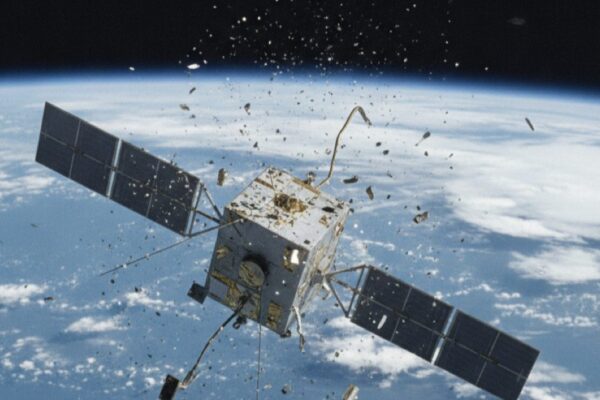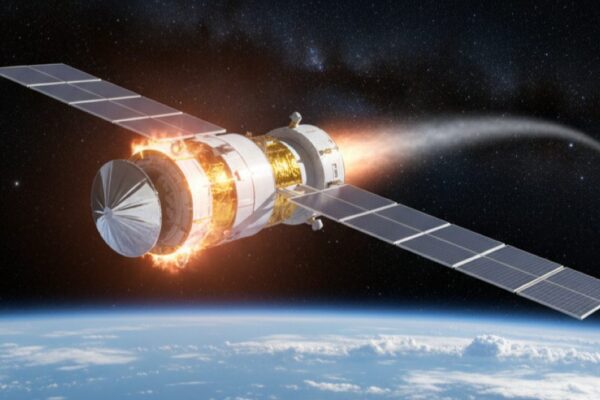
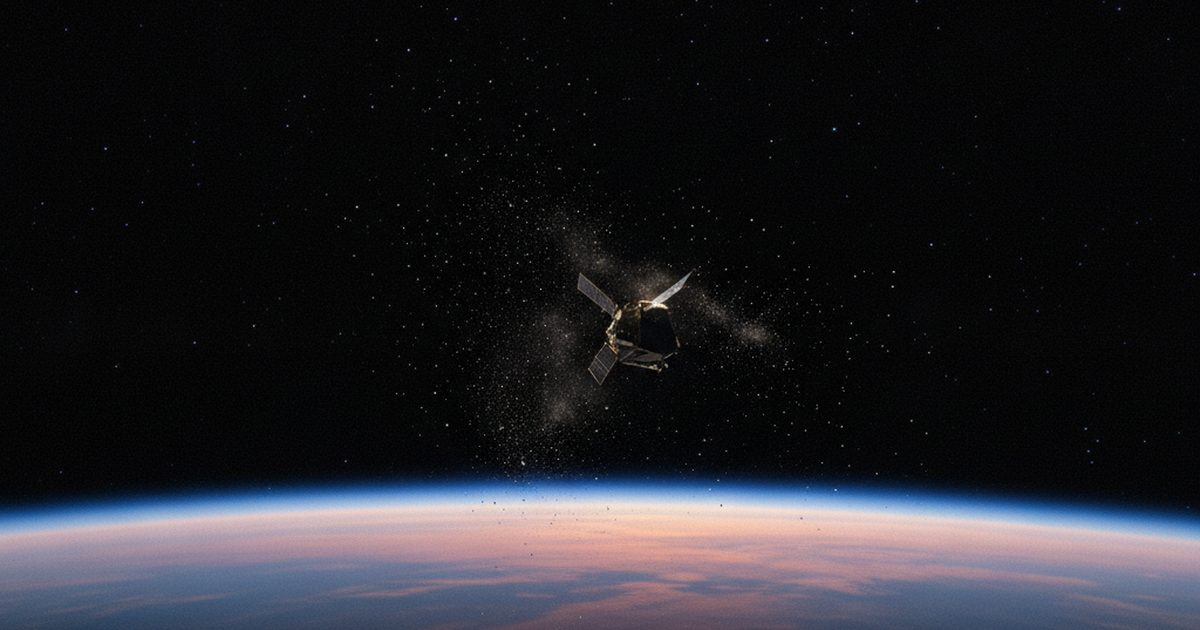
The USA 32 satellite breakup happened Sept. 13 in low Earth orbit. It scattered trackable debris through one of the most congested altitude bands around the planet. USA 32, a 38-year-old U.S. spy satellite retired from active service years ago, broke apart at roughly 775 kilometers up. U.S. Space Forces-Space (S4S) confirmed the fragmentation in an official Space-Track.org announcement. Independent tracking firms had already flagged unusual activity days earlier.
The satellite, cataloged as NORAD object #19460, was a National Reconnaissance Office signals-intelligence spacecraft. It launched Sept. 5, 1988, on a Titan II SLV. The Cold War-era mission monitored Soviet radar systems. According to Space-Track.org, the breakup occurred at approximately 21:13 UTC. More than 200 active satellites, including the Iridium NEXT communications constellation, orbit within 30 miles of that altitude.
USA 32 Satellite Breakup Confirmed, Cause Still Under Investigation
The event was first logged by KeepTrack Operations Center (KTOC), an orbital-debris monitoring service. KTOC classified it as a Tier 1 priority event based on sudden delta-V and orbital-element changes consistent with a fragmentation. S4S’s statement, cited in the KTOC notice, addresses the aftermath directly. It reads in part: “All tracked debris are being incorporated into routine conjunction assessment screenings to support spaceflight safety. No immediate threats have been identified; further analysis is ongoing.”
Officials have not disclosed an official cause. Space analysts say the leading theory is internal material failure: a ruptured pressurized propellant tank, or a degraded battery cell. That kind of failure often follows nearly four decades of thermal cycling between direct sunlight and Earth’s shadow. A micrometeoroid strike remains possible, too. Tracking teams are working backward from the fragments’ dispersal pattern to reconstruct the sequence of events. So far, analysts have found no indication of a deliberate act or anti-satellite weapon test.
A Familiar, Crowded Neighborhood
NASA has flagged the 775-kilometer band where USA 32 broke apart as a high-risk debris zone since 2009. That year, a defunct Russian Kosmos satellite collided with an active Iridium spacecraft at a similar altitude. The collision destroyed both spacecraft and scattered thousands of fragments that ground trackers still monitor today. USA 32 adds an unknown number of new fragments to that count. Even so, the same long-term collision math still governs every LEO breakup, regardless of a fragment’s age. More objects mean more possible intersections. That means more work for the conjunction-screening systems operators rely on to keep active satellites apart.
USA 32 is the third confirmed on-orbit breakup FODNews has tracked in less than two weeks. The first was the Chinese Long March 6C upper stage fragmentation on Sept. 1. The second was the Yaogan-50(02) reconnaissance satellite breakup on Sept. 11. Researchers have separately linked this clustering of breakups to accelerating collision-risk intervals in low Earth orbit. Notably, those two rocket-stage breakups involved active, recently launched hardware. USA 32’s failure instead points to a harder problem: aging derelicts that quietly orbit for decades before finally coming apart.
Fragment counts have not yet been finalized. S4S and KTOC both say cataloging and trajectory reconstruction will continue for weeks as more debris pieces become trackable.
Sources
- KeepTrack Operations Center. “USA 32 Breakup Announced By Space-Track.”
- Space-Track.org (U.S. Space Forces-Space). Official satellite catalog and conjunction-screening authority.