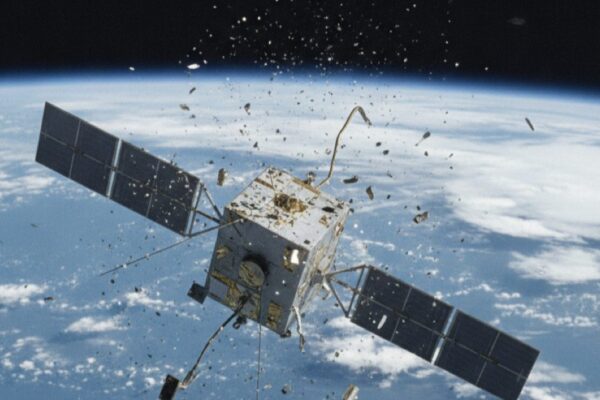

Twice within 24 hours this week, the Philippine Space Agency (PhilSA) issued a Philippines rocket debris warning covering waters near Cagayan. A second warning followed just a day later near Puerto Princesa. This time, sonic booms rattled the city loud enough to send residents running outside to look at the sky.
The back-to-back advisories were issued Sept. 16 and Sept. 17, 2026. They mark the latest reminder that China’s launch cadence is accelerating. Its rockets are generating foreign-object hazards far beyond its own launch pads. This time, the hazards stacked one on top of the other in the same Philippine archipelago.
First Warning: Yinli-1 Over the Luzon Strait
PhilSA’s first advisory covered the Yinli-1 rocket. It launched from the East China Sea Launch Area in the Eastern Waters of Shanghai at around 6:00 a.m. Philippine Standard Time on Sept. 16. The agency designated a drop zone roughly 61 nautical miles from Santa Ana, Cagayan. It set a second boundary 71 nautical miles from Babuyan Island — squarely inside the Philippines’ Exclusive Economic Zone.
PhilSA said it received the drop-zone details through a Notice to Airmen warning of “aerospace flight activity.” The agency then passed that information to relevant government agencies ahead of launch. Its advisory noted the debris was not projected to fall on land or inhabited areas. However, it flagged a real risk to “ships, aircraft, fishing boats, and other vessels” transiting the zone. There was also a chance debris could drift and wash up on nearby coasts.
Second Warning: Long March 12 Booms Over Puerto Princesa
A day later, PhilSA issued a near-identical advisory for a Long March 12 rocket. It launched from the Hainan International Commercial Launch Center in Wenchang at around 8:32 a.m. PhST on Sept. 17. This drop zone sat roughly 25 nautical miles southeast of Puerto Princesa. It also sat 19 nautical miles west of the Tubbataha Reefs Natural Park — a UNESCO World Heritage marine sanctuary.
This time, residents didn’t just read about it. The Philippine Navy’s Naval Command West reported observing the rocket at 8:42 a.m. It was “emitting a bright red-orange luminous trail” as it crossed the horizon. Loud sonic booms and a visible white vapor trail followed. Puerto Princesa residents told the Philippine Daily Inquirer the booms startled them. That reaction stood out even though rocket launches are no longer new to the city.
The Pattern Behind Every Philippines Rocket Debris Warning
Both launches followed the same basic physics. Boosters and payload fairings are designed to separate and fall back to Earth once a rocket clears the atmosphere. China’s coastal launch sites sit at Wenchang and Shanghai. Both put much of the South China Sea and West Philippine Sea directly under that flight path. Consequently, the Philippines has logged similar advisories for years. The drop zone pattern echoes an earlier incident — the Western Naval Command once tracked a Chinese launch visually over Palawan skies.
The bigger issue is uncontrolled re-entry risk, which PhilSA raised in both advisories. Rocket upper stages that reach orbit don’t always burn up cleanly. Predicting exactly where they’ll come down remains an unsolved problem. That gap is exactly what a European-led forecasting effort is trying to close — ESA’s NorthStar-led FALCON consortium is building models specifically to narrow the “where will it land” window for uncontrolled reentries. Similarly, this isn’t the first time a Chinese rocket has broken up messily in orbit. A Long March 6C upper stage fragmented into hundreds of pieces just weeks earlier in a separate incident. Debris from other launches has even been documented washing ashore as far away as an Australian beach.
A Call for Coordination, Not Just Warnings
PhilSA used both advisories to press the same point. As global launch rates climb, so does the volume of debris shed during staging and re-entry. No single country can track it alone. The agency said it “invites international partners to explore how our region can develop coordinated protocols and capabilities that protect both our space assets and our people on the ground.”
That framing lines up with a broader global trend. Agencies are increasingly treating uncontrolled reentry as a recurring operational hazard rather than a rare event. FODNews has documented that shift in earlier reporting — tracking the roughly one metric tonne of uncontrolled space debris now falling to Earth every week.
For now, PhilSA’s advice to Filipino fishing crews and mariners remains the same it has issued after every launch. Report any suspected debris to local authorities. Never touch or approach it — rocket debris can carry residual fuel and other toxic materials.
Stay informed — subscribe to FODNews for daily coverage of FOD incidents and prevention worldwide.
Sources
- Philippine Space Agency. “Advisory on the Yinli-1 rocket launch” (Sept. 16, 2026).
- Philippine Space Agency. “Advisory on the Long March 12 rocket launch” (Sept. 17, 2026).
- Philippine Daily Inquirer. “More Chinese rocket explosions reported in Puerto Princesa skies” (Sept. 17, 2026).
- ABS-CBN News. “Debris from fresh China rocket launch may have fallen near Tubbataha Reef, PhilSA warns” (Sept. 17, 2026).