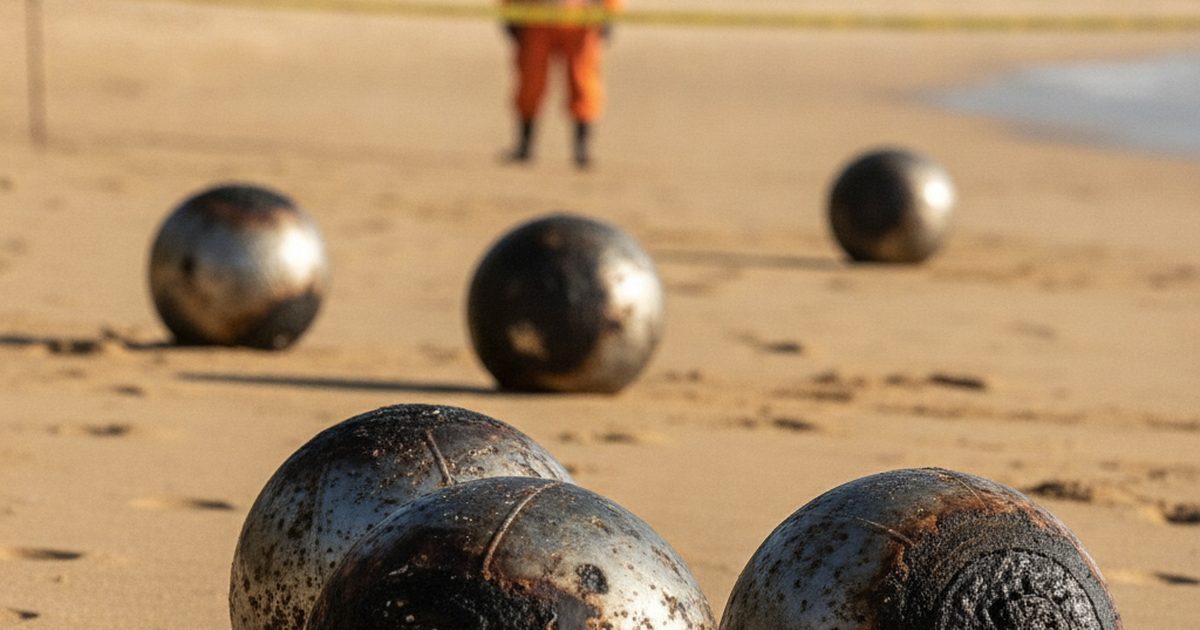
Six metallic spheres, each roughly twice the size of a basketball, washed ashore at Forrest Beach near Ingham in north Queensland over the first weekend of July 2026, triggering a multi-agency emergency response and confirming what space-debris experts have long warned about: debris washing up on Australian beaches is no longer a theoretical risk.
The Australian Space Agency confirmed the objects on Monday, July 7, stating they “appear to be pressure vessels from a space launch vehicle” consistent with debris from “a foreign rocket body that recently re-entered the atmosphere from orbit.”
Hazmat Teams Deploy, Exclusion Zone Established
The first sphere was discovered by a crab fisherman, who was immediately ordered to leave the area. Police and Queensland Fire Department responders arrived in hazmat gear and established a 50-meter exclusion zone as additional spheres continued washing in throughout the weekend.
Residents of Forrest Beach were briefly evacuated Friday as authorities worked to identify the objects. The bomb squad was placed on standby. Local resident Trevor Kyle, who helped police access the remote beach, described watching the situation escalate. “You could see that it was getting bigger and bigger,” Kyle told ABC News Australia. “It could have been serious and it was treated like that.”
By Monday, the Australian Space Agency declared all six objects safe and cleared the exclusion zone. Authorities warned that additional debris may still wash ashore.
What Are “Space Balls”?
The objects are known in the space-debris research community as “space balls” — a well-documented category of reentry survivability. Flinders University Associate Professor Alice Gorman, a space archaeologist specializing in orbital debris, told ABC News the spheres were a textbook example.
“Many rockets have liquid fuel systems with fuels under high pressure stored in these pressure vessels made of robust material,” Gorman explained. “These parts of the fuel system often survive because their melting points are higher than the temperature coming back through the atmosphere.”
The empty vessels are also buoyant, explaining how they drifted to shore. Gorman offered a blunt forecast: “We are going to see more of this — more rockets means more space junk.”
Launch Vehicle Identity Still Unconfirmed
The Australian Space Agency stated it is “continuing to engage with international authorities to formally confirm the launch vehicle and launching state.” No country has publicly claimed the debris. Long March 6 and Long March 8A missions launched July 4–5 have been cited among unconfirmed candidates in press reports, though the ASA has not confirmed any specific rocket program.
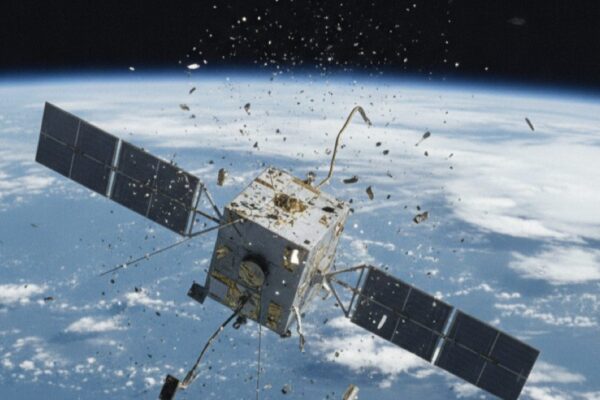
The agency’s confirmation that the source is “a foreign rocket body” points toward orbital reentry of an upper stage or payload fairing assembly — structural components routinely left in low Earth orbit after launch and subject to uncontrolled reentry as orbits decay.
Australia’s Third Major Space-Debris Recovery in Five Years
This marks the third significant space-debris ground-recovery event in Australia since 2022. In July 2022, debris from a Chinese Long March 5B fell across farmland in the Northern Territory. In July 2023, a piece attributed to a SpaceX Crew Dragon trunk section was recovered in outback New South Wales.
FODNews has previously reported on the growing challenge of uncontrolled reentry debris, including the Long March 6A upper stage breakup that generated hundreds of tracked fragments threatening the Qianfan LEO constellation.
Australia’s large landmass and remote coastal geography make it a statistically probable impact zone for reentry debris. As Gorman noted, populated areas have so far been spared — “so far” being the operative phrase as global launch rates continue to climb.
What to Do If You Find Space Debris
The Australian Space Agency has issued standing guidance following the Queensland incident:
- Do not handle, move, or attempt to recover suspected space debris.
- Assume the object is hazardous until authorities confirm otherwise.
- Contact local emergency services (000 in Australia for urgent situations).
- Notify the Australian Space Agency at space.gov.au/contact-us.
The agency noted that space debris may be constructed from materials that are chemically or physically hazardous and should only be handled by trained professionals.
Sources
- ABC News Australia — Australia’s Space Agency says beach objects likely fuel pressure vessels from launch vehicle (July 6, 2026)
- Space.com — Unidentified metal spheres found on Australian beach are debris from a foreign rocket body, space agency says
- NBC News — Metallic space balls found on Australian beach
- Fox Weather — Mysterious metallic spheres washing up on Australian beach identified (July 8, 2026)
- Australian Space Agency — space.gov.au