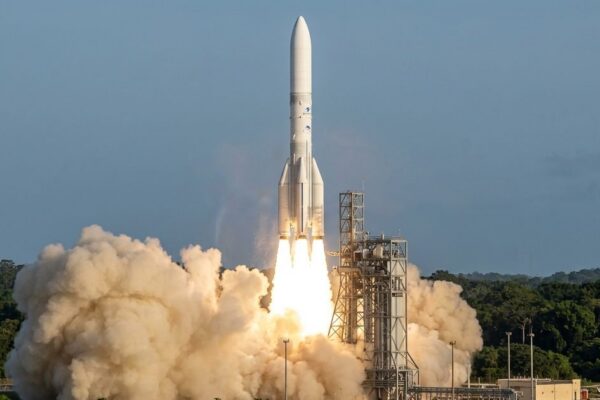
A robotic servicing satellite is set to lift off from a remote Pacific atoll Tuesday morning in a first-of-its-kind Swift satellite boost attempt — rescuing one of NASA’s longest-running space observatories from an uncontrolled reentry and establishing a commercial blueprint for servicing aging government spacecraft never designed to be maintained on-orbit.
The launch is scheduled no earlier than 6:23 a.m. EDT (10:23 UTC) on Tuesday, June 30, and is weather- and readiness-dependent. The window opens over Kwajalein Atoll, part of the Republic of the Marshall Islands in the Pacific Ocean.
Swift Satellite Boost: A Race Against Orbital Decay
NASA’s Neil Gehrels Swift Observatory has circled Earth since November 2004 — more than two decades of gamma-ray bursts, X-ray transients, and time-critical astronomical alerts that have made it one of the most productive telescopes in the agency’s fleet. But Swift carries no propulsion system of its own. It relies on natural orbit stability, and that stability has been eroding.
The culprit is the current solar maximum. Elevated solar activity superheats the upper atmosphere, causing it to expand and extend further into low Earth orbit. The resulting atmospheric drag bleeds energy from satellites — pulling them progressively lower with each pass around the planet. For most missions, orbital decay ends one way: uncontrolled reentry, with the timing and landing zone largely unknown until the final hours.
By late last year, orbital predictions from NASA showed Swift could dip below the critical 185-mile altitude threshold as early as July 2026 — the floor below which the boost mission loses its best chance of success. The operations team at Penn State’s Eberly College of Science responded with an unorthodox workaround: rather than pointing Swift at scientifically interesting targets, they began steering it into the most aerodynamically favorable orientation possible, reducing drag and buying time. Recent predictions suggest those adjustments will keep Swift above the threshold through fall.
That breathing room is exactly what tomorrow’s launch is designed to use.
LINK: A Servicer Built in Under a Year
NASA contracted Katalyst Space of Flagstaff, Arizona, in September 2025 to design, build, test, and launch a rescue vehicle — giving the company less than a year to pull off what had never been attempted: docking with an uncooperative, unprepared government satellite in low Earth orbit and physically raising its altitude using commercial propulsion.
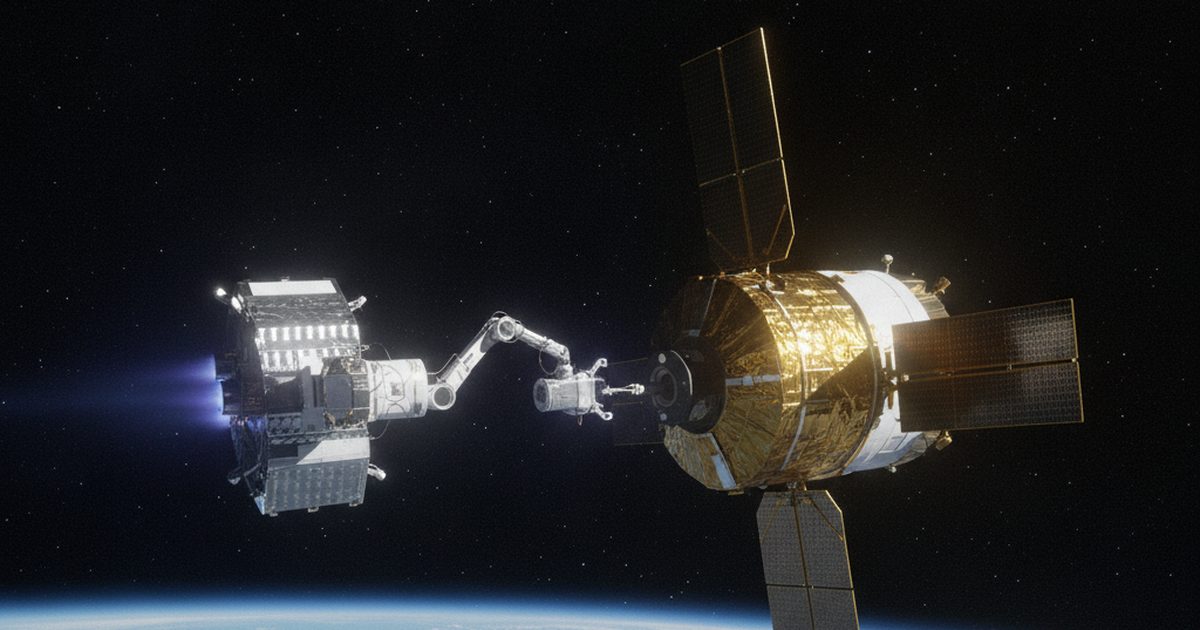
The resulting spacecraft, called LINK, weighs approximately 880 pounds and stands about five feet tall — roughly one-third of Swift’s overall size. Nearly 20 feet of solar panels power three ion thrusters and three robotic arms. Once in orbit, LINK will spend several weeks in commissioning before slowly approaching Swift, surveying the observatory, and grappling it with its robotic arms. It will then use its ion thrusters to gradually raise Swift’s orbit to approximately 370 miles — close to its original operating altitude — over several months.
Air-Launched Into Orbit
LINK is riding a Northrop Grumman Pegasus XL — an air-launched rocket that requires no fixed launch pad. A modified Lockheed L-1011 aircraft called Stargazer will climb to approximately 40,000 feet over the atoll, release the Pegasus XL, and the rocket’s three solid-fuel stages will fire in sequence to carry LINK to orbit. The air-launch approach gives mission planners flexibility on both timing and orbital insertion parameters.
The Pegasus XL and Stargazer departed NASA’s Wallops Flight Facility in Virginia on June 18 and have been staging at Kwajalein ahead of Tuesday’s window.
The Debris Angle: Servicing as an Alternative to Disposal
For the orbital debris community, the stakes in tomorrow’s launch extend well beyond a single aging observatory.
When satellites in low Earth orbit run out of fuel or cease functioning, the standard outcome is passive decay toward reentry. The timeline is governed by altitude and atmospheric conditions — factors that, during solar maximum, become increasingly difficult to predict with precision. An uncontrolled reentry of a spacecraft Swift’s size creates uncertainty about fragmentation altitude and ground track until shortly before it occurs.
The Swift Boost mission proposes a different path: commercial servicing as an active alternative to decay and disposal. If LINK succeeds, it will demonstrate that a spacecraft not designed for on-orbit servicing can still be captured, stabilized, and repositioned — potentially extending its useful life by years.
That precedent matters. Dozens of aging U.S. government satellites in LEO and geosynchronous orbit carry no serviceable interfaces but remain otherwise functional. A proven capability to boost or reposition them on demand changes the calculus for mission planners weighing costly replacements against fleet management strategies that simply didn’t exist when those spacecraft were built.
The concept is not entirely new. Northrop Grumman’s Mission Extension Vehicle program has docked with aging commercial satellites in geostationary orbit to extend their service lives — a model now surfacing its own complications for space situational awareness systems. Swift Boost tests a similar approach in a more demanding environment: LEO, with its higher debris density, faster orbital dynamics, and shorter reaction timelines. The June fragmentation of a Chinese Zhuque-2E upper stage, which added up to 150 trackable debris pieces to an already crowded LEO, underscores why keeping functional satellites operational matters beyond any single mission.
“Swift wasn’t designed to be serviced,” Katalyst CEO Ghonhee Lee said in a NASA statement. “By demonstrating we can quickly and cost-effectively extend its lifetime, we’re creating a blueprint for servicing spacecraft that were never designed for on-orbit maintenance.”
What Comes Next
If Tuesday’s launch proceeds on schedule, LINK will spend the coming weeks undergoing orbital commissioning before beginning its approach to Swift. The actual orbit raise is not expected to be complete until later this year — making tomorrow’s liftoff the first step in a months-long operation rather than an immediate resolution.
NASA has characterized the mission as “high-risk, high-reward.” Swift’s science team has been waiting. So, increasingly, has the satellite servicing industry.
Subscribe to FODNews for continued coverage of the Swift Boost mission and orbital debris developments worldwide.