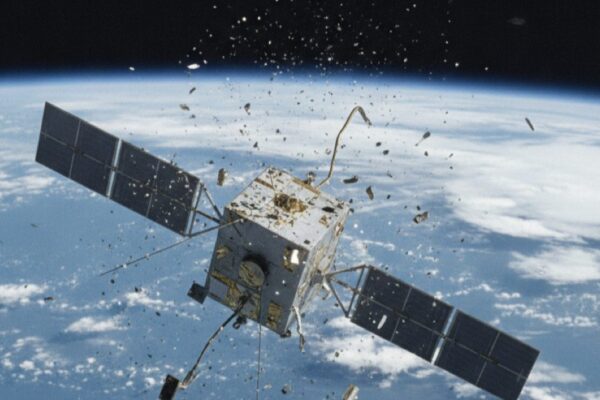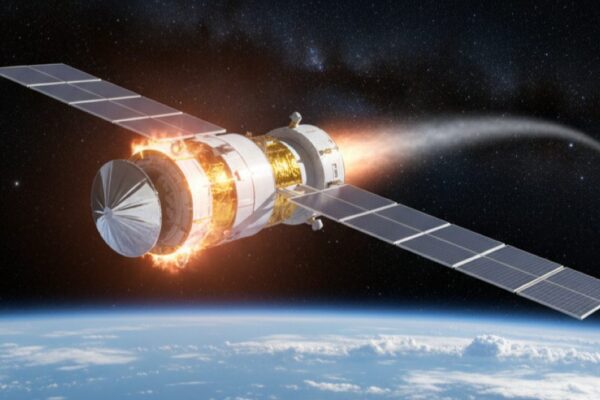

The European Space Agency has picked a Luxembourg-based tracking company to help answer one of orbital debris management’s hardest questions. It’s not just when a dead satellite or spent rocket stage will fall from orbit, but where it will actually land. ESA announced Aug. 31 that it selected NorthStar Earth & Space to lead the FALCON consortium. The new effort is aimed squarely at closing the ground-impact risk gap that has long limited uncontrolled-reentry forecasting.
FALCON stands for Forecasting of Atmospheric Location and Chronology of Re-entry. NorthStar’s European subsidiary will lead the project. Two academic partners join the effort: Universidad Carlos III de Madrid (UC3M) in Spain and Romania’s Institute of Space Science (ISS). Together, the three organizations will build probability-based forecasts. Those forecasts will show when and where uncontrolled rocket bodies and defunct satellites will break apart and strike the ground.
What the ground-impact risk gap actually means
Space agencies track tens of thousands of objects in orbit. Indeed, they can usually tell when an uncontrolled object’s altitude is decaying toward reentry. An object in low Earth orbit travels at roughly 17,000 mph, circling the planet every 90 minutes or so.
That speed makes small timing errors enormous on the ground. If a forecast is uncertain by even a few hours, the potential impact zone can stretch across multiple continents. That’s because the object covers thousands of miles with every orbit. Existing tracking systems are good at confirming an object is coming down. However, they are far less reliable at narrowing that window. The gap makes it hard to warn a city, close airspace, or clear a shipping lane in time.
NorthStar and ESA pointed to recent, concrete cases of that gap causing real disruption. In 2025, rocket debris fell in Poland. Last year, uncertainty about a large rocket stage’s descent triggered airspace restrictions over Spain. Neither event caused injuries, but both forced last-minute, wide-margin precautions that a tighter forecast could have narrowed.
Fusing three data streams into one forecast
FALCON’s approach stacks three separate data sources on top of each other. Instead, it doesn’t rely on any single one. NorthStar will contribute high-cadence observations from its commercial space-based optical sensors, which watch non-cooperative objects as they lose altitude. Meanwhile, ESA will add its own ground-based radar and optical observation networks. Layered on top of both is atmospheric drag and thermomechanical modeling. Together, they predict how and where a decaying object will structurally break apart and scatter fragments during reentry.
The academic partners bring specialized modeling expertise that NorthStar doesn’t have in-house. UC3M contributes work in Bayesian inference, Gaussian process modeling and uncertainty quantification for orbital dynamics. Previously, the university led ESA’s UNCPROP project, which pioneered probabilistic reentry time-window estimation. Similarly, Romania’s Institute of Space Science brings physics-based modeling of the thermosphere and ionosphere. It also operates the FORIND forecasting service as part of ESA’s Space Weather Service Network. Additionally, all three organizations are collaborating on a related ESA effort called RAPTOR, focused on atmospheric error modeling. That existing work gives FALCON a technical foundation to build from, rather than starting from scratch.
The goal isn’t a single point-in-time prediction. Instead, it’s a probability distribution — a forecast that expresses reentry timing and location as a range of likelihoods rather than one guess. The approach is similar in spirit to how hurricane forecasters model a storm’s possible landfall cone, rather than pinning down a single spot.
Part of a broader European debris push
FALCON slots into ESA’s wider Space Safety programme and its Zero Debris initiative. Both push for stricter tracking and disposal of large orbital objects before they become uncontrolled hazards. “The Agency has been actively studying the dynamics of reentry events to improve predictions, and to mitigate risks of uncontrolled reentries,” said Tim Flohrer, head of the Space Debris Office at ESA’s operations center in Darmstadt, Germany. “This project represents an important initiative in ongoing efforts to enhance the safety and predictability of reentry events.”
The timing tracks with a broader surge in uncontrolled reentries tied to rising launch cadence and mega-constellation growth. It’s a trend FODNews reported in August. That month, regulators in India, the U.S. and Europe moved to tighten disposal rules. The change came as more than a metric ton of uncontrolled debris reached the ground each week. Likewise, FALCON’s fragment-dispersion modeling is directly relevant to breakup events. One example: the Long March 6A upper-stage breakup FODNews covered in July, which scattered more than 300 tracked debris pieces in orbit.
NorthStar says the consortium will spend the next 12 months on preliminary modeling and data-architecture integration. Afterward, the team moves into live validation campaigns, using real uncontrolled upper-stage reentries as they occur to test the forecasts against actual outcomes. If the models hold up, the payoff would extend well beyond ESA’s own operations. Narrower, probability-based reentry forecasts could give civil aviation authorities, maritime operators and emergency planners worldwide a genuine tool for deciding when precautions are actually necessary. Ultimately, that would replace the current default: wide, costly exclusion zones every time something uncontrolled comes down.
Subscribe to FODNews for ongoing coverage of orbital debris tracking, reentry forecasting and space safety policy.