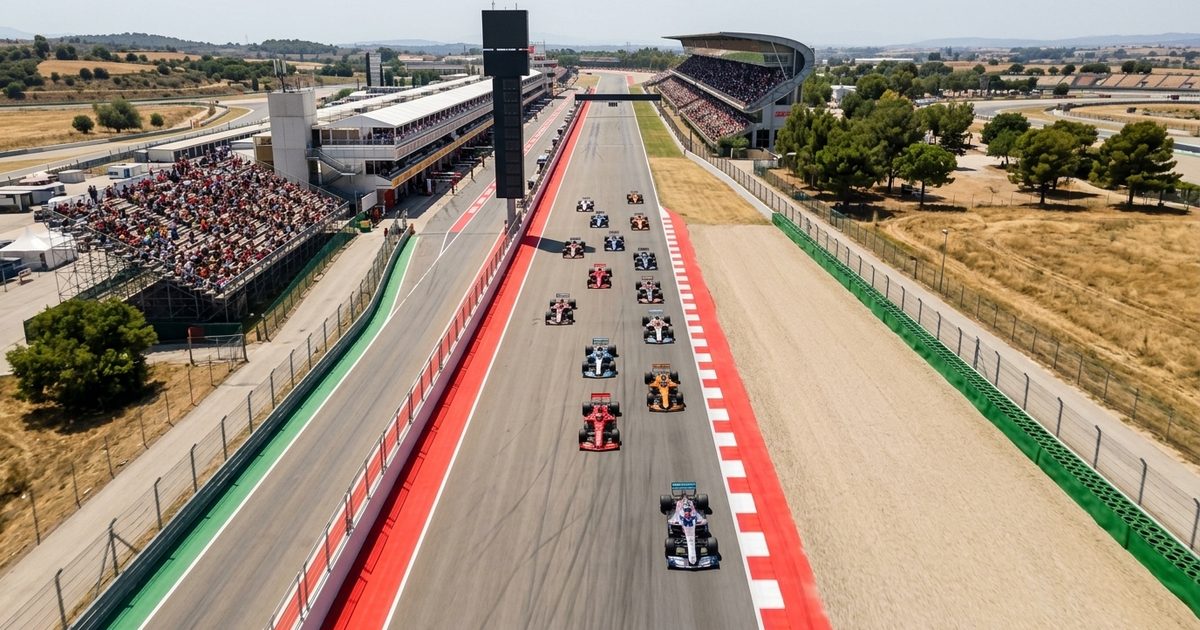
BARCELONA, Spain — Charles Leclerc’s Ferrari hit the tire barriers at Turn 4 during Q3 qualifying for the 2026 Spanish Grand Prix on Saturday, scattering car parts across the Circuit de Barcelona-Catalunya. The crash triggered an immediate red flag while marshals swept the track of debris before qualifying could resume.
The incident reshaped the front of the starting grid and extended a growing pattern of FOD events in the 2026 Formula 1 season.
Leclerc’s Q3 Crash at Turn 4
The crash unfolded on Leclerc’s first flying lap in Q3. Data analysis published by PlanetF1 shows Leclerc entered Turn 4 approximately 9 km/h faster than on his previous benchmark lap. That margin exceeded what the rear tires could support at the corner’s apex.
The excess speed induced a snap of oversteer. Leclerc’s corrective steering pushed the car onto the dirty, off-line surface on corner exit, where grip vanished entirely. The Ferrari SF-26 went head-on into the tire barrier at high speed.
Leclerc climbed out uninjured. The car’s front end sustained heavy structural damage.
Debris on Track — The FOD Event
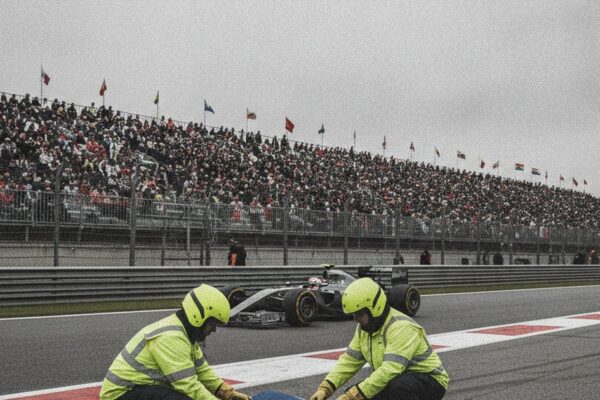
The barrier impact scattered car components across the racing surface. Officials displayed the red flag with approximately 8 minutes and 30 seconds remaining in Q3.
Marshals deployed immediately to retrieve and clear the debris field. The stoppage halted the session for all remaining competitors. At that moment, only Oscar Piastri and Max Verstappen had completed flying laps, with Piastri holding provisional pole.
When the session restarted, the compressed window forced a single-attempt push for the remaining field. Piastri held on to take pole position. Leclerc, who had not set a lap time before crashing, was classified 10th on the grid.
Leclerc Takes Full Responsibility
Speaking to media after qualifying, Leclerc was direct about the cause. “There are no excuses. It’s a mistake,” he told F1.com. He described Turn 4 as a personal weak corner and acknowledged he had simply carried too much entry speed.
Questions arose about Leclerc’s recently adopted Carbon Industrie brake discs — the same specification used by teammate Lewis Hamilton. Leclerc dismissed the connection: the brake hardware, he said, played no role in the crash.
Starting 10th, Leclerc worked his way into the points. He then retired late in the race with a reported mechanical failure — a gearbox or hydraulic issue — before the checkered flag.
Race Result: Hamilton First for Ferrari, Leclerc Retires
Lewis Hamilton won the 2026 Spanish Grand Prix — his first Formula 1 victory for Ferrari and his 106th career win. George Russell (Mercedes) finished second; Lando Norris (McLaren) was third.
For Ferrari, the result was a bittersweet split. Hamilton delivered the team’s win from the front of the grid. Leclerc, dropping to 10th after his Q3 crash, was unable to capitalize on a race-day recovery. He retired with a mechanical issue before the end, and Ferrari’s points haul at Barcelona fell short of what a Leclerc pole — achievable on pace — might have secured.
A Pattern in 2026: Two Red Flags, Two Debris Events
The Barcelona crash arrived just two weekends after a separate FOD event halted racing at Monaco. There, freshly laid tarmac at Turn 19 shattered under racing loads, scattering asphalt debris across the circuit. The stoppage triggered a 35-minute red-flag suspension starting on lap 68. FODNews covered the Monaco tarmac failure in full.
The two events represent distinct debris scenarios. Monaco involved track-surface disintegration — a materials and curing-time failure. Barcelona was crash-generated debris: fragments from a heavily damaged racing car distributed across the circuit by a high-speed impact. Both required red-flag stoppages and dedicated marshal clearing operations before racing could safely continue.
Both also illustrate how quickly a single impact point can escalate into a track-wide safety hazard. In each case, the debris field was not confined to the crash site — components and materials spread across the racing line, requiring systematic retrieval before cars could return to speed.
The FIA and circuit officials have not issued formal statements on debris management protocols in response to either incident. FODNews will continue to monitor developments.
Subscribe to FODNews for independent coverage of FOD incidents across aviation, military, and motorsport environments.
Sources
- F1.com — Leclerc: “No excuses” after qualifying crash, June 2026
- PlanetF1 — Data analysis: Leclerc’s Barcelona Q3 crash mechanics
- F1.com — Video: Leclerc crashes out of Q3 at Circuit de Barcelona-Catalunya
- ESPN — 2026 Spanish Grand Prix race result and report
- FODNews — Monaco Grand Prix: New tarmac shatters into debris, triggers red flag