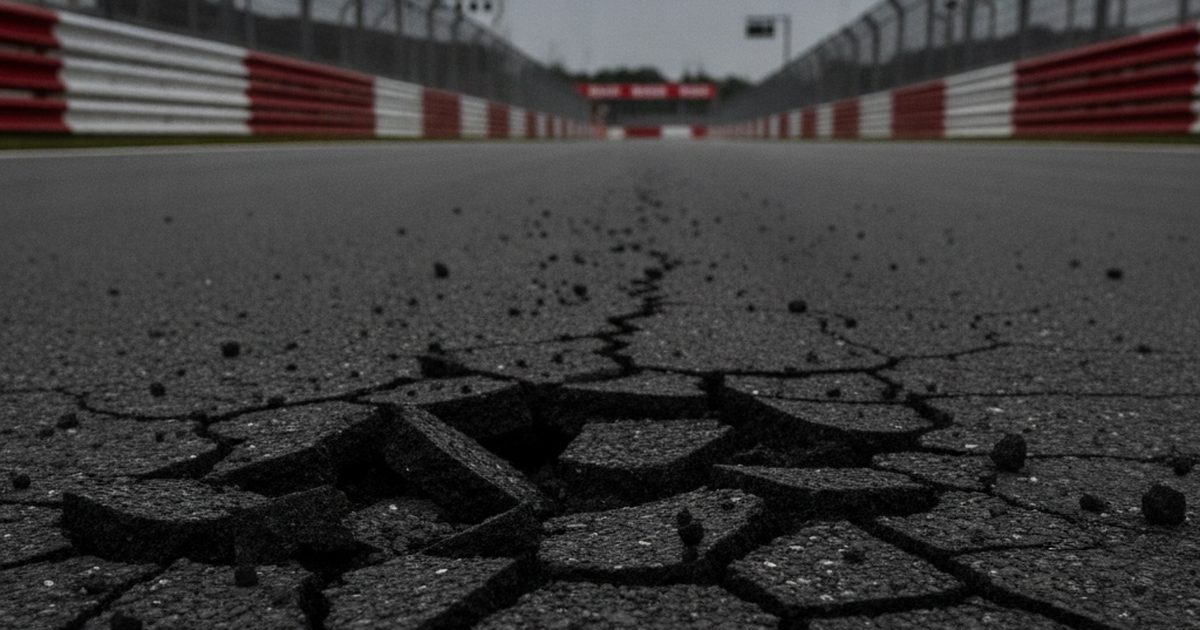
The tarmac at Monaco’s final corner broke apart during Sunday’s Formula 1 Grand Prix, scattering track debris across the racing surface. The break-up triggered a 35-minute red flag suspension — the first race-halting pavement failure in the sport since 2008.
The debris at Turn 19, also known as Anthony Noghès, contributed to separate crashes by Lance Stroll and Charles Leclerc. The FIA formally suspended the race on lap 68 of 78 “for an inspection of track break-up at Turn 19.”
Debris on the Racing Line
Broadcast footage showed chunks of tarmac and loose aggregate scattered along the left side of the track at Anthony Noghès — a recently resurfaced section of the circuit. The material had spread across the racing line, where cars follow a precise path through the final turn before accelerating onto the start-finish straight.
Sky Sports F1 analyst Anthony Davidson identified the hazard during the broadcast. “I first thought they were marbles at the side of the track, but I don’t think it is,” Davidson said. “I think this is the actual pieces of tarmac that have broken up and are laying on the side of the track. I thought it was too much of a coincidence, and it absolutely was.”
Fellow commentator Martin Brundle called the situation “highly unusual to say the least” and described it as “touch and go” as officials examined the critical exit point.
Two Crashes, Same Corner
The sequence began on lap 60, when Aston Martin’s Lance Stroll struck the barrier at Anthony Noghès. Officials immediately deployed a safety car, allowing marshals and race officials to observe the deteriorating surface from trackside.
On the restart on lap 66, Ferrari’s Charles Leclerc — in a potential second-place position at his home race — entered the same corner and crashed. His car wedged against the barrier; officials removed it by crane, ending his race on the spot.
Leclerc radioed his team: “Honestly, I’m not even going to take the f—ing blame. These f—ing brakes.”
He subsequently attributed the crash primarily to brake inconsistency, though he acknowledged the surface was a factor. “It doesn’t help to have asphalt that is coming off,” he told Sky Sports. Stroll similarly pointed to engine braking anomalies rather than the track itself.
Red Flag and 35-Minute Delay
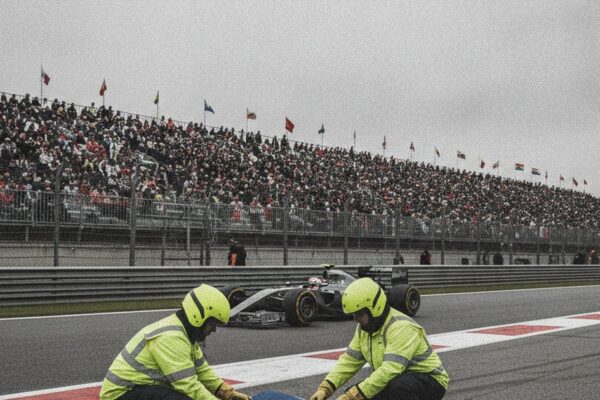
Race officials suspended the event two laps after Leclerc’s incident. They swept debris from the corner and inspected the pavement for approximately 35 minutes. Officials made no structural repairs to the broken asphalt during the stoppage.
According to GP Fans, this was the first race-affecting official response to tarmac condition in Formula 1 since the 2008 Canadian Grand Prix, when cement was applied overnight — a fix that produced minimal results. That race, like Sunday’s, ran to completion.
Officials declared the surface acceptable and restarted with a standing start, 10 laps remaining. Notably, Andrea Kimi Antonelli claimed victory for Mercedes, extending his championship lead to 66 points.
Debris as a Safety Hazard
New asphalt is inherently vulnerable to surface failure under racing conditions. Pavement binders require curing time and sustained traffic load to consolidate properly. A Formula 1 circuit subjects fresh tarmac to extreme braking forces, high cornering loads, and tire temperatures exceeding 100 degrees Celsius. Those conditions can fracture a newly laid patch before it fully bonds with the surrounding material.
Once dislodged, tarmac fragments become unguided projectiles in the traffic stream. A car cornering at speed has no practical ability to detect or avoid Monaco track debris on its chosen line. Loose material of unpredictable mass can appear without warning and cause component damage or sudden loss of control before any avoidance is possible.
Monaco’s debris problems did not begin on race day. FODNews reported Friday on two red-flag stoppages during practice, when car parts scattered across the circuit triggered crashes by Isack Hadjar and Fernando Alonso. The pattern across the full race weekend raises questions about the debris management plan for the circuit’s recent resurfacing.
Subscribe to FODNews for ongoing coverage of debris incidents across motorsport, aviation, and beyond.