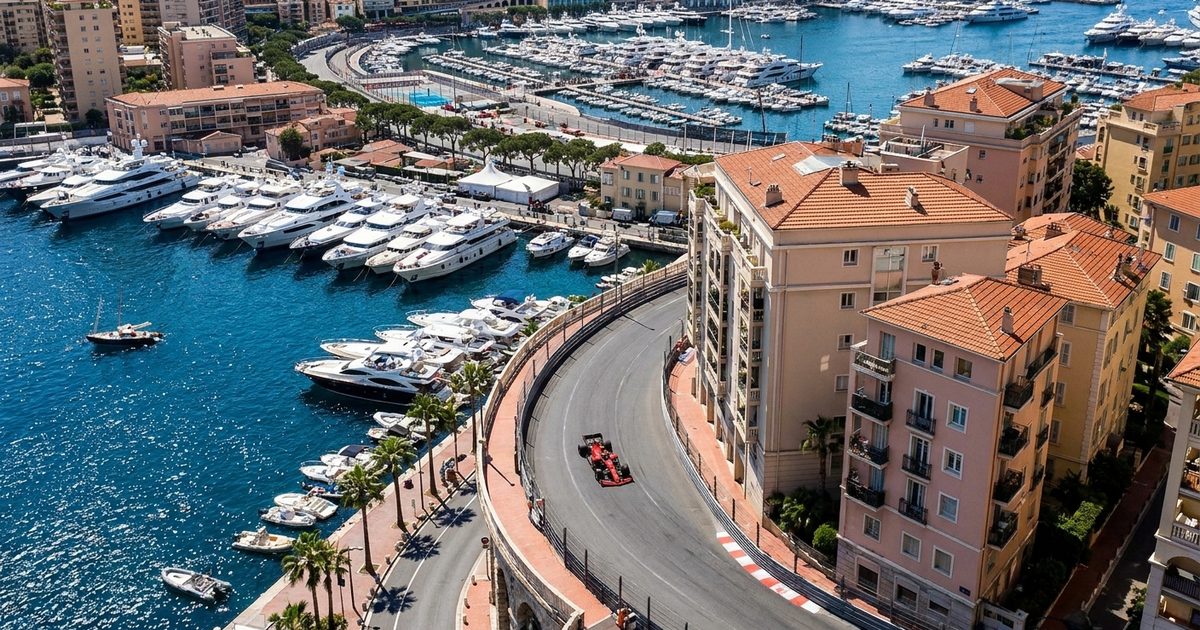
MONTE CARLO — June 5, 2026. The opening practice session of the 2026 Monaco Grand Prix was stopped twice by red flags on Friday after back-to-back crashes scattered structural debris across the racing surface — a pattern that highlights the unique track-safety hazard posed by Monaco’s wall-to-wall street layout.
Red Bull’s Isack Hadjar and Aston Martin’s Fernando Alonso were the two drivers involved, their incidents separated by roughly 24 minutes. Both required full red flags while marshals recovered cars and cleared parts from the active circuit.
Hadjar’s Swimming Pool Shunt Leaves Wheel and Wing on Track
With approximately 24 minutes remaining in the 60-minute session, Hadjar lost the rear of his RB22 at the Swimming Pool chicane. A sudden oversteer snap sent the Frenchman nose-first into the outside barrier at high speed.
The impact tore the car’s left-rear wheel completely free, leaving it — along with front-wing fragments — on the racing surface. Marshals were dispatched immediately and the red flag board was displayed while track workers cleared the stricken RB22 and collected loose components from the circuit.
“I don’t understand why it snapped like that. I’m sorry,” Hadjar radioed to his pit wall. He was uninjured and returned after the restart, classified 13th, 2.170 seconds off Leclerc’s pace.
The stoppage consumed nearly 10 minutes of track time during what had been a productive phase for many teams switching to the medium compound.
Alonso’s Mechanical Failure Drops Front-Wing Debris at Nouvelle Chicane
With barely five minutes remaining after the session resumed, Alonso’s Aston Martin lost rear grip exiting the tunnel and grazed the barrier at the entry to the Nouvelle Chicane — littering front-wing debris across the run from the tunnel exit to the chicane itself.
Alonso had flagged the risk explicitly on Thursday, warning in a media session that the AMR26 was suffering “random downshifts” capable of triggering rear locking. He noted that on a circuit this tight, such an event would have immediate consequences. It did.
Aston Martin ambassador Pedro de la Rosa, speaking at the FIA press conference moments after the incident, described “a massive rear locking issue” and confirmed that Alonso had managed to avoid a full spin only by briefly releasing the brakes. The car returned to the pits under its own power with front-wing damage. De la Rosa traced the underlying issue to driveability problems stemming from the team’s switch to Honda power units and in-house gearboxes this season.
Alonso was classified 20th and last, 2.700 seconds off the pace. The second red flag ended meaningful running for most of the field.
Monaco’s Zero Run-Off Turns Every Crash Into a FOD Emergency
The twin incidents illustrate a structural reality of the Monaco street circuit: there is nowhere for debris to go.
At permanent venues, crashed components can scatter into gravel traps, asphalt runoffs, or tire barriers that sit well clear of the racing line. Many such incidents can be cleared under a virtual safety car or even a brief yellow-flag period. Monaco offers no such margin. Armco barriers and concrete walls line both sides of the track at virtually every point, so a wheel separated at the Swimming Pool or a front wing shed exiting the tunnel comes to rest directly on the active racing surface.
The problem is not new to Formula 1 this season. A cooling fan left on a Mercedes sidepod became live track debris during Australian GP qualifying in March — an incident that unfolded on a permanent circuit with at least some runoff to absorb errant hardware. Monaco offers no such buffer at any corner.
Street circuits more broadly are presenting a recurring challenge in 2026. INDY NXT required four full-course yellows for track debris at the Detroit Grand Prix just days ago, another temporary circuit where the racing surface runs directly to concrete.
According to the official Formula 1 FP1 report, Charles Leclerc topped the session for Ferrari at 1:13.978, 0.226 seconds ahead of teammate Lewis Hamilton. Max Verstappen was third. Both Aston Martin drivers — Alonso and Lance Stroll — finished at the bottom of the 22-car order.
Free Practice 2 followed later Friday afternoon, with qualifying — where a clean track surface is at its most critical around Monaco’s barriers — set for Saturday.
Subscribe to FODNews for ongoing coverage of debris incidents in motorsport and aviation.