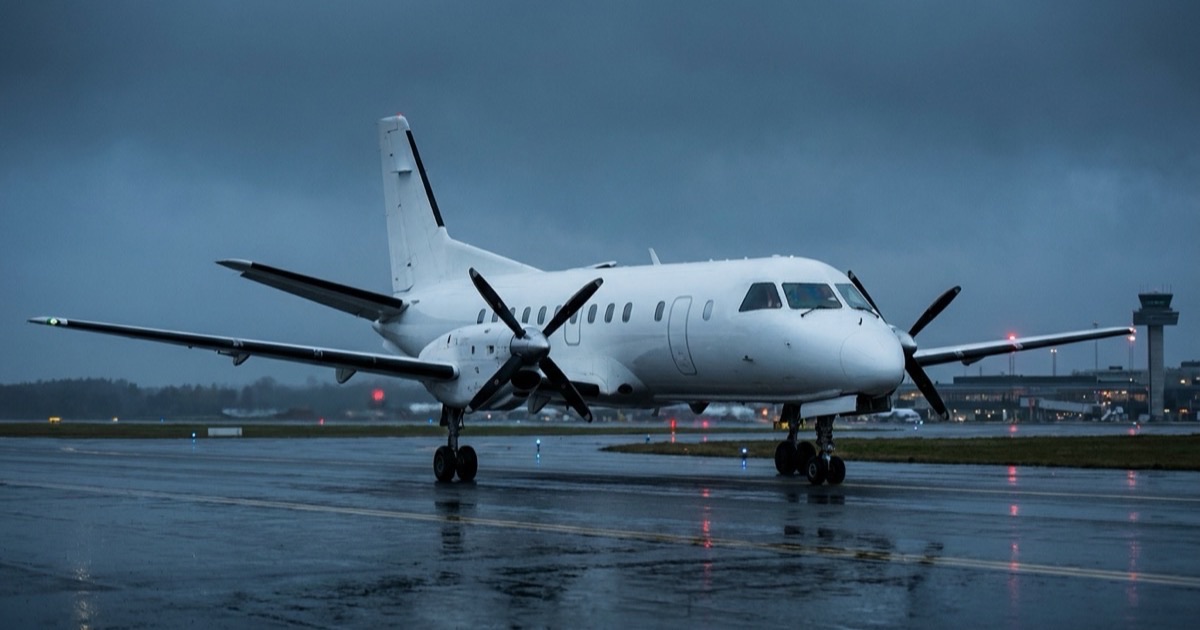
Australia’s aviation safety agency has released its final report on a Saab 340 wheel separation that turned an active runway into a live foreign object debris hazard. The Australian Transport Safety Bureau determined that bearing failure caused the left inboard main landing gear wheel to detach from a Link Airways aircraft during takeoff at Canberra Airport on Jan. 29, 2026 — depositing a wheel weighing more than 35 kilograms on the runway surface below.
Wheel Separates During the Takeoff Roll
Link Airways VH-VEZ, a Saab 340 carrying 19 passengers and three crew, was climbing out of Canberra Airport (ACT) bound for Newcastle, New South Wales, when air traffic control alerted the flight deck. ATC notified the crew during initial climb that a wheel appeared to have left the aircraft.
The crew maintained runway heading and climbed to minimum safe altitude. They reviewed the quick reference handbook but found no applicable checklist items for the situation. After assessing their options, the crew decided to return to Canberra.
They conducted a low fly-by of the control tower, which visually confirmed the left inboard main gear wheel was indeed missing. The crew then flew orbits east of the airport to prepare, assessed a normal landing configuration as most appropriate, and the captain declared a PAN. Emergency services stood by on the airfield. The aircraft landed safely on Runway 35 with no injuries.
Bearing Failure Identified as the Cause of the Saab 340 Wheel Separation
The ATSB’s final report AO-2026-008, released May 28, 2026, determined that the wheel separated due to bearing failure. However, because of the extent of damage to the bearing components, investigators were unable to establish what originally caused the bearing to fail.
The recovered wheel weighed more than 35 kilograms. A rotating main gear wheel departing an aircraft during the takeoff roll carries substantial kinetic energy. Its trajectory after separation is unpredictable — and its recovery location on the airport surface confirmed the scale of the runway debris hazard it created for other aircraft, vehicles, and ground personnel.
A 35-kg Airfield Debris Hazard in Context
Landing gear wheel separations during takeoff represent some of the most severe foreign object debris events an airfield can face. Unlike small tool drops or runway surface fragments, a departing wheel assembly is large, heavy, and energetic — capable of causing catastrophic damage to a following aircraft or injuring anyone in its path.
This incident reflects a pattern that safety professionals have documented across multiple platforms. In a similar takeoff event at Edmonton, a passenger aboard a Porter Airlines Embraer E195-E2 spotted a tire separating from the aircraft during the takeoff roll — further evidence that wheel assembly failures under departure loads can produce large debris in or near the active movement area with little warning.
ATSB Director of Transport Safety Stuart Macleod commended the response in the agency’s news release, noting that effective communication between ATC and the crew, combined with sound decision-making by the flight deck, contributed to a safe outcome for everyone on board.
Operator Responds With Fleet Inspection and Maintenance Changes
Following the incident, Link Airways conducted a fleet-wide inspection of main and nose wheel assemblies across its fleet. Investigators found no faults in the inspected assemblies. Nevertheless, the operator also implemented a proactive change to its wheel-bearing maintenance schedule — going beyond any immediate airworthiness requirement.
That response illustrates the FOD-prevention value of enhanced maintenance intervals for high-consequence components. Wheel bearings are not items typically associated with runway debris risk; however, when they fail in service, the downstream hazard is substantial. Tightening inspection cycles reduces the probability that bearing degradation reaches the point of separation — and keeps multi-kilogram hardware on the aircraft where it belongs.
Stay current on airfield debris incidents and FOD prevention reporting — subscribe to FODNews for free.