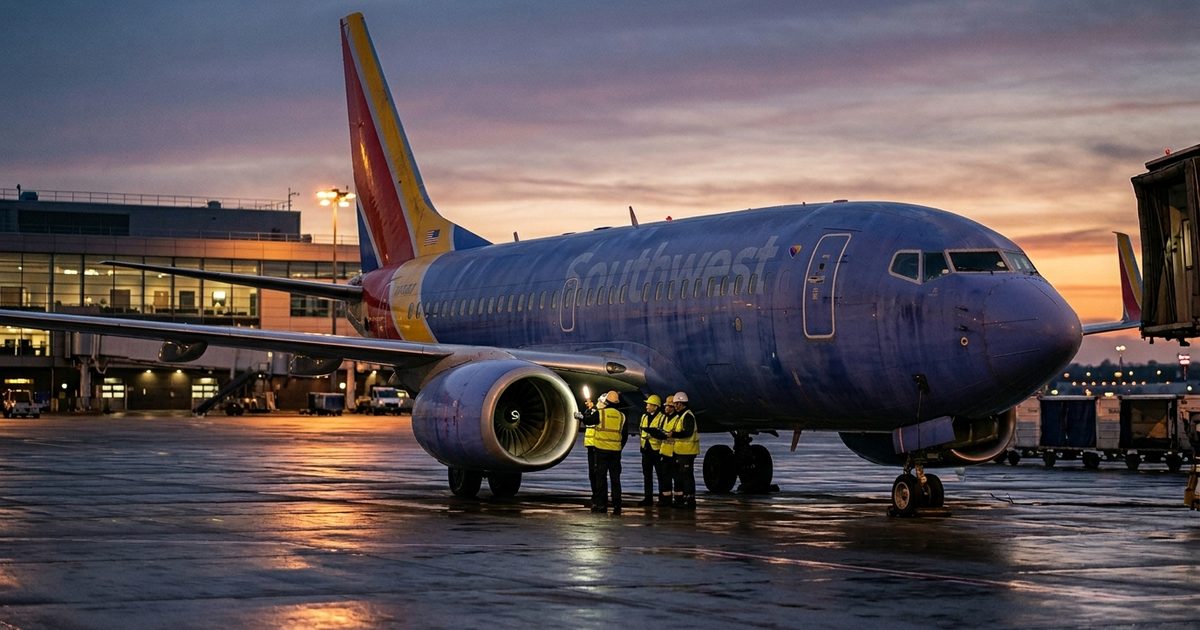
AUSTIN, Texas — A Southwest Airlines Boeing 737-700 diverted back to Austin-Bergstrom International Airport on June 4, 2026, after the crew reported right-engine problems just minutes after takeoff. Post-flight inspection revealed Southwest 737 engine debris inside the right powerplant — but the origin of that material remains unknown, and federal investigators are now involved.
Flight WN375 Turns Back at 13,000 Feet
Southwest Flight WN375 departed Austin-Bergstrom International Airport (AUS) at approximately 11:53 a.m. local time, bound for Phoenix Sky Harbor International Airport (PHX).
As the aircraft climbed through 13,000 feet, the flight crew reported anomalies with the right engine and requested an immediate return to Austin. Pilots told air traffic controllers they had not received an engine fire warning — but conditions in the cockpit were significant enough to divert and request emergency services meet the aircraft on arrival.
A weather system north of Austin briefly delayed the approach. The Boeing 737-700, registration N7855A, descended to approximately 5,000 feet and circled the area before receiving clearance to land. The aircraft touched down roughly 40 minutes after departure, according to flight tracking data from FlightRadar24.
Metal Debris and Internal Damage Found on Inspection
Emergency responders met N7855A on the runway for an initial review and cleared the jet to taxi to the terminal. Passengers deplaned without injury.
A more thorough post-flight inspection told a different story. Maintenance crews found metal debris and internal damage inside the right engine — consistent with the Aviation Herald report, which detailed the FAA’s own summary of the event: “Aircraft returned to airport due to an engine issue, and post-flight inspection revealed metal debris and damage to the right engine, Austin, TX.”
Southwest Airlines confirmed the diversion in a statement: “Southwest Airlines Flight 375 returned to Austin-Bergstrom International Airport on Thursday after experiencing a mechanical issue with an engine shortly after takeoff. The Crew followed procedures and the flight landed uneventfully.”
Aircraft N7855A was grounded pending investigation. Southwest substituted a replacement 737-700, tail number N920WN, for the Austin-to-Phoenix run, which arrived approximately 3.5 hours late.
FAA Opens Investigation Into Southwest 737 Engine Debris
The Federal Aviation Administration opened a formal investigation following the incident. The agency has confirmed the presence of metal debris and engine damage but has not publicly identified the source of that material.
Investigators are examining two primary scenarios: foreign object ingestion during ground operations or the takeoff roll, or an internal mechanical failure resulting from component wear or fatigue.
N7855A is 21 years old. The aircraft originally flew for China Eastern Airlines before joining Southwest’s fleet roughly nine years ago. Records show no prior incidents associated with the airframe.
FOD Ingestion or Internal Failure: Two Plausible Causes
Foreign object debris — loose material on runways, taxiways, and aprons — poses a persistent threat to jet engines. During takeoff, hard objects such as gravel, fasteners, or pavement fragments can be ingested and fragment turbine blades, scattering metal shards through the engine core.
Internal component failure is an equally credible explanation. Fan blade fatigue, degraded shaft bearings, and gearbox wear are all known to generate metallic debris without any external source. Extreme heat cycling over years of service can also cause blade-tip delamination, releasing small metal fragments into the engine flow path.
In the case of Flight WN375, neither scenario has been confirmed or ruled out. The FAA investigation is ongoing, and the aircraft remains grounded.
Stay current on FOD incidents and aviation safety developments — subscribe to FODNews.
Sources
- Simple Flying — “Metal Debris”: Southwest Airlines Boeing 737 Diverts Back To Austin With Damaged Engine
- AviationA2Z — Southwest Boeing 737 Makes Emergency Return After Mysterious Metal Debris Found in Engine
- Paddle Your Own Kanoo — Southwest Airlines Boeing 737 Diverts Back to Austin With Mysterious Metal Debris in Engine
- Aviation Herald — Southwest Airlines Boeing 737-700 N7855A, incident at Austin on Jun 4th 2026