
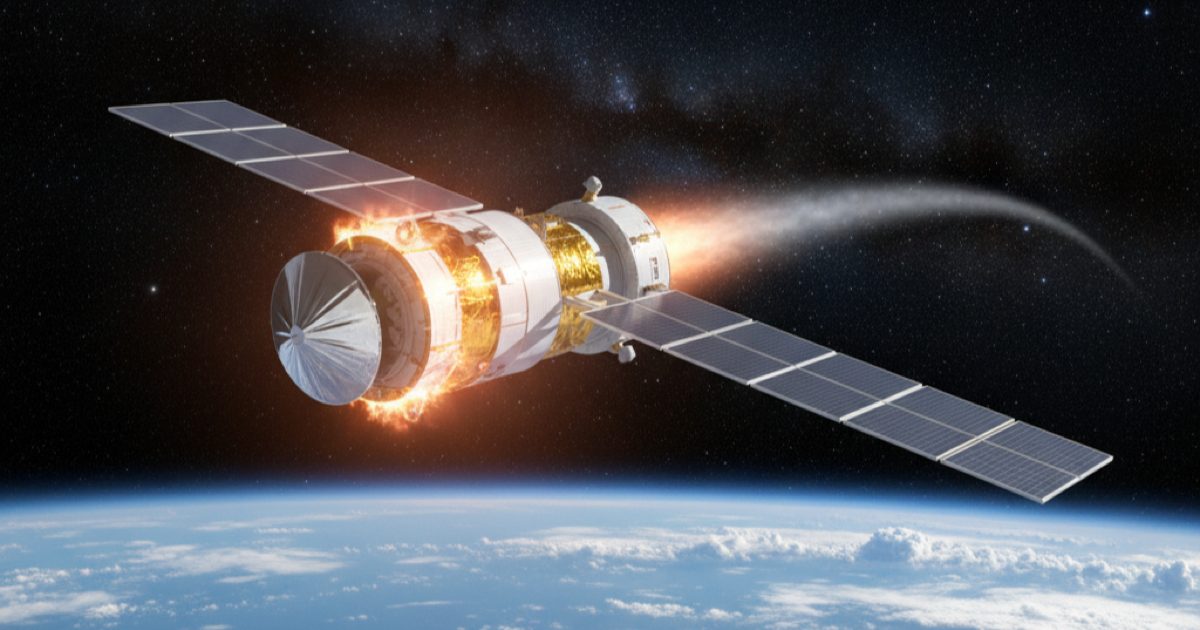
NASA‘s Neil Gehrels Swift Observatory is headed for an uncontrolled reentry after a commercial rescue attempt failed to arrest its 22-year-old orbit’s decay, the agency confirmed in statements issued between Sept. 30 and Oct. 2, 2026. The 3,200-pound gamma-ray burst hunter, circling roughly 200 miles above Earth, is expected to drop below a critical altitude threshold in early-to-mid October, after which its fall becomes effectively irreversible.
As of Tuesday, Oct. 6, 2026, Swift has not yet reentered. NASA’s public affairs office told Space.com the spacecraft “is not likely to reenter sooner than October” and said it would “share more information as reentry approaches, following established interagency procedures for such notifications.” The Associated Press has reported an expected reentry in early November, while NASA’s own statement frames the timeline more broadly, saying that without intervention, “Swift was going to re-enter the atmosphere by year’s end.”
Swift observatory reentry follows failed $30 million rescue
Swift launched in November 2004 to study gamma-ray bursts — the most powerful explosions in the universe — and served two decades as a rapid-response tool for astronomers tracking fast-changing cosmic events, from black hole flares to interstellar comets. Designed for a two-year mission, it had no onboard propulsion to counter atmospheric drag. Intense solar activity accelerated that drag in 2025 and 2026, pushing the $500 million observatory toward a premature reentry.
In September 2025, NASA awarded a $30 million contract to Katalyst Space Technologies, a Flagstaff, Arizona-based servicing company, to build and fly a rescue spacecraft within roughly a year. The resulting craft, LINK, launched July 3, 2026, from Kwajalein Atoll aboard a Northrop Grumman Pegasus XL rocket, carrying three robotic arms meant to capture Swift and boost it to a longer-lived orbit.
The mission unraveled quickly. Electronic failures knocked out two of LINK’s three reaction wheels, and a faulty valve sent the spacecraft into an uncontrolled spin that disrupted communications. Flight controllers regained control, and engineers later guided LINK to within nine miles of Swift, but the craft lacked fuel to complete a capture. NASA called off the rescue on Aug. 19, 2026. LINK itself reentered and disintegrated on Sept. 25, 2026, according to Katalyst.
NASA says risk to people on the ground is low
NASA Administrator Jared Isaacman said in the agency’s statement that “this is not the outcome we were working toward, but it does not change why this mission was worth attempting.” Shawn Domagal-Goldman, director of NASA’s Astrophysics Division, added that the agency is “capturing lessons learned” for future servicing missions. Katalyst CEO Ghonhee Lee said the company “took on this high-risk, high-reward challenge” and would carry the experience forward.
NASA’s Alise Fisher confirmed to Space.com that the agency expects most of Swift’s structure to burn up during descent, “but some components are expected to survive reentry. The risk of harm coming to anyone on Earth is unlikely.” Space-tracking firm LeoLabs echoed that in a statement to CNN, saying the probability of surviving debris “causing significant property damage or physical harm to anyone is very small,” with wreckage most likely to fall into the ocean or uninhabited land. Because Swift’s orbit is inclined 21 degrees, debris could come down anywhere between 21 degrees north and south latitude — a band spanning most of the tropics.
Another entry in a growing uncontrolled-reentry ledger
Swift’s fall adds to a string of large, uncontrolled reentries that has drawn scrutiny from orbital-debris trackers and regulators as low-Earth-orbit traffic grows. FODNews covered LINK’s launch in June, when the mission was framed as a test of commercial satellite servicing as much as a telescope rescue. With that rescue closed out, Swift joins a growing list of aging spacecraft whose unpredictable reentries have become routine as NASA, the U.S. Space Force and commercial trackers race to forecast decay windows that typically narrow only in the final days before impact.
Subscribe to FODNews for continuing coverage of FOD incidents and prevention worldwide.
Sources
- NASA — “NASA Updates Next Steps for Commercial Swift Boost Mission” (Aug. 19, 2026)
- NASA Science — “NASA Highlights Lessons Learned From Swift Boost Mission” (Sept. 28, 2026)
- CNN — “NASA’s Swift telescope will soon burn up in Earth’s atmosphere” (Sept. 30, 2026)
- Space.com — “NASA’s Swift space telescope will crash back to Earth — but when and where is anyone’s guess” (Aug. 27, 2026)
- Los Angeles Times (AP) — “Private spacecraft burns up in Earth’s atmosphere after failing to rescue aging NASA telescope” (Sept. 27, 2026)
- Ars Technica — “Here’s why NASA is celebrating the failed mission to save the Swift Observatory” (Oct. 1, 2026)