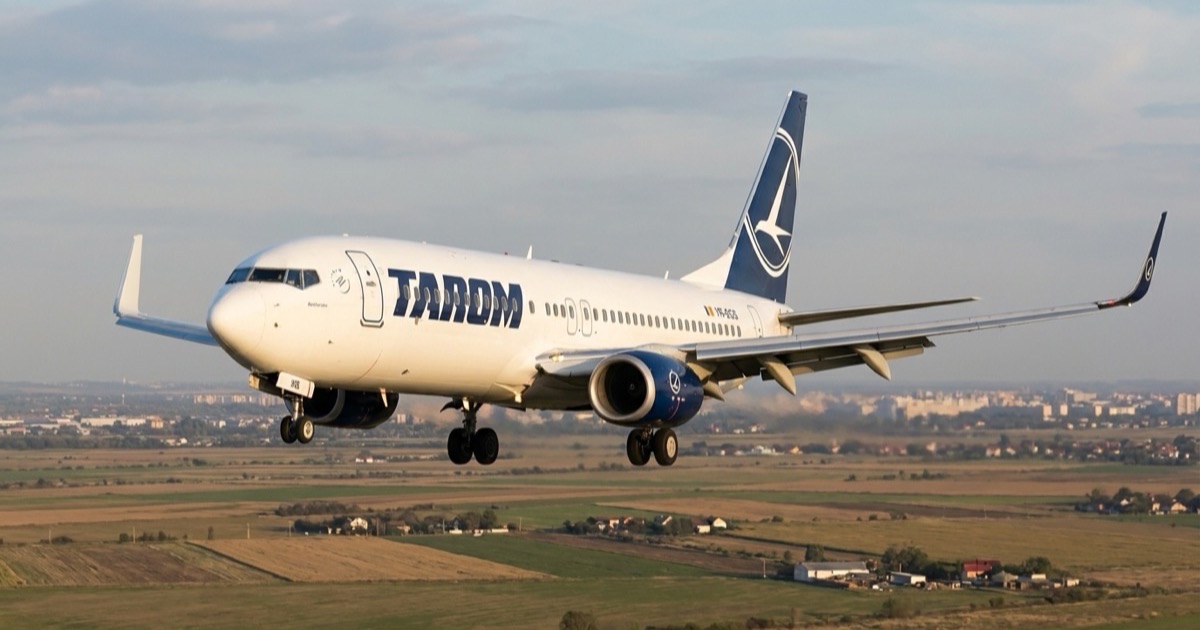
A TAROM bird strike diversion sent a Boeing 737-800 back to Bucharest instead of Antalya on Saturday. The aircraft struck a flock of birds moments after departing Cluj-Napoca, and the crew, carrying roughly 170 passengers, opted not to continue on to Turkey.
Flight RO4477 had barely left the runway at Cluj-Napoca’s Avram Iancu Airport around 2:20 p.m. local time when passengers heard a loud bang. Indeed, most had no idea what had happened. The aircraft was already headed toward Henri Coandă International Airport in the capital, roughly 45 minutes away, before the cause became clear.
“I Hit a Bird”: The Radio Call That Explained the Bang
Cockpit-to-tower audio captured the moment the crew reported the strike to air traffic control. “I hit a bird,” the pilot radioed. “We’d like to continue to Bucharest, if possible.”
The aircraft, registered YR-BGK and nicknamed “Marea Unire,” is a Boeing 737-800NG that joined the TAROM fleet in 2017. According to the crew’s account to controllers, the engines were not affected by the strike. The bigger concern was the nose. The pilot told controllers he believed the radome and forward section of the aircraft had taken the impact. He added that returning to Bucharest made more sense than continuing to Antalya, since TAROM’s maintenance base and technical staff are there.
TAROM spokesperson Silvia Teodorescu confirmed a bird strike caused the diversion. As a result, crews pulled the aircraft from service for inspection, she said. “There are several parts and components that need to be checked,” she said. Rather than wait for repairs, the airline swapped in another 737-800, registered YR-BGJ, to complete the Antalya charter.
No Injuries, But a Five-Hour Delay
No injuries were reported among the passengers or crew. Meanwhile, passengers deplaned at the terminal in Bucharest and waited for the replacement aircraft. It departed for Antalya later that evening. The total delay for the flight, which started in Cluj-Napoca that afternoon, ran to roughly five hours.
Still, the exact scope of the damage to YR-BGK has not been made public. Bird strikes to the nose and radome area are common enough that most carriers, including TAROM, require a full inspection before an aircraft returns to service. That holds even when the strike doesn’t appear to have caused structural damage. A bird impact strong enough to be heard throughout the cabin can still crack radome fiberglass or dent leading-edge surfaces that aren’t visible without a close ground inspection.
TAROM Bird Strike Diversion Fits a Recurring Pattern
Saturday’s incident joins a string of takeoff-phase bird strikes that have forced diversions or emergency returns in recent weeks. A Southwest 737 MAX diverted to Baltimore-Washington International after a bird strike on departure from Reagan National. A Ryanair 737 MAX diverted to East Midlands Airport with engine damage after striking birds leaving Norwich. In each case, the crew judged it safer to land nearby with maintenance support. Pushing on to the original destination simply wasn’t worth the risk.
The European Union Aviation Safety Agency tracks wildlife strikes as a persistent operational hazard. Notably, it flags spring and autumn migration seasons as the highest-risk windows. The agency recommends aerodromes run active wildlife-monitoring and habitat-management programs to cut the frequency of strikes near runways. Late September falls within that autumn migration window across much of Europe, when bird activity near airports tends to spike.
As of Saturday, TAROM has not said whether it identified the birds by species. Romanian aviation authorities haven’t indicated whether they’ll open a formal investigation, which is typical for bird strikes that don’t cause injuries or an aborted takeoff.
Subscribe to FODNews for continuing coverage of FOD incidents and prevention worldwide.