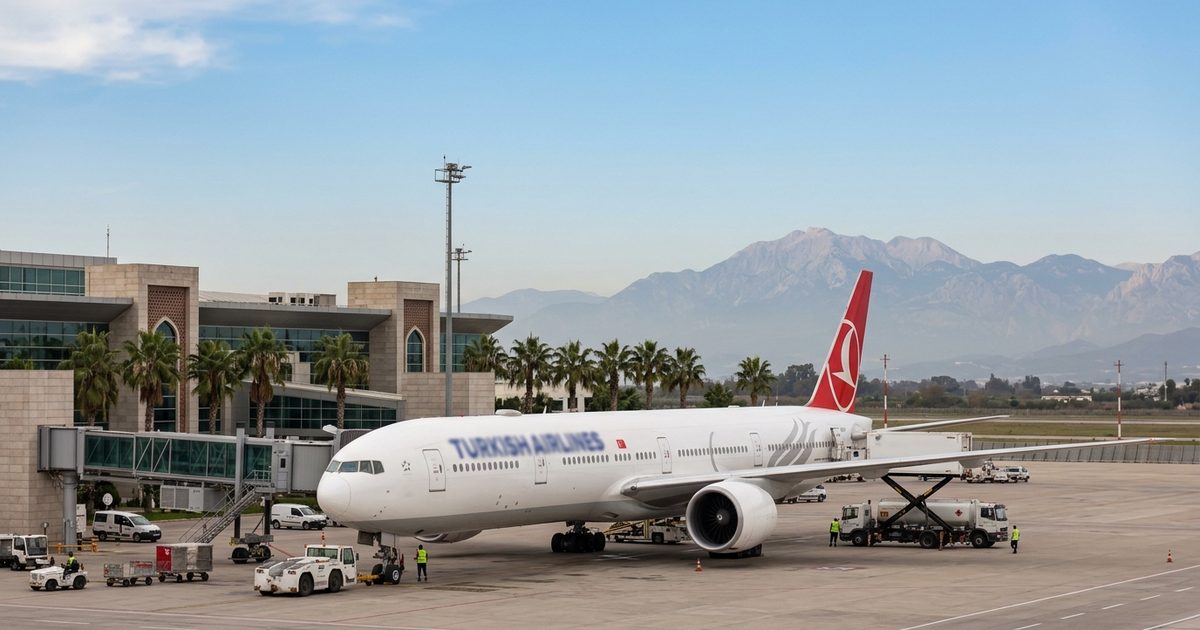
ANTALYA, Turkey — A Turkish Airlines Boeing 777-300ER struck a ground radar mast on the apron at Antalya International Airport on Thursday evening. The pole toppled into the aircraft’s fuselage, forcing the evacuation of all 267 passengers aboard.
Flight TK2430 operated a scheduled domestic route from Istanbul Airport (IST) to Antalya (AYT), landing normally at approximately 8 p.m. local time on June 11, 2026. Trouble began during the post-landing taxi phase when the aircraft’s right wing clipped the radar installation on apron 1.
The impact collapsed the mast, which then penetrated the fuselage skin and breached the cabin wall. Oxygen masks deployed automatically. At least one overhead bin tore from its housing.
In a statement to Simple Flying, Turkish Airlines confirmed significant damage to the right wing and rear fuselage: “Our Boeing 777 aircraft, registered TC-LKD, operating flight TK2430 from Istanbul to Antalya, contacted the ground radar antenna pole on its right wing while taxiing to its parking position at Antalya Airport.”
All 267 passengers evacuated the aircraft. The airline confirmed one passenger sustained minor injuries and remained in good health. Early media reports cited as many as three injured; the Turkish Airlines official statement is the most authoritative count available.
The aircraft, registration TC-LKD, is a 17-year-old Boeing 777-3Q8ER built in 2009. It returned from a nearly three-year IndiGo lease in March 2026 and had not yet been repainted in Turkish Airlines’ standard livery.
Wrong Lane, Wrong Aircraft for the Route
Meanwhile, Turkey’s Ministry of Transport attributed the collision to a taxiway routing error: the aircraft “entered the taxiway from the wrong lane after landing on our airport’s runway and collided with a ground radar mast on apron 1.”
Data filed with the Aviation Safety Network reveals the physical mismatch that made the error so consequential. The distance from the taxiway centerline to the base of the radar pole was approximately 29 meters (95 feet). The Boeing 777-300ER has a wingspan of 64.8 meters, placing each wingtip 32.4 meters from the aircraft’s centerline — more than 3 meters beyond what the taxiway offered.
Antalya Airport marks each taxiway with maximum allowable wingspan restrictions, and the path where TC-LKD struck the mast carried no approval for a widebody of the 777’s size.
Investigators are weighing two probable explanations. The crew may have missed a turn or taken the wrong taxiway entrance — plausible, since cockpit crews cannot directly see their own wingtips. Alternatively, ground control may have issued a routing clearance intended for a smaller aircraft. Investigators have not identified a preliminary cause.
Safety Infrastructure Became the Hazard
The incident carries a particular irony: the object that breached the cabin wall was itself part of the airport’s ground safety infrastructure. Ground radar installations track surface movements and improve situational awareness — the very systems meant to help prevent apron mishaps.
The collision raises questions about how airports site infrastructure relative to taxiway centerlines, and whether placement standards adequately account for the clearance demands of modern widebody aircraft. Ground operations place aircraft in closest proximity to fixed obstacles while constraining crew visibility of lateral clearances.
The incident adds pressure to a broader conversation about apron safety technology. As FODNews reported this week, Amsterdam Schiphol has begun deploying autonomous FOD detection systems as part of its electric TaxiBot program — one example of airports investing in ground-level surveillance to reduce runway and apron hazards.
Turkish Airlines Radar Mast: Repairs and Investigation
Crews towed TC-LKD to a parking area at Antalya Airport; the jet is grounded pending technical inspection. Turkish Airlines has formally launched a technical investigation. Turkey’s Directorate General of Civil Aviation is expected to review airline, airport, and air traffic control records under ICAO protocols.
The repair timeline remains uncertain. The right wing — which houses fuel systems and load-bearing structural spars — requires thorough assessment for fatigue damage. Breached fuselage sections must be cut out and replaced to restore pressurization capability. Estimates suggest the process could take weeks to several months depending on the full scope of structural damage.
Authorities have released no preliminary findings as of Saturday, June 13.
Subscribe to FODNews for continuing coverage of aviation ground safety incidents and FOD prevention developments.
Sources
- Simple Flying — Turkish Airlines Boeing 777 Knocks Over Radar Tower While Taxiing, Mast Pierces Cabin
- Aviation Safety Network — Incident: Boeing 777-3Q8ER TC-LKD, Thursday 11 June 2026
- Aviospace.org — TK2430: Turkish Airlines 777-300 ER Damaged After Radar Tower Collapse at Antalya Airport