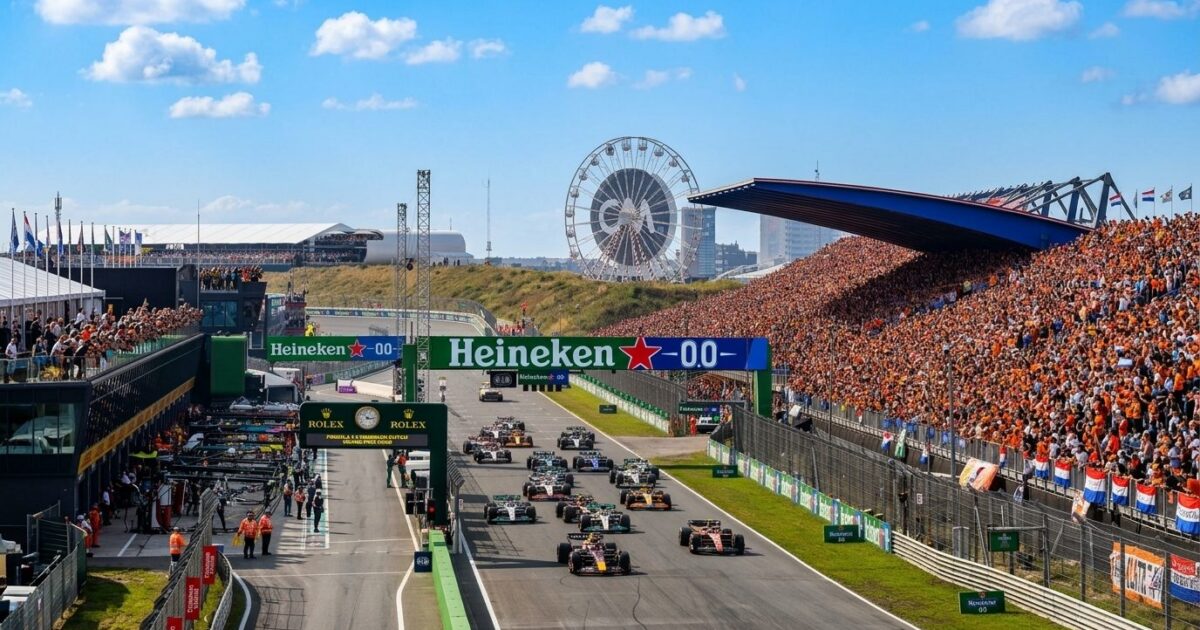
ZANDVOORT, Netherlands — A violent first-lap crash by home favorite Max Verstappen scattered carbon-fibre wreckage and a torn-off wheel across Circuit Zandvoort on Sunday. Race control threw a red flag on the Dutch Grand Prix so marshals could clear the debris and check a damaged barrier before racing could resume.
The crash happened at the end of the opening lap, at Zandvoort’s banked final corner, known as the Luyendyk corner. Because Zandvoort’s contract does not extend beyond this season, it may have been Verstappen’s last home race at the circuit.
Verstappen was driving a Red Bull RB22 and had started seventh. He clipped the inside line through the corner on a patch still damp from a pre-race shower. The rest of the track had dried enough for every driver to start on slick tires. According to Autosport, he hit the outside barrier head-on, then spun back across the track and came to rest on the inside line.
The impact tore a wheel loose, sending it rolling across the racing surface. Carbon-fibre bodywork fragments spread across the track near pit entry. The Race reported that race control suspended the event almost immediately, citing “the amount of debris and the precarious position of the car.”
Drivers scramble to avoid the debris field
Other drivers had to react in real time. Alpine‘s Pierre Gasly took evasive action to avoid the wreckage. Moments later, Audi‘s Gabriel Bortoleto spun at the same corner, narrowly missed by teammate Nico Hulkenberg, who was following close behind.
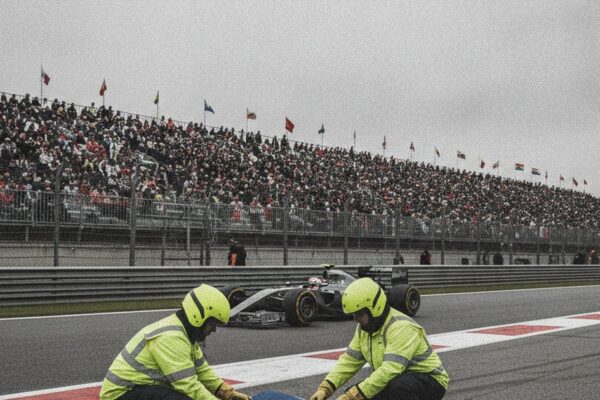
Under the red flag, cars queued in the pit lane while marshals cleared loose carbon-fibre pieces and the errant wheel from the track. Even so, Autosport noted that drivers restarting the race still had to navigate “a field of debris” near pit entry after the initial cleanup.
Race control also used the stoppage to inspect the barrier Verstappen struck. Barriers absorb enormous energy in high-speed impacts, so checking for structural damage before cars return to racing speed is standard procedure after a heavy hit.
Verstappen walks away as medical car responds
Verstappen climbed from his car unaided and radioed his team immediately to say he was unhurt. Formula 1’s medical car was automatically dispatched to the scene as a precaution, and medical staff evaluated and cleared him. The crash marked his first DNF at his home Dutch Grand Prix.
Speaking afterward, Verstappen said the damp patch at the final corner caught him off guard. “I could see a dry line coming… it caught me out,” he said. He added that he believed he struck a SAFER barrier, and that the outcome “could have been a lot worse” given how many cars were running close behind him.
A second cleanup period followed later in the race. A safety car let marshals clear additional debris from the circuit before racing resumed at speed.
Why Zandvoort called a red flag instead of a local yellow
Zandvoort’s tight, high-banked layout leaves little runoff area at several corners. As a result, debris from a crash can scatter directly back into the racing line rather than settling in a gravel trap. That geometry is part of why race control opted for a full red flag rather than a local yellow-flag zone. A large debris field on an active racing surface threatens every car still circulating at speed until it is fully cleared.
After the restart, Lando Norris went on to win the race, ahead of Kimi Antonelli and George Russell.
For more on how motorsport series manage on-track debris and safety-car cleanup procedures, see FODNews’s report on a carbon-fibre debris chain and SAFER barrier impact during Indy 500 practice.
Subscribe to FODNews for continuing coverage of debris incidents and track-safety response across motorsport.