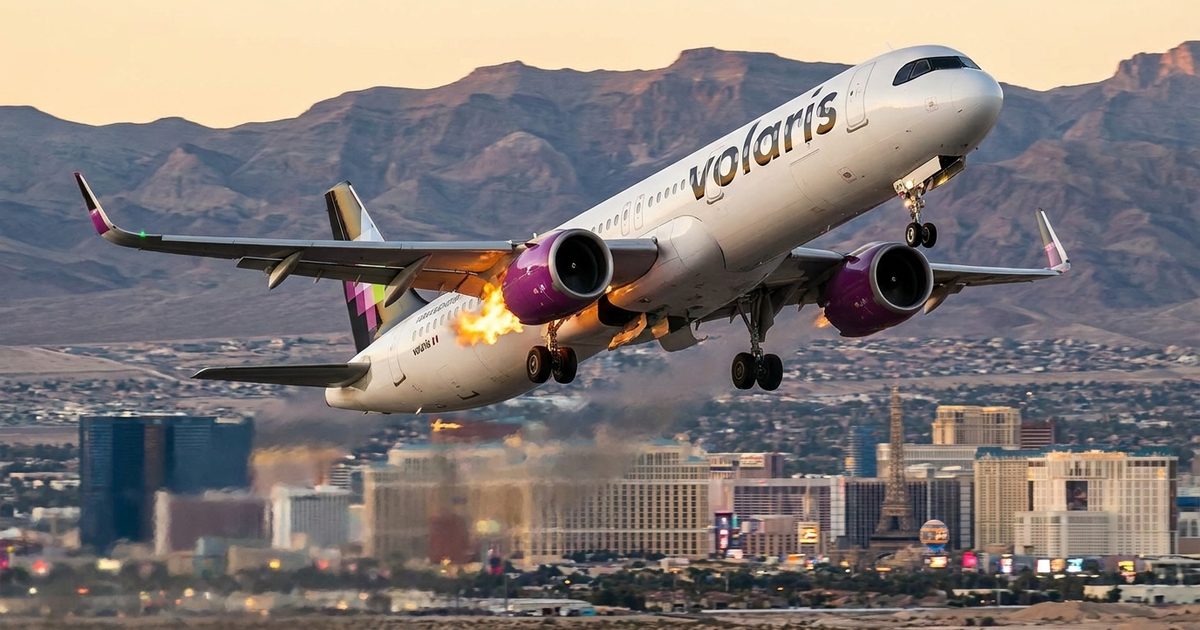
A Volaris Airbus A321neo bound for Guadalajara turned back to Las Vegas on September 14. A bird strike had ignited visible flames in its right engine seconds after takeoff, making it one of several recent bird strike engine fires to hit the A321 family this year.
Flight Y4 1741, registration XA-VUA, was departing Harry Reid International Airport‘s Runway 26R with 223 passengers. Air traffic control audio captured the crew declaring an emergency: “Flight 1741, mayday, mayday, mayday. Engine failure, requesting back to the airport.” Passengers and ground observers filmed bursts of orange flame and dark smoke pouring from the right engine nacelle during the initial climb. Some described a bang loud enough to resemble an explosion.
Forty Minutes Airborne Before the Bird Strike Engine Fire Landing
Rather than turning back immediately, the crew climbed to a safe altitude and worked through return checklists for roughly 40 minutes. The crew reported approximately 11,380 pounds of fuel on board — enough for over three hours of flight — while assessing the damaged engine. Airport rescue and firefighting crews staged on the tarmac as the aircraft lined up for Runway 26R. The A321neo landed without further incident, and all 223 passengers and crew deplaned safely with no injuries reported.
Volaris sent a replacement aircraft to complete the Guadalajara leg the following day. The airline said it provided meals and compensation vouchers. Some passengers publicly complained the compensation fell short given the scale of the scare.
Airline Cites Bird Ingestion, Official Cause Still Preliminary
Volaris issued a statement on September 15 attributing the fire to a bird strike, according to aeroTELEGRAPH. The airline said the right engine ingested a bird during the takeoff roll, triggering standard emergency protocols. Bird ingestion is a well-documented trigger for compressor stalls — a disruption in airflow through the engine’s compressor blades. That disruption can produce the kind of visible flame bursts passengers filmed, even when the engine itself sustains only localized damage.
That said, the precise cause has not been independently confirmed. Flight-tracking analysis of the incident notes the FAA‘s information remains preliminary, and investigators had not yet finalized findings as of this reporting. Volaris’s bird strike explanation lines up with the visible flame pattern and the crew’s engine failure call. It remains the airline’s account, though, pending an official determination. That’s the same posture FODNews has taken on other same-week incidents. In each, airlines named bird strikes as the likely trigger ahead of a completed investigation.
Part of a Broader Pattern of Engine-Ingestion FOD
The Las Vegas incident lands in a stretch of bird strike engine emergencies across the A321 family and beyond this year. That stretch includes a United Airlines mayday call over engine banging out of Houston. Each case underscores the same underlying hazard. A single bird ingested during the highest-thrust phase of flight can disrupt a modern high-bypass turbofan enough to force a full-emergency return. That holds true regardless of how well the aircraft’s core survives the strike.
Stay informed — subscribe to FODNews for daily coverage of FOD incidents and prevention worldwide.
Sources
- Tribuna de México. “Avión de Volaris sufre incendio en motor por ave durante despegue hacia Guadalajara” (Sept. 17, 2026)
- La Verdad. “Vuelo de Volaris regresa a Las Vegas tras incendio” (Sept. 17, 2026)
- aeroTELEGRAPH. “Airbus A321 Neo von Volaris kehrt nach Vogelschlag nach Las Vegas zurück” (Sept. 18, 2026)
- Yucatán Magazine. “Fire Breaks Out on Volaris Vegas Flight to Guadalajara” (Sept. 18, 2026)