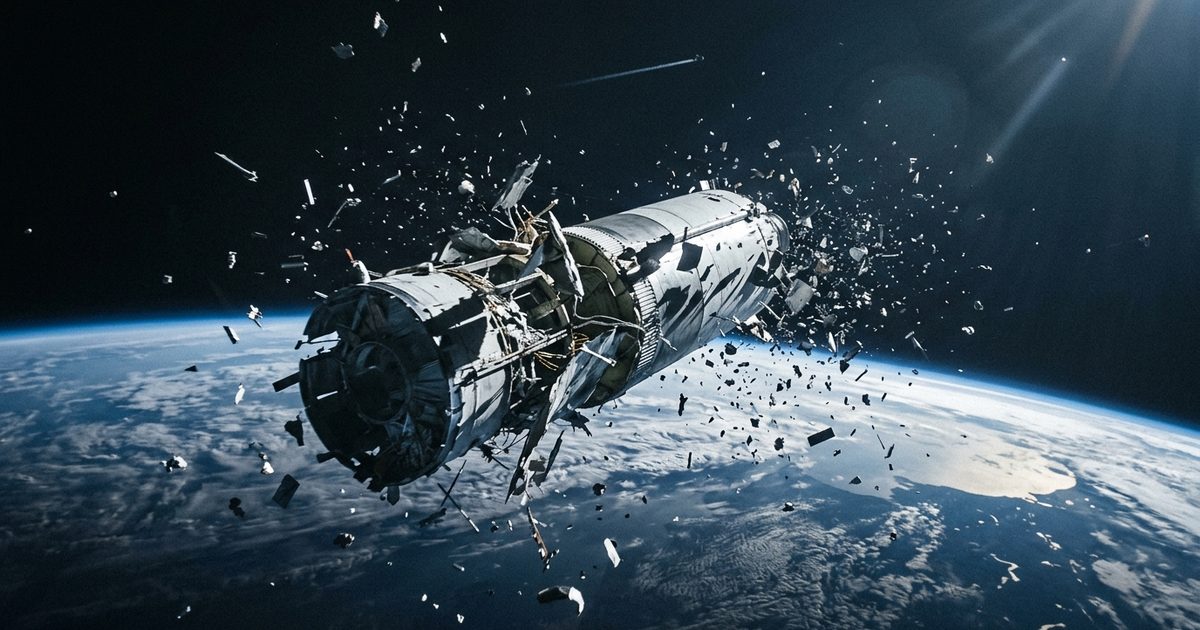
The upper stage of a Chinese commercial rocket has broken apart in low-Earth orbit, scattering debris through a heavily trafficked altitude band that is home to the International Space Station and a large share of SpaceX’s Starlink network.
The breakup involved the second stage of a Zhuque-2E rocket built by the Chinese company LandSpace, which reached orbit on June 9 carrying two satellites for direct-to-cell communications. The fragmentation occurred shortly after launch — roughly around the time the stage would have been expected to perform a disposal burn. The U.S. Space Force confirmed the event in an advisory posted to Space-Track.org, the military’s public orbit-data service.
“The tracked pieces are being incorporated into routine conjunction assessment to support spaceflight safety,” the Space Force wrote. “There are currently no threats to human spaceflight. Analysis is ongoing.”
Counting the fragments
As of mid-June, the Space Force had not yet added any of the fragments to its official catalog of human-made space objects. Darren McKnight, a senior technical fellow at the orbital-intelligence firm LeoLabs, estimated the event generated 100 to 150 pieces of trackable debris.
The largest single piece is the rocket’s upper-stage body itself — between 25 and 30 feet long and about 11 feet in diameter. It is now circling Earth between roughly 208 and 263 miles in altitude, at an inclination of 54.5 degrees to the equator. The high point of that orbit crosses the path of the International Space Station, but atmospheric drag is expected to pull the debris below the station’s altitude relatively quickly.
That same drag is the reason the event is not worse than it could have been. At this comparatively low altitude, most of the Zhuque-2E debris is expected to reenter the atmosphere and burn up within a matter of months. A fragmentation higher up — above roughly 400 miles — can leave debris in orbit for decades or centuries.
A growing threat to Starlink
The fragments pose the greatest near-term risk to satellites flying at lower altitudes, including hundreds of Starlink spacecraft — particularly newly launched satellites and those providing direct-to-device connectivity, which operate below the bulk of the constellation. Operators routinely respond to such risks with collision-avoidance maneuvers, nudging satellites onto slightly different paths when tracking data shows a close approach.
The episode lands amid mounting industry concern about orbital congestion. SpaceX itself flagged the danger in regulatory terms this month, warning in an IPO filing that orbital debris could eventually render parts of low-Earth orbit unusable.
China’s rocket-body record
The Zhuque-2E breakup is the latest entry in what analysts describe as China’s growing contribution to the space-junk problem. After decades of abandoning spent rocket bodies in orbit, launch operators in most countries now reserve enough fuel to steer upper stages back toward Earth for controlled reentries. Rocket bodies are among the most concerning debris sources because they are large and massive, and often retain residual propellant and high-pressure gases that can trigger an explosion long after a mission ends.
Russian and former Soviet rocket bodies still account for the bulk of launch-related debris in long-lived orbits, followed by China and the United States. But while the Russian and American totals are holding steady or declining, the mass of Chinese rocket bodies in those persistent orbits has grown by more than 150 percent over the past five years, according to space-domain-awareness analyst Jim Shell. The increase tracks with China’s push to launch its own megaconstellations to rival Starlink.
China’s Long March 6A rocket has a particularly poor record, including two explosions that each littered higher-altitude orbits with more than 1,000 fragments expected to linger for decades. “Three of the top four breakup events in LEO are of Chinese origin, with two of these events being from Chinese rocket body explosions in the last four years,” McKnight said.
McKnight characterized the Zhuque-2E event itself as a “slight space safety issue” given its low altitude and short expected lifetime. The broader trend, he and other analysts caution, is heading in the wrong direction — a concern echoed in recent international efforts such as the multinational ISOS orbital-debris declaration signed at the Berlin Airshow and Europe’s moves to build out independent space-debris tracking capacity.
Stay informed — subscribe to FODNews for daily coverage of FOD incidents and prevention worldwide.