
An Indian startup is poised to attempt what it claims will be the world’s first soft robotic debris capture demonstration in orbit — and it plans to do so aboard India’s first privately developed orbital rocket. Cosmoserve Space’s “Mission Embrace” features a Venus flytrap-inspired compliant arm designed to latch onto defunct satellites. The payload is manifested on Skyroot Aerospace’s Vikram-1, with its launch window open through August 4, 2026.
The rocket has not yet flown. An initial attempt within the July 12–August 4 window was postponed; no new date has been announced.
Soft Robotic Capture: A New Approach to Orbital Debris
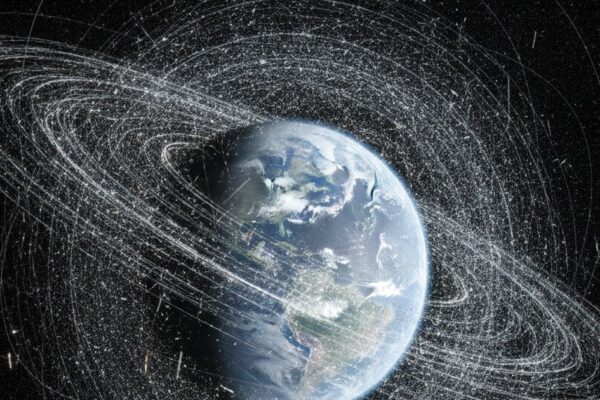
Low Earth orbit is accumulating a permanent debris field. Unlike airport runway FOD, these objects travel at roughly 17,000 miles per hour and never fall to the ground on their own. NASA estimates more than 100 million pieces of debris larger than one millimeter currently circle Earth, weighing a combined 6,000 tons.
Most proposed active debris removal (ADR) systems are rigid: robotic arms, harpoons, or nets that require precise positioning relative to a tumbling, non-cooperative target. Cosmoserve’s soft-robotic mechanism uses compliant, flexible materials that conform around irregular surfaces without requiring a special docking adapter — exactly the kind of unprepared debris cluttering LEO today.
Mission Embrace: From Concept to Launchpad in Four Months
For this demonstration, the soft-robotic arm will fly attached to Vikram-1’s payload deck. The objective: validate the capture mechanism in the space environment for the first time, proving the compliant structure performs under vacuum, thermal cycling, and microgravity.
“Mission Embrace forms part of India’s first private orbital launch while also attempting the world’s first demonstration of soft robotic capture in orbit,” said Chiranjeevi Phanindra, founder and CEO of Cosmoserve Space. “We developed this technology from concept to flight-ready hardware in just four months within a company that is less than a year old.”
The hardware cleared a full engineering review overseen by an independent committee of former ISRO scientists before receiving flight approval. The “world’s first” claim is Cosmoserve’s own; FODNews has not independently verified it against all competing programs.
The Rocket: Why Vikram-1 Matters
The mission’s significance is amplified by its ride. Skyroot Aerospace built Vikram-1 in Hyderabad as India’s first privately developed orbital-class rocket — a successful flight would mark a milestone for the country’s commercial space sector. Space.com has detailed coverage of Skyroot’s bid to make spaceflight history.
The target orbit for Mission Aagaman — Vikram-1’s test flight designation — is approximately 450 km at 60-degree inclination, placing it squarely in the crowded LEO band where debris density is highest. Aviation NOTAMs specify a possible launch on any day between July 18 and August 4, from 10:30–14:30 IST, with at least 24 hours’ advance notice.
The Business Case: Regulation and Commercial Demand
ADR has historically drawn government funding. That is changing. A new FCC rule taking full effect in 2027 requires satellite operators to deorbit defunct spacecraft within five years of end-of-mission — a sharp tightening from the previous 25-year guideline.
“In the last seven decades we have launched roughly 20,000 objects into space, and now we’re talking about launching as many as one million satellites in just the next ten years,” Phanindra told the New York Post. He estimates the commercial ADR market could reach $8 billion by 2030. Cosmoserve says its full dual-spacecraft system can perform debris removal at roughly one-tenth the cost of comparable solutions — a figure the company has not independently substantiated.
Mission Embrace is the first step in that roadmap. If Vikram-1 reaches orbit and the arm performs as planned, Cosmoserve will have proven soft-robotic capture from a standing start in under a year. That milestone would directly inform the company’s first free-flying servicer spacecraft.
For now, Vikram-1 sits on the First Launch Pad at Satish Dhawan Space Centre, fully stacked, waiting for its window.
Subscribe to FODNews for continuing coverage of orbital debris and space sustainability.
Sources
- Business Standard — Cosmoserve to test debris removal technology aboard Vikram-1
- Economic Times — Vikram-1 to carry Cosmoserve debris-removal demo, Grahaa satellite on maiden orbital flight
- Space.com — Getting Vikram-1 to orbit: Inside Skyroot Aerospace’s coming bid to make spaceflight history
- New York Post — The latest space race is to become the first galactic garbageman