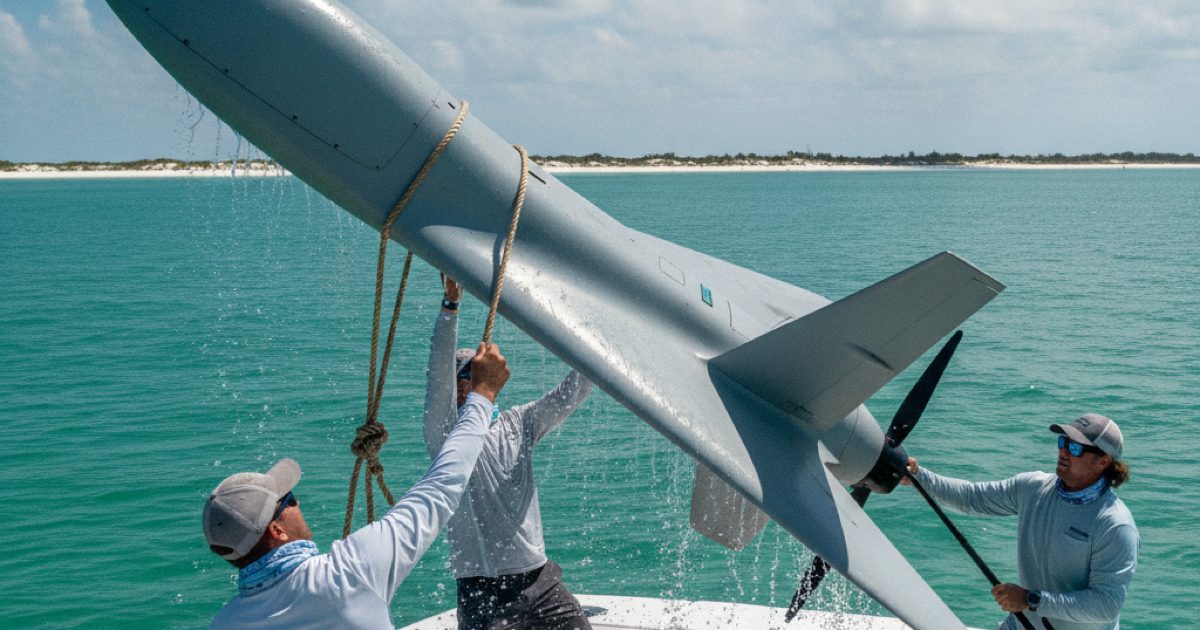
A Pensacola-area fishing charter hauled a piece of Eglin test debris out of the Gulf of Mexico on Saturday, Sept. 19. The debris turned out to be a U.S. Air Force drone that had gone down two days earlier during routine testing off Eglin Air Force Base.
Hot Spots Charters, captained by Daniel Arsenault, was about 20 miles southeast of Pensacola Pass when the crew spotted what looked like an overturned boat. Up close, it turned out to be a roughly 10-foot-long, delta-wing drone, partially submerged and filled with water.
Arsenault told Task & Purpose that four customers aboard that day were active-duty military helicopter pilots, so the group’s first instinct was to check for anyone who might need help. After radioing the Coast Guard, the crew learned the service was already tied up with an active search. They then decided to bring the drone back themselves — but not before fishing near it and landing mahi-mahi and tripletail.
Once ashore, the local sheriff’s office took custody of the drone. Arsenault told CBS News and AFP that a military representative called later that day asking for it back.
Eglin Air Force Base confirmed to Task & Purpose, CBS News and Military Times that a LUCAS unmanned aircraft system — short for Low-cost Uncrewed Combat Attack System — “impacted the water during routine scheduled testing on the Eglin AFB Range” on Thursday, Sept. 17, two days before the charter found it. “The aircraft has been recovered and is back in the Department’s possession,” a base spokesperson said, adding that officials could not confirm whether it was the same aircraft the charter had pulled from the water.
Arizona-based SpektreWorks builds LUCAS as the FLM 136, a one-way attack drone modeled on Iran’s Shahed-136. U.S. Central Command‘s Task Force Scorpion Strike has flown the design operationally since earlier this year. However, the airframe recovered off Pensacola was a test article, not a combat round.
Eglin Test Debris: The Public Warning
Days later, on Thursday, Sept. 24, the 96th Test Wing at Eglin Air Force Base issued a public notice — as reported by Get The Coast — reminding residents, boaters and anglers across the sprawling test range not to touch, move or attempt to recover unidentified military or test-related items. The notice does not cite the drone recovery as its trigger. Still, the timing underscores the kind of hardware the warning is meant to address.
“As good neighbors, we remind people that for their own safety do not touch or handle any unidentified military or test-related items,” Col. Brian Taylor, 96th Test Wing deputy commander, said in the notice. “Please remain clear of test and operational safety zones and report any unidentified items to the proper authorities.”
The wing said items turning up on the range may carry hazards that aren’t readily visible, including explosive components, stored electrical energy, fuels and sharp or damaged materials. The range spans roughly 724 square miles of land plus about 120,000 square miles of overwater airspace across the eastern Gulf. All debris and materials tied to test operations remain the exclusive property of the U.S. government, and federal law prohibits salvaging or retaining them.
Specifically, the notice outlines a report-don’t-touch procedure: don’t handle, move, open or tow a suspicious item, and keep a safe distance from it and keep others away. Instead, mark the location with a dropped pin, GPS coordinates or a grid reference, then report it rather than bringing it anywhere. On land, the notice directs people to local law enforcement or the 96th Security Forces Squadron Base Defense Operations Center at 850-882-2000. On the water, it directs people to the U.S. Coast Guard or the Eighth Coast Guard District’s Sector Mobile, which covers the Florida Panhandle and Alabama coastline.
Overall, the episode fits a broader pattern of civilian-facing debris hazards tied to weapons and aerospace testing, from rocket fragments reaching populated areas overseas to hardware failures over open water. For related coverage, see FODNews’ reporting on back-to-back rocket debris warnings in the Philippines and the Long March 6C upper-stage fragmentation debris incident.
Subscribe to FODNews for continuing coverage of FOD incidents and prevention worldwide.
Sources
- Task & Purpose — “An Air Force LUCAS drone was hauled aboard a fishing charter off the Florida coast” (Sept. 22, 2026)
- CBS News/AFP — “Fishing boat reels in large U.S. military drone off Florida coast” (Sept. 22, 2026)
- Military Times — “What a catch! Florida fishing boat reels in UAS resembling LUCAS drone” (Sept. 22, 2026)
- WEAR — “Pensacola fishing charter finds large drone floating in Gulf” (Sept. 22, 2026)
- Get The Coast — “Eglin AFB warns public not to touch unidentified military, test items” (Sept. 25, 2026)